

The advent of artificial intelligence (AI) is fundamentally restructuring the landscape of protein drug discovery. Following the breakthrough of structural prediction models like AlphaFold, advanced generative AI algorithms (such as diffusion models) can now design hundreds or even thousands of highly specific protein binders, nanobodies, and miniproteins in silico within minutes. These algorithms leverage massive datasets and deep learning to navigate the vast protein sequence space with unprecedented atomic-level precision.
The True Bottleneck: High-Throughput Wet-Lab Validation
While computational design has accelerated exponentially, the physical production and validation of these molecules remain bound by biological constraints. The true bottleneck in modern structural biology and drug discovery has shifted downstream: AI-designed candidates require rigorous wet-lab validation to confirm their empirical folding, target specificity, and binding affinity.
The throughput and quality of these wet-lab experiments dictate the iteration rate of generative algorithms. Traditional cell-based expression systems (using E. coli, yeast, or mammalian cells) are fundamentally constrained by cell growth kinetics, membrane transport barriers, and cellular toxicity. They require weeks for vector construction, cell culture, induced expression, and multiple chromatographic purification steps before functional assays can begin.
Mechanistic Advantages of Cell-Free Protein Synthesis (CFPS)
To overcome the limitations of living cells, researchers are increasingly turning to Cell-Free Protein Synthesis (CFPS). CFPS operates as an open reaction system by extracting the essential translational machinery—ribosomes, translation factors, and tRNAs—from cellular confines. By supplementing these extracts with amino acids, energy regeneration systems, and nucleic acid templates, protein synthesis is decoupled from cell growth and viability.
From an academic perspective, this open environment offers profound advantages. It enables the expression of proteins that are toxic or otherwise difficult to produce in living cells, facilitates the incorporation of non-canonical amino acids, and dramatically condenses the timeline from DNA to functional protein. Because CFPS can directly utilize linear DNA templates generated via PCR, it can bypass cloning steps in certain workflows, enabling highly parallelized library screening in a matter of hours.
Biophysical Precision: SPR Analysis in Complex Matrices
Synthesizing the protein rapidly solves only half the problem; assessing its binding kinetics without purification is equally challenging. Surface Plasmon Resonance (SPR) has long been established as the biophysical "gold standard" for label-free, real-time biomolecular interaction analysis. SPR detects minute changes in the refractive index at a metal-dielectric interface when an analyte binds to an immobilized ligand on a sensor chip.
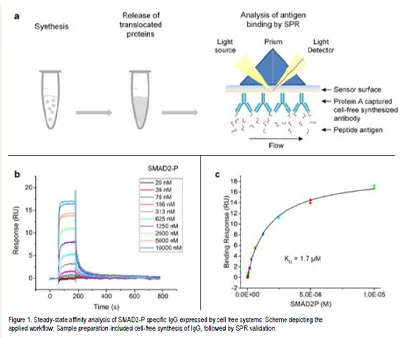
Crucially, modern SPR microfluidics and surface capture chemistries enable the analysis of target interactions directly within complex, unpurified matrices like CFPS crude lysates. By immobilizing specific capture molecules (e.g., anti-His or Protein A antibodies) on the sensor surface, researchers can selectively pull down the synthesized tagged binders from the crude supernatant, washing away the complex background of the cell-free extract before introducing the target antigen. Stech et al. successfully expressed complex antibody formats, including full-length IgG and scFv-Fc, using a microsome-containing CHO-based cell-free system, and subsequently validated them using surface plasmon resonance (SPR). The SPR analysis confirmed the conformational integrity and specific, concentration-dependent binding affinity (with a measured KD of 1.7 µM for IgG) of these in vitro synthesized SMAD2-P antibodies, proving their functional viability and suitability for high-precision downstream kinetic characterization (Figure 1).
Empirical Validation: A High-Throughput Case Study
To empirically validate this theoretical synergy, a recent collaborative study utilized optimized commercial platforms—coupling Sino Biological’s XPressMAX™ cell-free protein synthesis system (CFPS) with Cytiva’s Biacore SPR technology—to evaluate a library of AI-designed VHH (nanobody) molecules (Figure 2).
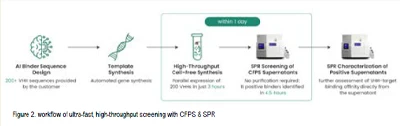
The researchers synthesized 200 distinct VHH variants in parallel. Leveraging the high translational efficiency of the optimized extract, the synthesis phase was completed in merely 3 hours. Subsequently, the CFPS supernatants were directly injected into the SPR biosensor utilizing a His-capture methodology. The high-throughput SPR system screened all 200 variants in just 4.5 hours, successfully isolating 11 positive binders.
To rigorously assess the biophysical fidelity of this purification-free method, the kinetic parameters (Kon, Koff, and KD) of the identified binders were compared across four distinct sample preparations (Table 1 and Figure 3.

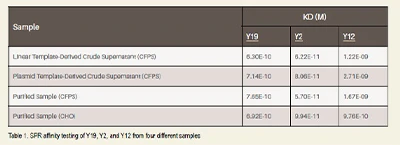
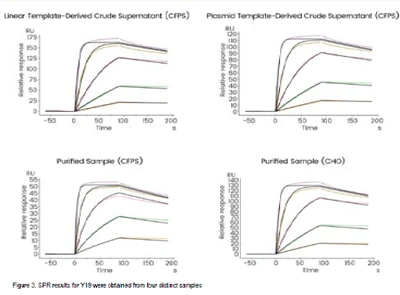
The quantitative kinetic data across all four conditions were statistically indistinguishable. This robust correlation proves that proteins synthesized in vitro fold accurately and possess binding activities identical to their in vivo counterparts, and that direct SPR measurement of CFPS supernatants is analytically sound without compromising sensitivity due to matrix interference.
Closing the AI Loop
The integration of rapid cell-free expression with purification-free SPR kinetics represents a paradigm shift in structural biology. By condensing the "build-test" cycle from weeks to a single day, this methodology provides the massive, high-quality, real-world data necessary to fine-tune and retrain generative AI models. Moving forward, the seamless coupling of computational design with such streamlined biophysical validation will be paramount in unlocking the full potential of AI-driven therapeutic discovery.
Read the full article — it's free
Register with Pharma Focus America to unlock expert insights, research articles and in-depth industry analysis.