

Biomarker analysis is pivotal in modern drug discovery and development, boosting therapeutic success rates. By measuring biomarkers (biological molecules that indicate a biological state, condition, or process), researchers gain deeper insights into disease mechanisms, pinpoint potential drug targets, and track treatment efficacy and safety. Additionally, regulatory agencies increasingly value biomarkers for streamlining drug approval processes.
Analytical considerations for biomarker analysis
Analytical testing often involves a careful balance between sample throughput and data quality to ensure timely and reliable results, with the correct level of detail. The total time required for analysis encompasses several stages, including sample preparation, sample analysis, data processing, and final reporting. Each step contributes to overall turnaround time, making efficiency across the entire workflow essential for meeting project deadlines and performance expectations.
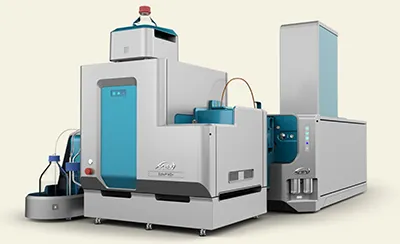
Using the Echo® MS+ system with ZenoTOF 7600 system helps to address some of these challenges by deploying acoustic ejection mass spectrometry, which offers both speed and data quality.
Biomarker analysis using the Echo® MS+ system
In the technical note, Rapid and accurate quantitation of thyroglobulin biomarkers using the Echo® MS+ system with ZenoTOF 7600 system SCIEX describes a rapid method capable of detecting and quantifying thyroglobulin peptides using the Echo® MS+ system with ZenoTOF 7600 system. This solution benefited from:
• Data acquisition at rates as fast as 5 seconds per sample was achieved using Zeno MRMHR mode
• Linearity was achieved from 3.91 to 250 ng/mL for 2 different thyroglobulin peptides
• No carryover was observed due to constant carrier solvent flow in the Acoustic Ejection Mass Spectrometry method
Method development
Method development can be one of the most rewarding tasks for an analytical scientist; however, it can also be one of the most frustrating and time-consuming. A sampling rate of up to 1 sample/second reduces some of the burden. In the technical note, Determining optimal buffer concentration and compatibility for high-throughput intact protein analysis SCIEX presents a rapid and efficient method for determining optimal buffer conditions for intact protein analysis of myoglobin. Selecting the appropriate buffer is essential for preserving protein structure and activity, as proteins must often be maintained in biochemically relevant environments, such as Good’s buffers, regardless of the downstream analytical technique. However, while these buffers are ideal for maintaining protein integrity, their high salt content can significantly impair ionization efficiency in mass spectrometry. Acoustic Ejection Mass Spectrometry (AEMS) offers a solution to this challenge by minimizing ion suppression through the precise ejection of nanoliter-scale sample volumes into a carrier solvent.
In this study, myoglobin was analyzed across 16 different buffer types and 9 concentrations using the Echo® MS+ system coupled with the ZenoTOF 7600 system. Method development was performed in standard peak mode at a rate of one second per sample, with an additional three-second delay to accommodate buffer changes—though this delay is not necessary for routine analyses. Within approximately 34 minutes, the optimal buffer and concentration were identified for both apo- and holo-myoglobin, with triplicate measurements ensuring data reliability. Importantly, this workflow is broadly applicable and can be extended to other analytes, offering a powerful approach for rapid buffer optimization in protein analysis.
Turnaround times
Assay turnaround time has become a critical factor for organizations engaged in drug discovery. Many of our customers are tasked with screening millions of compounds to avoid overlooking the next promising therapeutic candidate. While traditional plate reader assays offer rapid throughput, they often rely on labeling techniques that can alter the native properties or efficacy of the compounds being tested. In contrast, label-free analytical methods—capable of detecting a broad range of analytes including proteins, peptides, and small molecules—offer a more accurate representation of biological interactions. However, conventional liquid chromatography-mass spectrometry (LC-MS), a gold standard for label-free analysis, is often constrained by lengthy sample processing times, limiting its utility in high-throughput environments.
Workflow automation
The sample throughput of the Echo® MS+ system means that integration with automation is essential to prevent simply moving the bottleneck within a laboratory. This integration was demonstrated in a technical note, An automated, real-time measurement of the kinetic hydrolysis of a glucuronide using the Echo® MS+ system with ZenoTOF 7600 system
The Echo® MS+ system was engineered with seamless integration into fully automated work-cells in mind, addressing the evolving demands of high-throughput analytical environments. As advancements in mass spectrometry have significantly accelerated sample analysis speeds, the primary bottleneck has shifted from data acquisition to the efficient preparation and loading of samples. To accommodate the diverse automation infrastructures found across laboratories, the Echo® MS+ system features a flexible control API. This design enables compatibility with virtually any automation platform, allowing users to customize and scale their workflows according to their specific operational needs and preferences. This level of adaptability ensures that the Echo® MS+ system can be effectively deployed in a wide range of automated settings, maximizing both productivity and analytical performance.
Data processing
The Echo® MS+ system is rapidly proving to be industry-agnostic, with its versatility and performance resonating across a wide range of applications. A consistent message from our customers is clear: speed is essential. Whether screening millions of compounds or analyzing a select few, rapid turnaround times are critical for making timely, informed decisions. However, speed alone is not enough—the ability to generate and process meaningful data quickly is equally vital. High-throughput analysis loses its value if data processing becomes a bottleneck. To address this, the Echo® MS+ system leverages the power of SCIEX OS software for fast and efficient plate processing. For more advanced data analysis needs, we’ve partnered with Genedata Expressionist® and Genedata Screener®, enabling seamless integration of high-throughput data into robust, scalable informatics platforms. This combination of speed, flexibility, and analytical depth ensures that users can move from data acquisition to actionable insights faster than ever before.
Summary
The Echo® MS+ system with ZenoTOF 7600 system, represents a significant advancement for biomarker analysis by high-throughput mass spectrometry. By addressing key challenges such as assay turnaround time, buffer compatibility, automation integration, and data processing efficiency, the platform empowers researchers to accelerate drug discovery workflows without compromising data quality. As the demand for faster, more reliable analytical tools continues to grow, the Echo® MS+ system stands out as a transformative technology for modern laboratories seeking to make faster, data-driven decisions in therapeutic research and development.