
The pharmaceutical industry is in a constant race against time. New diseases are always developing that require new medications and vaccinations. And common diseases like cancer are still among the most common causes of death, so the range of treatments is continuously being refined. One example is high-potency active pharmaceutical ingredients, or HPAPIs for short. In all of these cases, the key is to get medications onto the market as quickly as possible. And that’s not the only challenge: Interrupted supply chains, cost pressures and the demand for efficiency, short innovation cycles, high-quality products, and increased flexibility all have to be taken into account. And of course, the world’s resources are finite, so there’s an urgent need for sustainability. As a result, the industrial world has never been as complex as it is today.
The solution: Digitalisation
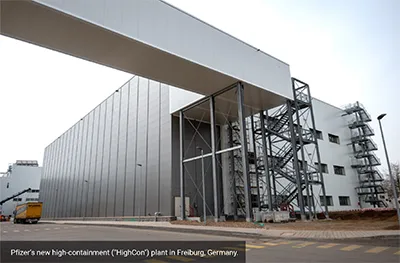
The solution to all of these challenges is digitalisation and automation. When the real and digital worlds work together, the result is faster and safer production. That’s why Siemens developed an end-to-end digital portfolio of software and automation solutions. “It helps the pharmaceutical industry become faster, more flexible, and more efficient along the entire value chain,” says Stefan Haberstroh, Sales Manager Digital Industry at Siemens. “It’s essential to have consistently high quality and to observe Good Manufacturing Practices (GMPs) and everything required by law.” At Pfizer’s new high-containment plant, for example, Siemens acts as a single-source provider of complete industrial logistics solutions, from the initial design through to a smoothly running system. The operation at Freiburg is also paperless. The Manufacturing Operations Management (MOM) solution from Siemens has completely digitalised production operations. The Automation Execution System (AES), based on SIMATIC IT, coordinates the entire flow of materials. It’s the interface between higher-level systems like the order and logistics systems and the lower-level equipment.
High containment for HPAPIs
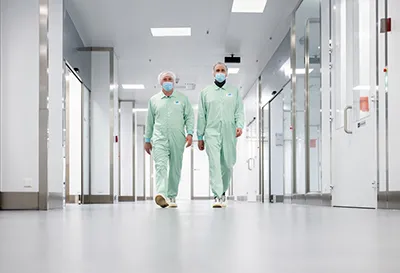
What distinguishes high-potency active ingredients is their elevated pharmacological action at low doses as well as their high selectivity, which reduces the risk of adverse drug effects. Both of these factors contribute to the growing popularity of HPAPIs in medicine. But their use in medications means that the utmost precautions must be applied during their manufacture. When highly active toxic ingredients are used in manufacturing, it’s essential to ensure maximum cleanliness and safety for people and products in the production process. High-containment plants make that possible. What’s special about Pfizer’s new plant in Freiburg is that medications in category OEB4 can be made there, but employees only need protective clothing to the OEB3 level – and that improves safety for the employees. This is made possible by a special containment concept and innovative technologies that are monitored and controlled by building services from Siemens.
Smart building management
Desigo CC is the integrated, scalable, and open building management platform from Siemens for controlling high-performance buildings and clean-rooms. It can integrate diverse systems and devices and automate all processes. “Desigo CC enables a range of systems to communicate with each other and collaborate via a centralised control center,” says Andreas Bühring, Vertical Sales, and Siemens Smart Infrastructure. “That turns the platform into the technological backbone of a smart building infrastructure.” Because Desigo CC is linked to the SIMATIC WinCC Unified visualization system used at Pfizer, data sharing is easy: Data relevant to production from the building management platform is transferred to the SCADA system via OPC UA. SIMATIC WinCC, the innovative, scalable process visualisation system, offers many powerful functions for monitoring automated processes. At the same time, information from other production systems can be fed into Desigo CC and used for predictive control functions in the building automation systems. “Thanks to this link, building management data can be used in the central management system, and it can be accessed in the individual production areas at any time,” Bühring concludes. From power distribution to automation, technologies like Desigo PX integrate the various building systems in Pfizer’s new high-containment plant, including ventilation, air-conditioning, and heating.
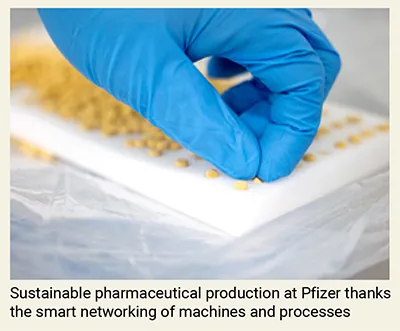
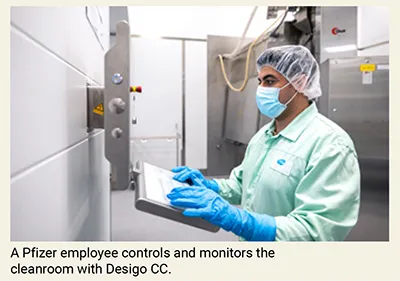
Example of sustainable pharmaceutical production
“Thanks to the smart networking of machines and processes, production at the Pfizer plant in Freiburg can be faster and more flexible and can better conserve resources,” says Gunter Bechmann, who heads the HighCon plant project at Pfizer. For example, networking and visualising data in the Desigo CC management system helps Pfizer’s new high-containment production plant consume about 40 percent less energy than traditional plants. That’s an important contribution to energy-efficiency, because 40 percent of global primary energy consumption happens in buildings, and that figure is growing. Germany’s Federal Environment Agency has recognised that Pfizer’s rigorous attention to its environmental footprint extends beyond the plant construction stage: The Freiburg location is also an example of a best practice in sustainable pharmaceutical production.
The ultramodern and high-performance highcontainment plant in Freiburg offers a highly automated and also sustainable production process, from powder to tablet. The seven billion tablets that are produced here every year and supplied to more than 150 countries are ultimately contributing to greater global health.