

Trial start-up sets the pace for everything that follows in clinical development. Site activation, the work required to prepare a site before the first patient can be recruited, is therefore a critical early test of whether a study can deliver against its timelines.
IQVIA’s Global R&D Trends 2026 | IQVIA report highlights a broader challenge: clinical trials have become increasingly complex, with studies requiring more endpoints, more eligibility criteria and greater operational coordination than in the past. That complexity can create additional burden during start-up, from site identification and regulatory submissions to budget negotiations, training and vendor onboarding, increasing the risk of delays and rework for sites, sponsors and CROs alike.
Meanwhile, development costs keep climbing, biotech investors want faster milestones, and boards ask harder questions about when a program will hit its next decision point. Every month lost to site start-up delays everything that follows: decisions, costs, and ultimately patient access. Speed isn’t an operational nice-to-have anymore, but a boardroom issue.
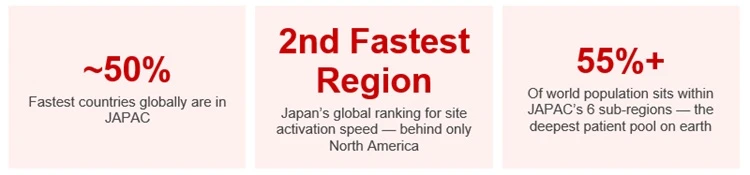
Here’s the gap I keep coming back to: how fast JAPAC can move, set against how few global sponsors have built that speed into their site strategy.
It would be easy to describe JAPAC as simply a fast region. I don’t think that’s the right framing, and it undersells what’s going on. JAPAC is a genuinely diverse region, and each destination inside it brings its own regulatory requirements, patient pools, and site capabilities. The opportunity isn’t that JAPAC is uniformly fast, it’s that if you know where to look, you can tap into each country’s individual strengths to move faster than almost anywhere else in the world.
The Speed Data
In IQVIA's internal comparison against CMR International benchmark data (2021-2023), key JAPAC destinations including Australia, China, India, Korea and Japan achieved Final Protocol to First Patient Screened timelines that were at least 29% faster than comparable global CMR benchmarks.
One JAPAC, Six Different Destinations
Here’s a misconception I run into constantly: that JAPAC is a complex region, and therefore a slow one. Yes, it’s complex. But complexity and speed aren’t opposite here. JAPAC comprises six distinct sub-regions, Japan, Greater China, ANZ, Korea, India, and Southeast Asia, together home to more than half of the world’s population. Each has its own activation profile: different regulatory timelines, different approval pathways, different site readiness. Treat JAPAC as one geography and you build one activation plan for a region that needs six. That’s exactly where timelines slip. The better approach is to pick the countries that can start up fast and hopefully enroll fast too.
So, what does that look like, destination by destination?
Japan’s Pharmaceuticals and Medical Devices Agency (PMDA) run a highly predictable regulatory process: its Clinical Trial Notification review takes 30 days for an initial submission and just 14 days for follow-on amendments, and trial sites are experienced enough to deliver high-quality data even under that discipline. It’s best suited to multi-regional clinical trials.
Australia is faster still to get moving. Most studies proceed through the CTN pathway without needing a US IND first: a notification-based process through Australia’s Therapeutic Goods Administration (TGA), with a relatively small submission package (protocol, investigator’s brochure, and informed consent form, no translation required). The TGA doesn’t scientifically review the trial data before start-up, that’s the job of the Human Research Ethics Committee.
It’s one of the reasons Australia is a preferred destination for first-in-human and early-phase work: Phase 1 healthy-volunteer studies can start within 8 weeks, and Phase 1 oncology within about 4 months.
New Zealand is often grouped with Australia as “ANZ” for convenience, but on its own it’s the fastest country in JAPAC. Its Health and Disability Ethics Committees and Medsafe review run in parallel, there’s no requirement for a prior US IND, and private sites can be up and running in as little as 10 to 12 weeks. It’s a strong choice for early-phase studies.
India has closed the gap through parallel processing rather than raw speed alone. India’s Central Drugs Standard Control Organisation (CDSCO) and Ethics Committee reviews now run concurrently, supported by the SUGAM digital platform and a more risk-based regulatory posture, with statutory timelines of 30 working days for India-developed trials and 90 for global ones. And with roughly 20% of the world’s disease burden, India brings a depth of patient access few other destinations can match.
China has transformed over the past decade. A decade ago, approvals could take well over a year. Today, the standard pathway set by China’s National Medical Products Administration (NMPA) runs on a 60-working-day implied approval, and under its 2025 reform (Announcement No. 86 of 2025), eligible innovative products can move even faster, down to 30 working days. China is particularly strong for early-phase oncology, and its patient pool makes it a powerful engine for later-phase multi-regional trials.
South Korea combines a roughly 30-working-day review from its Ministry of Food and Drug Safety (MFDS) with globally recognized investigators and strong recruitment, particularly in oncology and rare disease. The country keeps investing in speed: closer industry collaboration with MFDS, simplified IND requirements, and an active pre-IND consultation process that in some cases has shortened formal review timelines following positive pre-IND feedback. It’s well suited to later-phase multi-regional studies.
And Taiwan runs its central IRB review in parallel with the regulatory process, adding another fast lane to the region.
Where Each Destination’s Strength Really Lies
Zoom out of the country mechanics and ask why each sub-region is actually fast, and the answer differs destination to destination. ANZ's advantage comes from a streamlined regulatory environment, efficient study start-up processes and highly experienced study sites. Investigators are well-prepared, activation pathways are well established, and studies can move quickly while maintaining the high-quality standards expected by sponsors and regulators.
Japan is fast in a different sense: activation is thorough rather than rushed, and that discipline is exactly why the data holds up to FDA and EMA scrutiny without rework later. Greater China is fast at scale; its large site networks identify patients rapidly even though the activation process itself carries more complexity. South Korea is fast because its site activation maturity keeps improving year over year, with increasingly competitive start-up timelines. India is fast for large studies specifically, because the scale of its investigator networks lets sites get identified quickly even at volume. And Southeast Asia’s speed depends on the destination and the therapeutic area: it’s fastest where site networks are already well established, particularly vaccines and infectious disease.
Two Southeast Asian countries are worth calling out specifically.
Malaysia’s National Pharmaceutical Regulatory Agency (NPRA) introduced a more flexible approach to demonstrating GMP compliance in February 2026, allowing a Competent Personnel Declaration in place of a formal GMP certificate for sponsors who can’t obtain one, a meaningful unblock for biotech and China- or US-based sponsors.
And in the Philippines, House Bill 9867, the Pharmaceutical Innovation Act, is aimed squarely at reversing a decline in new clinical trials that’s persisted since 2014. Regulatory and ethics review timelines are already improving as the bill moves forward. Approvals from the Philippine FDA, the country’s own national drug regulator and not the U.S. agency of the same name, have gone from roughly 7 months in 2023 to about 3 months in 2025. Reviews by the Single Joint Research Ethics Board (SJREB), the Philippines’ joint ethics board for multi-site studies, have improved from roughly 3.5 months to about 1.5 months over the same period.
source : Manila Bulletin - House panel OKs bill boosting Philippine clinical trials
Where Speed, Patient Access and Efficiency Intersect
Put three things side by side, speed, patient pool, and cost, and JAPAC offers a compelling combination of activation speed, patient access and operational efficiency. The speed is proven by data, not perception. The patient pool spans more than half the world’s population across six sub-regions, including large treatment-naive populations. And the cost efficiency isn’t about cheap labor, it’s about getting more from every dollar invested: faster activation, stronger site performance, lower attrition.
Closing the Confidence Gap
So why isn’t every sponsor already building JAPAC into their site strategy from day one? Based on a recent Biopharma Customer survey by IQVIA, 75% of sponsors say what they need most is greater clarity on timelines and regulatory requirements, not lower complexity, not better logistics, not lower cost. The barrier is knowledge, not willingness.
That connects directly back to where this started. Boards are demanding speed, but too many decision-makers are still working from outdated mental models of what JAPAC activation actually looks like. It’s a self-reinforcing cycle: sponsors default to the geographies they already know, build more experience there, and never gather the data that would tell them JAPAC could solve their timeline problem. Breaking that cycle starts with better information.
Across JAPAC, IQVIA teams delivered multiple global first site activations and first-patient-in milestones across oncology, cardiovascular, CNS and rare disease studies during 2025.
- Australia achieved a global first site activation in a Phase 2 oncology study within 108 days, and a separate global first site activation in Phase 2 cardiovascular.
- China delivered a global first patient in for a Phase 2 oncology study, with site selection to activation in roughly 146 days.
- India achieved a global first site activation in a Phase 3 cardiovascular program, contributing more than 100 sites.
- Japan contributed the global first patient in across six separate Phase 2/3 studies, spanning oncology, CNS, and reproductive health.
- Korea delivered a global first site initiation in a Phase 3 oncology (head and neck) study, and a global first patient in for a Phase 1 oncology (DLBCL) study.
- New Zealand delivered a global first patient in for a Phase 1 CNS study, and Taiwan did the same for a Phase 1 oncology (multiple myeloma) study.
That’s not a lucky run, but a region that can consistently deliver the firsts sponsors need.
“The opportunity isn’t that JAPAC is uniformly fast. It’s that if you know where to look, you can tap into each country’s individual strengths to move faster than almost anywhere else in the world.”
— Andy Lee, Senior Director, Site Activation, Clinical Operations, R&DS APAC, IQVIA
What Comes Next
None of this is abstract for me. I work in site activation every day, and the pattern I see most often is sponsors who engage JAPAC early ending up not just accelerating their timelines, but de-risking their whole program. Based on IQVIA’s own research, 60% of sponsors say earlier engagement with JAPAC would directly shape their clinical development programs, and the sponsors who already treat JAPAC as a primary site strategy decision, not a fallback, are consistently the ones delivering faster, more resilient programs.
IQVIA's Global R&D Trends 2026 | IQVIA report reinforces what many of us see every day: clinical trials are becoming increasingly complex. The average number of endpoints per trial has risen from 7.7 in 2016 to 8.5 in 2025, while eligibility criteria remain well above historical levels. As complexity grows, so does the operational burden on sponsors, CROs and sites, making efficient study start-up and execution more important than ever.
Importantly, JAPAC is not the only region focused on accelerating clinical trial start-up. Governments and regulators around the world, including in Brazil and the UK, are introducing initiatives to streamline approvals and attract more studies. That is a positive development for industry, and it creates a valuable opportunity for countries and regions to learn from one another. Against this global momentum, JAPAC's advantage is not simply faster start-up in selected destinations. It is the ability, in the right countries and therapeutic areas, to carry that momentum from activation into recruitment, supported by large patient populations, experienced sites and established investigator networks.
JAPAC is continuing to build on that foundation: China is reducing review timelines, India is improving its processes, Korea's MFDS is pursuing closer industry collaboration, Australia is moving toward a one-stop-shop model, and Japan is working toward a single IRB system. Five years from now, I do not think sponsors will be asking whether JAPAC belongs in their global development plans, but why it was not part of the plan from the start. The region already offers speed, patient access, regulatory infrastructure and site depth to support that ambition. What is changing is the willingness to act on those strengths before a program falls behind, rather than after.