


Manufacturing Is Now a Strategic Function
Biologics have permanently altered the risk profile of pharmaceutical commercialization. Advanced monoclonal antibodies, recombinant proteins, and increasingly complex modalities now dominate late-stage pipelines. With this shift, manufacturing strategy has become inseparable from commercial strategy.
Manufacturing is no longer a downstream operational function. It is a strategic determinant of commercial viability.
For many years, development milestones and regulatory approval were considered the primary inflection points of value creation. Today, operational readiness has joined that list. A therapy cannot succeed commercially without reliable, scalable, inspection-ready manufacturing behind it.
As a result, executive leadership teams are elevating manufacturing to the board agenda—aligning infrastructure investment directly with portfolio strategy, capital allocation, and long-term enterprise value creation.

The Biologics Scale-Up Reality
Biologics manufacturing is inherently complex. Process scale-up from clinical to commercial volumes is not linear. Variability in cell culture performance, raw material sourcing, and process parameters can introduce significant risk if not addressed early.
The traditional model, optimize in development and resolve scale issues later—no longer aligns with market expectations. Compressed timelines, global demand, and regulatory scrutiny require a more disciplined approach.
Operational strategy must be embedded during development, not layered on at the point of commercialization.
For example, insufficient early process characterization often surfaces during PPQ or late-stage validation, introducing delays that could have been mitigated through integrated development and manufacturing alignment. When commercial-scale considerations are addressed during early development, validation becomes confirmation rather than discovery.
Organizations that integrate process development, analytical alignment, and commercial manufacturing systems from the outset reduce the friction typically associated with tech transfer and scale expansion. The result is fewer surprises during validation, smoother regulatory engagement, and accelerated market entry.
Infrastructure as Risk Mitigation
In today’s environment, infrastructure is not merely capacity; it is risk mitigation.
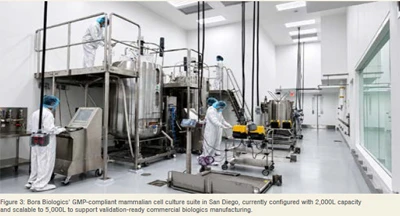
Purpose-built GMP biologics facilities designed for commercial production provide structural advantages:
• Scalable mammalian cell culture suites
• Flexible single-use technologies
• Robust environmental control systems
• Digitally monitored process parameters
• Established quality management frameworks
However, infrastructure must be validated through execution. Inspection-proven facilities—those with demonstrated regulatory performance—offer sponsors an additional layer of confidence.
Regulators increasingly evaluate not only process data, but the maturity of the systems supporting it. Quality culture, documentation discipline, and deviation management are operational capabilities that cannot be improvised at the end of development.
When infrastructure and quality systems mature in parallel, organizations achieve what is increasingly essential in this market: commercial certainty.
Development-to-Commercial Continuity
One of the most common sources of delay in biologics programs remains the transition from development to commercial manufacturing.
Knowledge gaps between teams, analytical inconsistencies, and insufficient process characterization can result in rework, revalidation, or regulatory delay.
An integrated model—where development scientists, engineers, and commercial operations function within aligned systems—reduces this risk significantly.
Development-to-commercial continuity enables:
• Early identification of scale-dependent variables
• Harmonized analytical methodologies
• Data integrity across lifecycle stages
• More efficient regulatory submissions
This integration is particularly important as modalities increase in complexity. Advanced biologics demand deeper process understanding and tighter control strategies.
Organizations that treat development and manufacturing as continuous rather than sequential processes gain measurable time and risk advantages.
The Strategic Importance of U.S.-Based Manufacturing
Recent years have underscored the importance of supply chain resilience. For the U.S. pharmaceutical market, domestic biologics manufacturing provides tangible strategic benefits:
• Proximity to regulatory authorities
• Reduced logistical dependencies
• Faster decision cycles
• Improved oversight and communication
Bi-coastal, inspection-proven U.S. manufacturing capabilities further enhance redundancy, regulatory alignment, and operational responsiveness, while maintaining centralized quality oversight. Geographic diversity within a domestic framework reduces vulnerability without introducing excessive operational fragmentation.
For emerging and mid-sized biopharma companies, access to integrated U.S.-based manufacturing platforms can offer institutional-level capability without requiring large-scale capital deployment.
The result is a more resilient commercialization pathway.
From Cost Center to Value Engine
Historically, manufacturing discussions centered on cost efficiency. While operational efficiency remains important, the conversation has evolved.
Reliable commercial supply directly influences revenue continuity, market trust, and long-term portfolio expansion. Manufacturing failures can erode not only margins, but also brand equity.
Investors and boards increasingly evaluate operational readiness as an indicator of execution maturity. A robust manufacturing strategy signals discipline, foresight, and scalability.
In this context, manufacturing must be evaluated not solely through unit economics, but through its ability to safeguard revenue continuity, protect brand equity, and enable sustainable enterprise value.
Preparing for Increasing Complexity
The next wave of biologics, including bispecific antibodies, antibody-drug conjugates, and other advanced modalities, will place even greater demands on manufacturing systems.
Future-ready organizations are investing in:
• Enhanced process analytics and real-time monitoring
• Modular facility expansion models
• Workforce depth in advanced biologics operations
• Digitally integrated quality systems
These investments are not reactive; they are strategic.
Operational readiness for emerging modalities must precede pipeline acceleration. Otherwise, infrastructure becomes a constraint rather than a catalyst.
Leadership Alignment Is Essential
Ultimately, manufacturing strategy reflects leadership philosophy.
Executive teams must align infrastructure investment with portfolio ambition. They must view quality systems as strategic assets, not compliance requirements. And they must cultivate partnerships rooted in operational transparency and long-term planning.
When manufacturing is treated as strategic infrastructure, the organization’s risk profile improves. Decision-making accelerates. Regulatory interactions become more predictable. Commercial launches become more controlled.
The organizations that lead in this biologics-driven era will not be those with the most ambitious pipelines alone, but those with the operational discipline to deliver consistently.
Conclusion
Biologics have reshaped pharmaceutical innovation. They now demand a corresponding evolution in manufacturing strategy.
Infrastructure, integration, and inspection-proven execution have become foundational to competitive readiness. Commercial success is no longer secured at approval; it is secured through operational preparation long before launch.
In today’s biologics-driven environment, manufacturing is not a support function; it is strategic infrastructure.
Competitive advantage will increasingly belong to organizations that operationalize certainty long before launch.
Organizations that recognize this reality and align leadership, systems, and investment accordingly will define the next chapter of pharmaceutical resilience and growth.
Read the full article — it's free
Register with Pharma Focus America to unlock expert insights, research articles and in-depth industry analysis.