


Liquid Chromatography-Mass Spectrometry (LC-MS) has emerged as one of the most powerful and versatile tools for metabolite identification in modern analytical science. By combining the separation capabilities of liquid chromatography with the detection and structural elucidation power of mass spectrometry, LC-MS enables researchers to analyze complex biological samples with high sensitivity, specificity, and throughput.
Despite its strengths, LC-MS-based metabolite identification faces challenges such as detecting trace-level metabolites and comprehensive fragmentation tools for confident identification and localization of metabolic sites. Ongoing advancements in instrumentation, software, and data integration are continually enhancing its accuracy and applicability.
This article delves into an innovation in LC-MS-based metabolite identification.
Metabolite Identification: A Critical Step in Drug Development
In the drug discovery process, identifying a drug’s metabolites and pinpointing the exact site of metabolism is essential. This step provides critical insights into a compound’s pharmacokinetics, efficacy, toxicity, and potential for drug-drug interactions. Without accurate metabolite identification, a promising therapeutic candidate may face delays or failure in clinical development due to unforeseen safety issues.
Analytical requirements for confident identification
To meet regulatory expectations and scientific rigor, analytical methods must deliver:
• Sensitive detection of metabolites at low concentrations
• Reliable structural identification of known and unknown metabolites
• Quantitation in complex biological matrices
Metabolite identification by LC-MS
LC-MS has become the gold standard for this task. It separates complex mixtures via liquid chromatography and then analyzes the mass-to-charge ratios of analytes and their fragments using mass spectrometry. Structural elucidation, essentially solving a chemical jigsaw puzzle, is performed by interpreting these fragment ions to confirm the identity and structure of metabolites.
Traditionally, fragmentation in LC-MS workflows is achieved using Collision-Induced Dissociation (CID). CID is widely adopted due to its simplicity and well-established performance. However, in some cases, CID does not preserve labile modifications to confidently identify metabolites, especially when dealing with structurally complex or novel compounds. When this happens, additional testing may be required, increasing both the cost and time of drug development.
A New Era: Electron-Activated Dissociation (EAD)
Recent advancements have introduced a powerful alternative, Electron-Activated Dissociation (EAD), available on the ZenoTOF 8600 system. EAD induces fragmentation through a different mechanism than CID, producing complementary fragment ions that can reveal structural features missed by traditional methods. This expanded fragmentation coverage enhances the ability to complete the structural puzzle, increasing confidence in metabolite identification.
With EAD, scientists are more likely to meet regulatory requirements for challenging analytes in a single analysis, reducing the need for follow-up experiments and accelerating the path from discovery to development.
EAD in Action
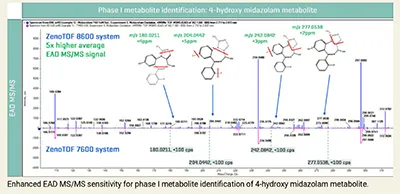
Breaking the limits: An ultra-sensitive complementary fragmentation for the confident identification and characterization of drug metabolites highlights the ZenoTOF 8600 system ability to identify critical phase I and phase II drug metabolites through the generation of unique fragment ions using electron-activated dissociation (EAD), with mass accuracy maintained within a 5 ppm error margin. All data acquisition, management, and processing were seamlessly conducted on a unified platform using SCIEX OS software, which includes the integrated Molecule Profiler software for streamlined analysis.
In this example, Innovative drug metabolite identification and characterization using electron activated dissociation, and metabolite identification was carried out using the ZenoTOF 7600 system. The spectra provided a greater number of diagnostically relevant fragments, significantly enhancing the ability to localize biotransformation sites within the metabolite structures. Molecule Profiler software further streamlined this process by integrating unique fragments from both EAD and collision-induced dissociation (CID) spectra into a single result file. This comprehensive data integration supports more accurate metabolite structure assignments and facilitates the pinpointing of modification sites. The demonstrated workflow is not only efficient but also adaptable for in vivo metabolism studies, where the enhanced sensitivity of the Zeno trap enables the detection of low-abundance metabolites.
Breaking the limits: An ultra-sensitive complementary fragmentation for the confident dentification and characterization of drug metabolites
Beyond the technology
Running a laboratory is a complex and multifaceted endeavor. While producing high-quality analytical data is undeniably at the heart of any lab’s mission, it’s only one piece of a much larger puzzle. The technology discussed here fits into a holistic solution from SCIEX that helps contribute to a successful lab operation:
1. Meet deadlines
Robust and reliable instruments allow for predictable scheduling and on-time project completion. When needed, our systems are supported by highly respected services and backed by the SCIEX Now support network to ensure that service calls are quickly reported and tracked.
2. Efficiently recruit and train staff
Streamline new-hire training with knowledge base articles available on demand from the SCIEX Now Learning Hub. SCIEX OS software is designed to be easy to learn and use for data collection, processing and reporting within a single platform.
3. Meet regulatory requirements
SCIEX OS software and Molecule Profiler are compliant-ready to help ease the burden of regulatory activities, including managing user access levels, and to reduce the potential for human error.
4. Manage capital expenses
Invest only in what you need, so you don’t have to spend money on features and system performance that are unnecessary for your samples.
Conclusion
The integration of EAD into LC-MS workflows represents a significant leap forward in metabolite identification. By providing richer structural information and improving confidence in metabolite characterization, this innovation supports faster, more efficient drug development. As the pharmaceutical industry continues to seek ways to streamline discovery and reduce risk, technologies like EAD are poised to play a pivotal role in shaping the future of drug safety and efficacy assessments.