Adaptive Clinical Trials: Building Flexibility into Modern Drug Development
Lakshmi, Editorial Team, Pharma Focus America
Adaptive clinical trials are no longer methodologically controversial; the constraint has moved elsewhere. This article examines why most adaptive designs still sit in early phases, what a harmonized ICH E20 standard will demand of American sponsors, what a decade of adaptive platform data actually proved, and why supply chains, firewalls and simulation capacity now determine whether a pharmaceutical organization can run an adaptive trial at pivotal scale.
Introduction:
Adaptive Clinical Trials Have Stopped Being the Experiment
For two decades, adaptive design was sold to pharmaceutical boards as a promise. In 2026 it is closer to standard vocabulary: few protocol synopses reach a development committee without some flexible element written into them. What has not kept pace is execution. Adaptation remains concentrated in the cheapest part of development, and the machinery required to act on an interim signal is missing from a surprising number of organizations that describe themselves as adaptive.
Two regulatory events sharpened the picture. In June 2025, the International Council for Harmonisation endorsed a draft guideline, E20, devoted specifically to adaptive designs for clinical trials. The FDA issued it as draft guidance for industry in September 2025 under docket FDA-2025-D-3023. E20 consolidates region-specific guidance that had governed the field for years into a single harmonized framework, with expanded recognition of Bayesian and enrichment-based approaches and explicit expectations on documentation.
For American sponsors, that changes the nature of the conversation. Adaptive design has moved from a methodological argument a sponsor makes to a reviewer, to a documented standard a sponsor is measured against. The strategic question for leadership is no longer whether to adapt. It is whether the organization can actually execute an adaptation on the day the interim data demand one.
Adaptive Clinical Trials Are a Governance Instrument, Not a Statistical Trick
An adaptive trial permits prospectively planned modifications to one or more design elements based on accumulating data from patients already enrolled. In practice that means resizing the sample, dropping an arm that is not working, narrowing to the population showing benefit, shifting allocation toward the better-performing arms, or moving from Phase 2 to Phase 3 without stopping enrollment in between.
The defining feature is pre-specification. The protocol commits to the decision rule, the timing of each look, and the statistical machinery that preserves the error rate before the first patient is enrolled. The trial does not improvise; it executes a plan that anticipated uncertainty.
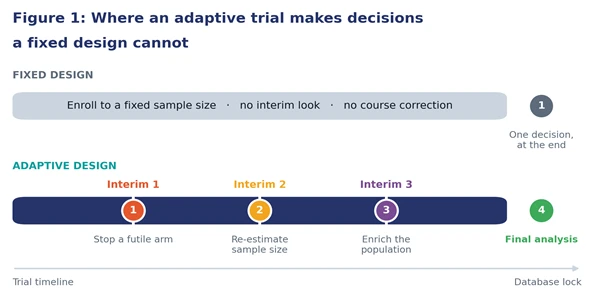
Figure 1: Adaptive designs replace a single terminal decision with a sequence of pre-specified decision points. Every adaptation is written into the protocol before the first patient is enrolled.
Read commercially rather than statistically, that is a financing structure. A fixed design asks a company to commit the full cost of a study against a single hypothesis and learn the answer once, at the end. An adaptive design converts the same commitment into staged tranches with defined exit points. The value is not primarily the money saved when a trial shrinks. It is the money not spent when a trial should never have continued.
What American Sponsors Actually Adapt in Practice
The published record shows where flexibility has genuinely taken hold. A systematic review of 317 adaptive trial reports and protocols found that oncology accounted for 53 percent of them and that 87 percent sat in Phase 1 or Phase 2. Adaptive dose-finding was by far the most common adaptation, appearing in 38.2 percent of trials, followed by continual reassessment methods, adaptive randomization and group sequential designs. Drop-the-losers and seamless Phase 2 to Phase 3 designs, the two adaptations with the largest effect on development timelines, appeared in fewer than one trial in ten. Roughly two-thirds used frequentist methods; Bayesian approaches featured in about a quarter.
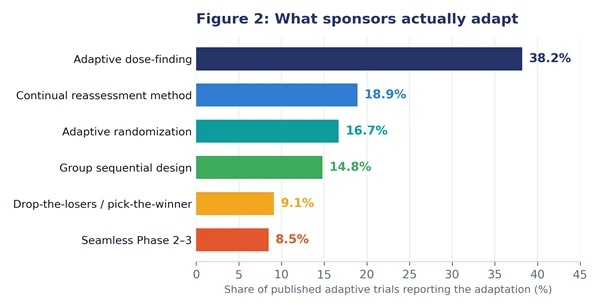
Figure 2: Adaptations reported across 317 published adaptive trial reports and protocols. Many trials used more than one adaptation, so the shares do not total 100 percent.
That gap is beginning to close from an unexpected direction. A separate global survey of more than 600 drug trials carrying adaptive elements found that master protocols, meaning umbrella, basket and platform studies that test several agents or several populations under one operational framework, accounted for 59 percent of them, far ahead of group sequential and dose-finding designs as a share of that set. Master protocols are how adaptation is reaching later-phase, higher-cost development: not by making a single pivotal study cleverer, but by spreading one study's infrastructure across many questions at once.
The distribution is revealing. The industry has adopted flexibility where a study costs a few million dollars and left it largely absent where a study costs tens or hundreds of millions. Adaptation is concentrated in the phases where being wrong is survivable and thinnest in the phase where being wrong ends programs. The risk-reduction value of an adaptive design is greatest precisely where uptake is lowest, and that gap is a strategic opportunity rather than a methodological curiosity.
Case Study: A Decade of Adaptive Platform Design in High-Risk Breast Cancer
The most instructive American demonstration is the I-SPY 2 neoadjuvant platform in stage 2 and 3 high-risk breast cancer, which has been running as a multicenter adaptive platform trial for more than a decade. Patients are classified into ten biomarker-defined subtypes using hormone receptor, HER2 and 70-gene signature status. Bayesian response-adaptive randomization then steers assignment toward the experimental arms performing best within each subtype, against a shared control arm common to every agent on the platform.
The decision rules are explicit and unusually disciplined. No more than about 120 patients are needed per experimental arm. An agent graduates when it reaches an 85 percent Bayesian predictive probability of success in a simulated 300-patient Phase 3 trial within a given signature, and is declared futile when that probability falls below 10 percent across all ten signatures. Of the agents that completed accrual, seven graduated in at least one subtype; others were dropped for futility or halted for toxicity.
Two features matter to a chief executive more than the statistics. The first is amortization: the sites, the biomarker assay, the shared control arm and the data pipeline are standing infrastructure, so the eighth agent tested on the platform costs a fraction of what the first one did. The second is the speed of a negative answer, delivered in roughly 120 patients rather than several hundred. The platform has since been reconfigured as a sequential multiple assignment randomized trial, in which patients predicted to respond poorly move to a second and, if necessary, a third regimen, extending the question from which drug works to which sequence works, and demonstrating in 2024 that therapy can be de-escalated in some subgroups without sacrificing outcomes.
The transferable lesson is that the platform's real asset was never the Bayesian engine. It was the standing operational capability underneath it, which is a multi-year capital decision rather than a protocol decision.
ICH E20 and the New Documentation Bar for Adaptive Clinical Trials
E20 addresses confirmatory trials specifically, and its emphasis is on the things that make an adaptive result interpretable: control of Type I error, unbiased estimation of the treatment effect once an adaptation has occurred, safeguards for trial integrity, and alignment with the estimand framework already established under E9(R1). It also formalizes what a sponsor must be able to show, and this is where much of the industry is exposed.
The published evidence on reporting quality is not flattering. Among trials using response-adaptive randomization, 71 percent lacked clear detail on statistical implementation, and more than half of those reporting results described allocation changes inadequately. In a separate review of 265 adaptive trial protocols, justification for the sample size parameters was missing in 43.8 percent, and fewer than half provided sufficient information on the design's operating characteristics. Under a harmonized standard, the simulation report that establishes those operating characteristics stops being supporting material and becomes part of the evidentiary package.
American sponsors also face a capacity constraint that is easy to overlook. The FDA's Complex Innovative Trial Design paired meeting program, continued under PDUFA VII for fiscal years 2023 to 2027, selects one to two eligible proposals per quarter, up to roughly eight a year across the drug and biologics centers, granting each an initial and a follow-up meeting on the same design. Eight slots a year, industry-wide, is a narrow channel. A company planning an adaptive pivotal trial without securing early alignment is competing for a scarce regulatory resource on someone else's timetable.
The Operational Machinery Behind Adaptive Clinical Trials
The honest performance data should temper expectations. Across 152 completed randomized adaptive trials, an adaptation reduced the planned sample size in 21.7 percent and increased it in 9.9 percent. In roughly two-thirds, no adaptation was triggered at all. Where response-adaptive randomization was used, the average sample size reduction was around 22 percent.
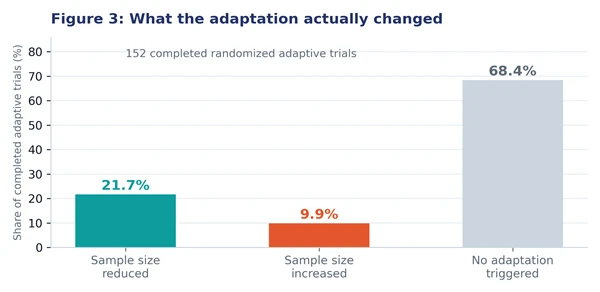
Figure 3: Outcomes across 152 completed randomized adaptive trials. Most adaptive designs never trigger the adaptation they were built to permit, which is the nature of an option rather than a failure of the design.
Read correctly, this is not a disappointing result. An adaptive design is an option, and most options expire unexercised. But it means the business case cannot rest on expected savings alone. It rests on the value of holding the option, and that option has a price.
The price is operational. Establishing the design's operating characteristics requires a simulation program with people who can build and defend it. Interim decisions require statistical firewalls, an independent data monitoring committee with genuine authority, and access controls strict enough to survive an inspection. Drug supply must flex: an arm dropped mid-study strands manufactured inventory, an arm expanded needs material nobody forecast, and both scenarios have to be planned before enrollment opens. Interactive response technology and site processes must execute an allocation change without leaking information to investigators. Data management must deliver clean interim data on a fixed schedule, not eventually. Complexity, cost and simulation burden, not skepticism about the mathematics, are the reasons adoption still trails the enthusiasm.
Conclusion:
Build Adaptive Clinical Trials Into the Operating Model, Not the Protocol
The decisive question for an American pharmaceutical or biotechnology leadership team is not whether adaptive designs work. Regulators have effectively answered that, and a harmonized international guideline now describes how to do them properly. The question is whether the organization is built to use one.
That means biostatistics with real simulation capacity, in-house or reliably contracted. A supply organization that can flex within a study. Data infrastructure that produces trustworthy interim readouts on schedule. Governance that vests genuine stopping authority in an independent committee rather than in the program's sponsor. And a portfolio culture in which an early futility stop is recorded as a successful decision rather than a career risk.
Companies that install that machinery will find adaptive design cheap to add to almost any program, because the fixed cost has already been paid. Companies that do not will keep writing flexible language into protocols they cannot operationally honor, and will discover the gap at the interim analysis, which is the most expensive possible moment to learn it.

Lakshmi is a science writer with a foundation in the laboratory. She earned her master's in biotechnology and trained through research internships at ICGEB (JNU) and DIPAS, DRDO, with her work appearing in the Egyptian Journal of Veterinary Sciences. Now APCRM-certified and part of the editorial team at Pharma Focus America and Pharma Focus Europe, she reports on pharmaceutical technology, research, and innovation — giving complex science a clear and confident voice for industry leaders.