Adaptive Trial Designs: Enhancing Speed and Decision-Making in Clinical Development
Lakshmi, Editorial Team, Pharma Focus America
Adaptive trial designs let pharmaceutical sponsors modify a study while it runs, according to rules written before the first patient enrolls. Used well, they stop failing programs sooner, concentrate patients on promising arms, and remove the idle months between development phases. This article explains the economics, the FDA's evolving position, a landmark oncology platform trial, and the operating capabilities American leadership teams need before adopting these designs at scale.
Introduction: The Most Expensive Word in Pharma R&D Is “Wait”
A conventional clinical trial is a sealed envelope. The sponsor fixes the sample size, the doses, the patient population and the analysis plan, then enrolls for years without looking inside. Only at the end does the organization learn whether its assumptions were right. If the assumed effect size was too optimistic, the study is underpowered. If one dose was clearly inferior, patients kept receiving it anyway. If the drug never worked, the full budget was spent proving it.
For American pharmaceutical executives, the cost of that design is felt twice: once in the direct spend of a failed study, and again in the patent life consumed while the company waited for an answer it could have had sooner. Adaptive trial designs offer a disciplined alternative. They allow the envelope to be opened at planned moments, by an independent committee, with every permissible response written into the protocol in advance. The result is not a looser trial. It is a trial that is designed to learn.
What Adaptive Trial Designs Actually Change in Pharmaceutical Development
“Adaptive” covers a family of methods rather than a single technique. Group-sequential designs, the most established variant, allow a study to stop early for overwhelming efficacy or for futility at pre-planned interim looks. Sample size re-estimation lets a sponsor enlarge a trial when interim variability or effect estimates show the original size was miscalculated. Response-adaptive randomization shifts the allocation of new patients toward arms that are performing better. Seamless Phase 2/3 designs select a dose or population in a first stage and carry those patients directly into confirmatory testing. At the broadest end, master protocols — platform, basket and umbrella trials — evaluate many therapies or many diseases under one standing infrastructure.
What adaptive designs do not change is equally important. The rules must be pre-specified. The overall false-positive rate must remain controlled. Interim results must be shielded from the teams running the study. An adaptation invented after unblinded data is seen is not an adaptive design; it is a protocol violation, and regulators will treat it as one.
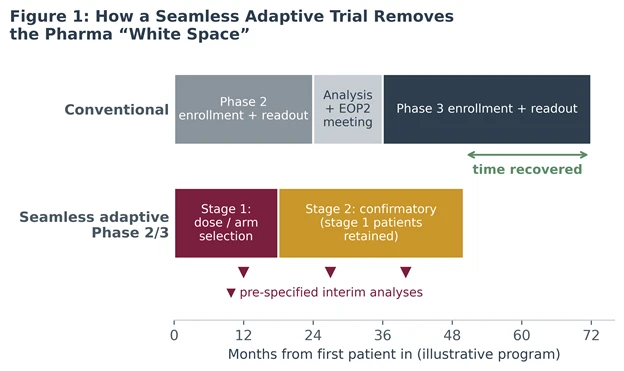
Figure 1. In a seamless design, stage-one patients count toward the confirmatory answer and the pause between phases largely disappears. Timelines are illustrative.
The Pharmaceutical Economics of Adaptive Trials: Failing Faster, Succeeding Sooner
The financial logic rests on a simple observation: most of the value in drug development is destroyed by late, expensive failure. A design that stops an ineffective program after a third of its planned enrollment returns capital and investigator capacity to the portfolio years early. A design that stops early for clear benefit brings a medicine to patients and to market sooner, which in a fixed patent window translates directly into revenue.
Figure 2 shows this effect using a simulation built for this article. A conventional two-arm trial sized for 90% power commits 468 patients regardless of what the drug actually does. A three-look group-sequential design with the same statistical guarantees enrolls, on average, around 270 patients when the drug has no effect and around 260 when the effect is large. Savings are smallest in the gray zone of modest benefit — precisely where the extra patients are most needed to reach a reliable conclusion.
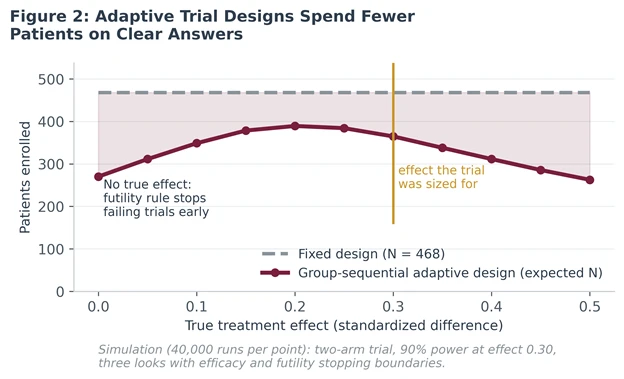
Figure 2. Expected enrollment across a range of true treatment effects. The shaded area represents patients, time and budget the adaptive design does not need to spend.
Those efficiencies are not free. Adaptive studies cost more to design, require extensive simulation before launch, and depend on faster data flows than many sponsors currently operate. The return is highest where uncertainty is highest: first-in-class mechanisms, uncertain dose-response, biomarker-defined subgroups and rare diseases where every patient is scarce.
Adaptive Trial Designs and the FDA: From Tolerance to Encouragement
A decade ago, many American development teams avoided adaptive features for fear of regulatory pushback. That hesitation is increasingly out of date. The FDA finalized its guidance on adaptive designs for drugs and biologics in 2019, setting out expectations for pre-specification, error control, simulation reporting and protection of interim information. The agency has also published guidance on master protocols and runs a Complex Innovative Trial Design meeting program, created under the PDUFA framework, that gives selected sponsors additional access to FDA statisticians while a novel design is still being shaped.
Internationally, harmonized guidance on adaptive designs under the ICH E20 initiative was released in draft in 2025, signaling that the principles are converging across major regulators. For U.S. sponsors running global programs, that convergence reduces the risk that a design acceptable in Washington will be questioned elsewhere. The consistent regulatory message is not “avoid adaptation” but “show your work”: document every rule, simulate its operating characteristics, and prove the firewall held.
Case Study: How an Adaptive Platform Trial Reshaped Pharmaceutical Oncology Development
THE PROBLEM
Breast cancer is not one disease, and testing new agents one at a time in broad populations was producing slow, expensive and often inconclusive results. In 2010 a U.S. public–private consortium, working with the FDA and the National Cancer Institute, launched I-SPY 2, a Phase 2 platform trial in women with high-risk, early-stage breast cancer receiving treatment before surgery.
THE DESIGN
Patients were classified by tumor biomarker profile and randomized either to standard chemotherapy or to chemotherapy plus an investigational agent, all under a single master protocol with a shared control arm. The primary endpoint was pathologic complete response — no invasive cancer remaining at surgery — which can be measured within months. A Bayesian model continuously updated each agent's estimated benefit within each biomarker subtype, and randomization shifted toward combinations that appeared to be working in specific subtypes. An agent “graduated” when its predicted probability of success in a modest-sized confirmatory Phase 3 trial reached 85% in at least one subtype; it was dropped when that probability fell below 10% in all of them.
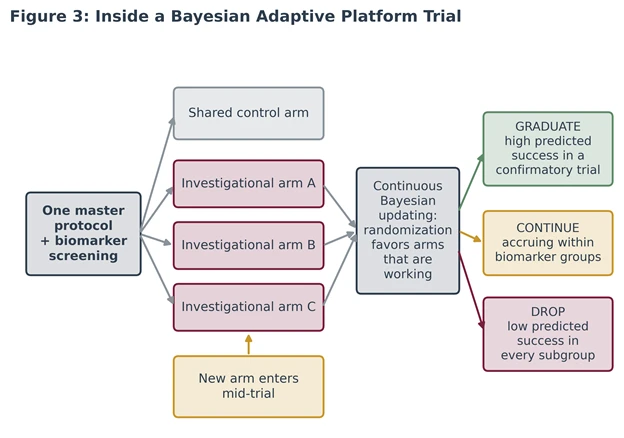
Figure 3. Simplified architecture of a biomarker-driven Bayesian platform trial, showing shared control, adaptive allocation, and graduation or discontinuation of arms.
THE RESULTS
More than twenty investigational regimens have been evaluated within the platform. The first two graduates, reported in 2016, matched specific agents to specific subtypes: a PARP-inhibitor combination in triple-negative disease and a HER2-targeted agent in HER2-positive, hormone-receptor-negative disease. The most consequential result came with an immune checkpoint inhibitor, which graduated across all HER2-negative subtypes after testing in fewer than 70 patients, with estimated complete response rates more than doubling versus control. A subsequent large randomized Phase 3 trial confirmed the benefit in triple-negative breast cancer, and the FDA approved that pre-surgical use in 2021.
WHY IT MATTERS TO THE C-SUITE
The platform demonstrated that shared infrastructure, a fast surrogate endpoint and pre-specified graduation rules can generate subtype-specific signals on a small number of patients, telling a sponsor not only whether to proceed to Phase 3 but in whom. For portfolio leaders, that is the real prize: a smaller, better-targeted confirmatory trial with a materially higher probability of success.
Building the Operating Model Adaptive Trial Designs Require
The companies that extract value from adaptive designs treat them as an organizational capability rather than a statistical option. That begins with simulation: before launch, thousands of virtual trials should test how the design behaves under optimistic, pessimistic and ambiguous scenarios, and executive teams should review those results as they would a financial model.
It continues with data velocity. An interim analysis is only as good as the data behind it, and a design that depends on clean data within weeks will fail inside an organization whose sites report in months. Clinical operations, data management and vendors must be contracted and resourced for that speed from the outset.
Governance is the third pillar. Unblinded interim results should be seen only by an independent data monitoring committee and a separated statistical team. Senior leaders must accept that they will not see the numbers — and must decide in advance, and in writing, what they will do when the committee recommends stopping, enlarging or dropping an arm. Finally, drug supply must be flexible enough to follow the design, since arms that grow or shrink mid-study cannot be served by a fixed manufacturing forecast.
An adaptive trial does not give leadership more freedom to change its mind. It forces leadership to decide, before the data arrive, what every answer will mean.
Frequently Asked Questions on Adaptive Trial Designs
Q. Do adaptive trial designs weaken statistical rigor?
Not when properly executed. Pre-specified rules and simulation are used to keep the overall false-positive rate at the same level a conventional trial would accept. The rigor moves from the end of the study to its design stage.
Q. Will the FDA accept an adaptive design in a pivotal trial?
Yes, provided the adaptations are prospectively planned, error rates are controlled and interim information is protected. Early engagement with the agency on the design and its simulations is strongly advisable.
Q. Are adaptive designs always faster and cheaper?
No. Design and operational costs are higher, and when the true effect is modest the savings may be small. The advantage is greatest when uncertainty about dose, population or effect size is large.
Q. What is the difference between a platform trial and other adaptive designs?
A platform trial is a standing master protocol in which multiple therapies are tested against a shared control, with arms entering and leaving over time. It often uses several adaptive features at once.
Q. Where should a pharmaceutical company start?
Typically with a Phase 2 program facing genuine dose or population uncertainty, supported by an experienced statistical team and an independent monitoring committee, before expanding into confirmatory and platform settings.
Conclusion: Designing Pharmaceutical Trials That Learn
Adaptive trial designs are no longer an academic curiosity or a regulatory gamble. They are an established, guidance-backed way to spend fewer patients, less capital and less patent life on questions whose answers become clear before a study ends. The platform model has shown that the approach can reshape an entire therapeutic area, not merely trim a single study.
For American pharmaceutical leaders, the decision is less about statistics than about organizational readiness. Simulation discipline, rapid data, strict firewalls and flexible supply are the real prerequisites. Companies that build them will make better go/no-go decisions, and make them sooner, across the whole portfolio. In an industry where time is the scarcest asset, a trial that learns while it runs is a competitive advantage that compounds.

Lakshmi is a science writer with a foundation in the laboratory. She earned her master's in biotechnology and trained through research internships at ICGEB (JNU) and DIPAS, DRDO, with her work appearing in the Egyptian Journal of Veterinary Sciences. Now APCRM-certified and part of the editorial team at Pharma Focus America and Pharma Focus Europe, she reports on pharmaceutical technology, research, and innovation — giving complex science a clear and confident voice for industry leaders.