

Advancing Pharmaceutical Manufacturing Through Innovation and Regulatory Preparedness
Lakshmi, Editorial Team, Pharma Focus America
American pharmaceutical manufacturing is being reshaped by two forces at once: a wave of advanced production technologies and a regulator that now rewards early, transparent engagement. FDA initiatives such as the Advanced Manufacturing Technologies Designation Program and the PreCheck pilot signal a new compact between industry and agency. This article explains why innovation without regulatory preparedness stalls, and how pharmaceutical leaders can align the two.
Introduction
Pharmaceutical manufacturing has rarely been a topic that commanded sustained attention in American boardrooms. Discovery pipelines, pricing and market access usually dominated the agenda, while plants were treated as cost centers to be run quietly and efficiently. That era is ending. Drug shortages, supply chain shocks, rising quality enforcement and federal policy aimed at strengthening domestic production have moved manufacturing to the center of corporate strategy.
At the same time, the technology available to pharmaceutical manufacturers has advanced faster than at any point in decades. Continuous processing, process analytical technology, digital twins, modular facilities and artificial intelligence for process control are all commercially viable. Yet many companies struggle to translate this promise into approved, operating capacity. The missing link is regulatory preparedness: the organizational ability to bring a novel manufacturing approach to the FDA early, with evidence, and to sustain compliance once it is running. For US executives, innovation and regulatory readiness are no longer separate disciplines. They are a single competitive capability.
The Pharmaceutical Manufacturing Innovation Gap
The pharmaceutical industry has long been described as a late adopter of manufacturing technology, and the label is largely deserved. Many US plants still rely on batch processes, paper-heavy documentation and end-of-line testing designed for an earlier generation of products. The reasons are understandable. Every change to an approved process carries validation cost and regulatory risk, and the safest commercial decision has often been to leave a working process untouched.
That caution now carries its own risk. Older facilities are harder to staff, more expensive to maintain and more prone to the kinds of failures that trigger shortages and enforcement. New therapeutic modalities, from cell and gene therapies to complex injectables, demand manufacturing approaches that legacy infrastructure simply cannot provide. The innovation gap is no longer a matter of efficiency alone; it increasingly determines which companies can launch, supply and defend their products.
Workforce realities sharpen the problem. Many experienced operators and quality professionals in US plants are approaching retirement, and the institutional knowledge that keeps older processes running often lives in people rather than systems. Modern, data-rich manufacturing platforms are easier to train on, easier to monitor and less dependent on tacit expertise, which makes modernization as much a talent strategy as a technology choice.
The FDA's New Posture on Pharmaceutical Manufacturing Innovation
The most significant change for American manufacturers is not a single technology but a shift in regulatory posture. The FDA has spent more than a decade building pathways that encourage early dialogue on novel manufacturing, and those pathways have recently become more formal and more strategic.
In January 2025, the agency finalized guidance for its Advanced Manufacturing Technologies (AMT) Designation Program, created under section 506L of the Federal Food, Drug, and Cosmetic Act. The program allows a novel manufacturing method, or a novel use of an established method, to receive designation when it can meaningfully improve quality, shorten development time or strengthen supply of critical medicines. Requestors must show that the technology is mature enough to manufacture product reliably, and designation brings earlier interaction with the agency before applications are filed. Importantly, a technology holder that is not itself an applicant can seek designation using data from a model drug, opening the door for equipment and platform developers to de-risk technologies before sponsors adopt them.
Alongside AMT designation, the FDA's Emerging Technology Program continues to offer a forum for companies to discuss unfamiliar approaches with a dedicated team before submission. Together, these mechanisms tell pharmaceutical leaders something important: the agency is prepared to share risk on innovation, but only with sponsors who arrive early and arrive prepared.
Regulatory Preparedness as a Pharmaceutical Manufacturing Discipline
Regulatory preparedness is often misunderstood as a filing activity handled late in development. In practice, it is an operating discipline that begins when a manufacturing strategy is first conceived. It encompasses the scientific rationale for a new process, the control strategy that assures quality, the data infrastructure that proves it, and the quality culture that sustains it after approval.
Recent enforcement trends show why this matters. An independent analysis of 85 drug product warning letters posted by the FDA during 2025 found that the agency recommended engaging a CGMP consultant in 87 percent of cases. The most frequently cited provisions were not exotic. They involved the basics: the responsibilities of the quality unit, identity and purity testing of incoming components, validated production procedures and thorough investigation of discrepancies. Domestic facilities received 59 percent of the letters, a reminder that compliance risk is not confined to overseas suppliers.
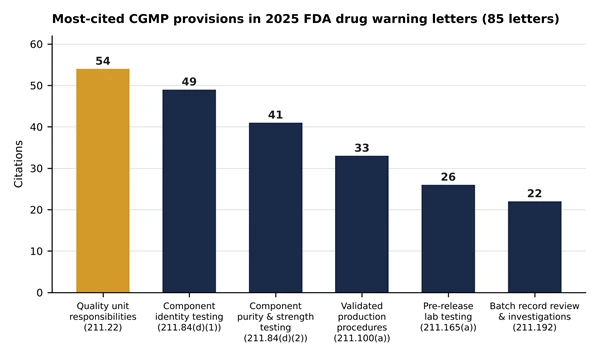
Figure 1: Most frequently cited 21 CFR Part 211 provisions across 85 FDA drug product warning letters posted in 2025. Quality unit figure combines citations under 211.22(a) and (b). Source: independent analysis of FDA warning letters, December 2025.
For executives, the lesson is direct. A company cannot credibly ask the FDA to accept a sophisticated new manufacturing method while its foundational quality systems are under strain. Innovation readiness and compliance readiness draw on the same organizational muscle.
Case Study: Inside the FDA PreCheck Pilot for Pharmaceutical Manufacturing
The FDA's PreCheck program offers a clear illustration of how regulatory preparedness is being rewarded. Launched on February 1, 2026, the pilot invites companies building new US drug manufacturing facilities to engage with the agency well before those sites begin operating. Within the first month, the FDA received more than 80 requests to participate, and in June 2026 it selected seven participants.
The program unfolds in two stages. In the facility readiness phase, the agency provides early technical input and reviews facility information submitted through a facility-specific drug master file, before the plant is complete. In the application phase, participants receive facility-focused pre-submission meetings designed to accelerate evaluation and allow inspections to occur earlier in the review cycle. To qualify, applicants had to propose a facility that addresses a supply need or unmet medical need and commit to filing an application that relies on it.
The strategic signal is significant. The strong response showed that manufacturers value predictability as much as speed. The structure rewards companies that can present mature designs, credible control strategies and organized documentation early. Sponsors that treat regulatory engagement as a late-stage formality are poorly positioned to benefit; those that build preparedness into facility design from the first blueprint gain a meaningful advantage in time to market.
Digital Foundations for Pharmaceutical Manufacturing Readiness
Much of what separates prepared organizations from unprepared ones is digital. Electronic batch records, integrated laboratory systems and manufacturing execution platforms create the traceable, attributable data that regulators expect and that advanced processes require. Process analytical technology generates continuous evidence of quality instead of periodic snapshots, while process models and digital twins allow companies to explore operating ranges virtually before committing material.
These tools also address a persistent compliance weakness. Data integrity remains a recurring theme in FDA enforcement, and paper-based or fragmented systems make it harder to demonstrate that records are complete and unaltered. A well-designed digital backbone strengthens day-to-day compliance while laying the foundation for artificial intelligence applications in deviation management, predictive maintenance and real-time release. Executives should view digital investment not as an IT project but as the evidence infrastructure on which every future regulatory conversation will rest.
Preparedness also extends to how companies manage change after approval. A modern manufacturing process will evolve as data accumulates, equipment is upgraded and supply sources shift. Organizations that establish robust lifecycle management plans, use comparability protocols where appropriate and maintain clear post-approval change strategies can improve their processes continuously without repeatedly stalling in regulatory review. In this sense, the value of a digital foundation compounds over the full commercial life of a product.
Leadership Imperatives for American Pharmaceutical Executives
Translating innovation into approved, resilient capacity requires choices that only senior leaders can make. The first is to elevate manufacturing and quality into enterprise strategy, with board-level visibility of facility risk, technology roadmaps and compliance health. Plants that are managed purely as cost centers rarely attract the investment needed to modernize.
The second is to integrate regulatory affairs, quality and engineering from the outset of any new manufacturing program. Companies that pursue AMT designation, Emerging Technology Program engagement or PreCheck participation successfully tend to assemble cross-functional teams early, with clear ownership and executive sponsorship.
The third is to invest in people. Advanced pharmaceutical manufacturing demands process engineers, data scientists and quality professionals who understand both technology and regulation. Partnerships with universities, workforce development programs and structured career paths in manufacturing science are increasingly part of competitive strategy rather than human resources administration.
Finally, leaders should apply the same discipline to their external network. Contract manufacturers and component suppliers sit inside a sponsor's regulatory exposure, and oversight of their quality systems must be as rigorous as oversight of internal sites.
Conclusion
The next era of American pharmaceutical manufacturing will belong to companies that pair bold technology adoption with disciplined regulatory preparedness. The FDA has opened new pathways for early engagement, but they reward organizations with strong quality foundations, digital evidence and cross-functional leadership. Executives who build these capabilities now will move faster, supply more reliably and earn lasting regulatory trust.

Lakshmi is a science writer with a foundation in the laboratory. She earned her master's in biotechnology and trained through research internships at ICGEB (JNU) and DIPAS, DRDO, with her work appearing in the Egyptian Journal of Veterinary Sciences. Now APCRM-certified and part of the editorial team at Pharma Focus America and Pharma Focus Europe, she reports on pharmaceutical technology, research, and innovation — giving complex science a clear and confident voice for industry leaders.