


AI-Driven Clinical Development: Transforming Biopharma Decision-Making
Lakshmi, Editorial Team, Pharma Focus America
Artificial intelligence has moved from pilot projects into the core machinery of American clinical development, yet adoption has outrun demonstrable impact. This article examines where AI genuinely changes biopharma decision-making, why the FDA's own adoption of AI creates a new asymmetry for sponsors, what the agency's credibility framework demands of executives, and how governance now determines whether AI investment converts into approvals.
Introduction
Ask ten American biopharma executives whether their organisation uses artificial intelligence in clinical development and ten will say yes. Ask the same ten to name a decision — a go/no-go, a protocol amendment, a site cut, a dose selection — that was materially changed by a model, and the room becomes noticeably quieter. That gap between deployment and demonstrable consequence is the defining feature of AI in clinical development in 2026, and it is now a board-level problem rather than an IT one.
The reason it has become urgent is not that the technology improved. It is that the regulatory environment moved. The FDA has issued a framework governing how AI-derived evidence must be justified, joined its European counterpart in publishing shared principles for good AI practice, and — most consequentially for sponsors — begun deploying AI extensively inside its own review and inspection operations. American biopharma is no longer using AI in a regulatory vacuum. It is using AI in front of a regulator that is doing the same thing, at scale, on the other side of the submission.
For chief executives, chief medical officers and heads of development, three questions now matter more than any technology roadmap: where AI actually shifts clinical development economics, what evidence the agency will demand when a model informs a filing, and who inside the company is accountable when the model is wrong. This article takes each in turn.
The AI Adoption Curve Has Outrun the AI Evidence Curve
Investment is not the constraint. Analysts place the pharmaceutical AI market at roughly USD 4.35 billion in 2025, with projections approaching USD 25.7 billion by 2030 across clinical trials, precision medicine and commercial operations. Within clinical development specifically, AI-enabled trial services continue to expand as sponsors look for relief from the cost and duration of conventional studies. Regulatory traffic tells the same story: the FDA has received several hundred drug and biologic submissions containing AI components since 2016, with the volume rising sharply in recent years, concentrated in oncology and neurology.
The uncomfortable counterpoint is that a large share of enterprise AI deployments across industries produce no measurable financial return, and life sciences is not exempt. Independent analyses of generative AI programmes in 2025 and 2026 found that the applications delivering consistent value share unglamorous characteristics: they operate on well-structured data, sit inside existing scientific workflows, and produce outputs that can be verified against established knowledge. Applications that fail tend to be those bolted onto processes nobody has redesigned.
The strategic implication for American sponsors is that AI in clinical development is not a technology purchase. It is a workflow redesign with a technology component, and the organisations reporting real timeline compression are those that changed how decisions are made, not merely what software supports them.
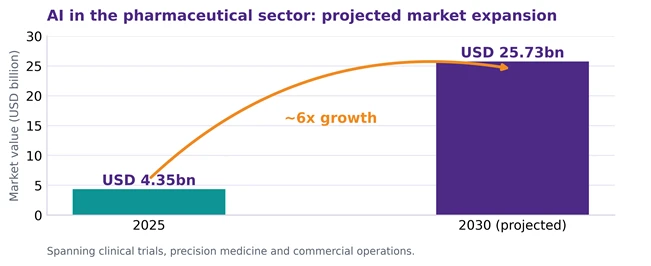
Figure 1. Projected expansion of AI in the pharmaceutical sector, 2025-2030.
Where AI Genuinely Changes Clinical Development Decisions
Four decision points account for most of the demonstrable value. The first is patient identification. Roughly four in five clinical trials miss their enrolment timelines, and models that parse electronic health records against protocol criteria have cut screening effort dramatically, with reported reductions in screening time ranging from roughly a third to, in some deployments, well over ninety per cent compared with manual chart review. For a programme where each month of delay carries a seven-figure carrying cost and a compressed exclusivity runway, this is the clearest line from algorithm to income statement.
The second is protocol design. Outcome prediction models trained on historical trial data now inform endpoint selection, sample size calculation and eligibility criteria before a single patient is enrolled. This matters disproportionately because protocol complexity is largely self-inflicted; criteria added defensively in design meetings become the reason a site cannot enrol. Modelling that quantifies the enrolment cost of each additional criterion changes the conversation from opinion to arithmetic.
The third is site selection and enrolment forecasting, where predictive analytics on historical site performance replaces relationship-driven selection with something closer to portfolio management. The fourth is safety signal detection, where continuous monitoring across structured and unstructured sources surfaces adverse event patterns earlier than periodic manual review. None of these four replaces clinical judgement. All four change what judgement is exercised on, and how early.
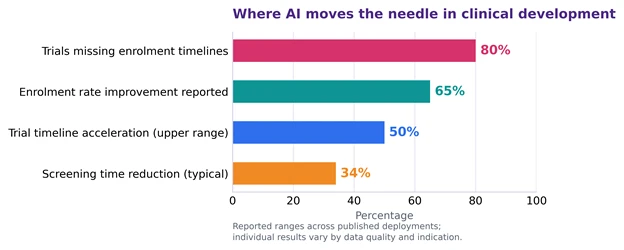
Figure 2. Reported impact of AI across the highest-value decision points in clinical development
The Regulator Now Uses AI Too: A New Asymmetry for American Sponsors
This is the development most under-discussed in the C-suite. The FDA introduced an internal generative AI assistant for its staff in mid-2025 and has expanded it aggressively since, releasing a substantially upgraded version in May 2026 alongside the consolidation of more than forty separate application and submission data systems into a single unified platform. Agency leadership has described the shift plainly: rather than staff bringing data to the AI tool, the tool now sits on top of the agency's data. Reviewers use it to summarise adverse event reports, support clinical and protocol review, and help identify high-priority inspection targets.
Three consequences follow for American biopharma leadership. Submissions will increasingly be read, at least in part, by systems that reward structural clarity, internal consistency and traceability — a submission whose narrative contradicts itself across modules is now far more likely to be caught. Inspection targeting is becoming more data-driven, which means readiness assumptions built on historical inspection frequency are less reliable than they were. And review pace may become less predictable in the near term as adoption varies across divisions and reviewers.
There is a candid caveat that boards should hear rather than be shielded from. The agency's tools have drawn documented criticism over reliability, including reported instances of fabricated references, and internal debate about how far AI should extend beyond administrative tasks. The correct executive response is neither dismissal nor alarm. It is preparation: assume your submission will be machine-read, and build it accordingly.
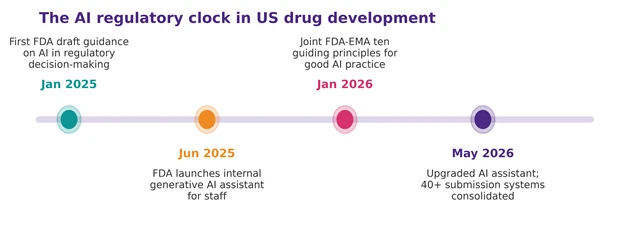
Figure 3. Key regulatory and agency milestones shaping AI use in US drug development.
Credibility Is the New Currency: What the FDA's AI Framework Demands
In January 2025 the FDA published its first draft guidance on using AI to support regulatory decision-making for drugs and biologics, establishing a risk-based, seven-step credibility assessment framework. The critical concept is context of use. The agency does not evaluate an AI model in the abstract; it evaluates whether a specific model, used for a specific purpose, carrying a specific level of influence over a regulatory conclusion, has been validated to a proportionate standard. A model that prioritises monitoring visits and a model that supports an efficacy claim sit at opposite ends of that spectrum and attract entirely different evidentiary burdens.
In January 2026 the FDA and the European Medicines Agency jointly issued ten guiding principles for good AI practice across the medicines lifecycle, covering human-centric design, risk-based approaches, clear context of use, data governance and documentation, lifecycle management and risk-proportionate performance assessment. The direction of travel is unambiguous: AI supports human regulatory decision-making rather than substituting for it, and documentation must be sufficient for a reviewer to independently evaluate how a model behaves.
Translated into executive language, this means an AI capability without a documentation trail is not an asset. Companies that adopted models quickly, through vendor relationships that did not contemplate regulatory scrutiny, may discover during a filing that they cannot reconstruct which model version generated which analysis, on which data, under whose sign-off. That reconstruction problem is expensive at the best of times. Attempting it under review-clock pressure is considerably worse.
Case in Point: How a US Mid-Cap Rebuilt Its Phase II Go/No-Go Around AI
Consider a pattern now common among mid-cap American sponsors running an inflammatory disease programme through Phase II. The company had deployed AI in three places: an enrolment forecasting model, a natural language system reading site monitoring notes, and a predictive tool flagging patients likely to discontinue. Individually, each performed as advertised. Collectively, they changed nothing, because the quarterly portfolio review that governed investment decisions still ran on a static slide deck compiled six weeks in arrears.
The intervention that mattered was organisational rather than technical. Leadership redefined the Phase II go/no-go as a rolling assessment rather than a calendar event, with defined quantitative triggers — enrolment trajectory falling below a threshold, discontinuation risk crossing a set level, a safety signal reaching a defined confidence — each of which convened a decision forum within a fixed number of days. Model outputs were routed to that forum with explicit confidence intervals and a named clinical owner accountable for interpretation. Crucially, every model informing a decision that might later appear in a submission was catalogued with its version, training data provenance, validation evidence and intended context of use, before it was used rather than afterwards.
The measurable results in cases of this kind are consistent: earlier termination of underperforming cohorts, faster reallocation of trial spend, and a documentation package that survives regulatory questioning without a retrospective archaeology exercise. The instructive part is what did not change. The models were the same models. What changed was the decision architecture around them — which is precisely where most AI programmes in clinical development fail to invest.
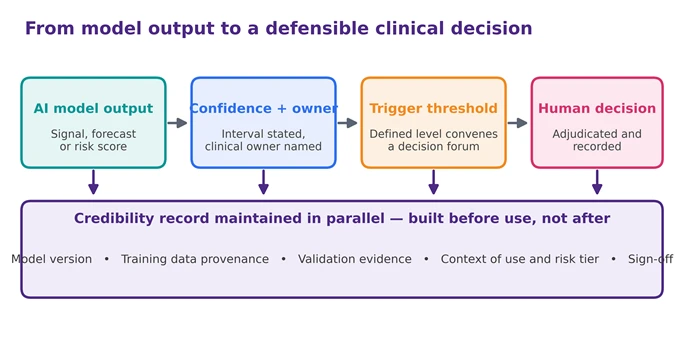
Figure 4. A decision architecture that converts AI output into a decision able to withstand regulatory review.
The AI Accountability Gap in the Boardroom
Most American biopharma organisations can name the executive accountable for clinical quality, for pharmacovigilance and for data privacy. Far fewer can name the executive accountable for AI-derived evidence. The result is a diffusion of responsibility in which data science owns model performance, clinical owns interpretation, regulatory owns the filing, and nobody owns the question of whether this model, in this context, at this level of influence, is fit to inform this decision.
That gap has a straightforward structural fix, and the companies furthest ahead have implemented some version of it: a single accountable owner for AI credibility, a maintained inventory of models by context of use and risk tier, defined thresholds above which human adjudication is mandatory regardless of model confidence, and contractual rights to the validation evidence and version history of any externally supplied model. None of this is technically difficult. It is, however, organisationally uncomfortable, because it forces the company to state in writing which decisions it is willing to let a model influence — a statement most executive teams have avoided making explicitly.
What AI-Driven Clinical Development Will Reward Next
Three shifts will separate leaders from laggards over the next planning cycle. First, verifiability will outrank sophistication. As regulatory expectations firm up, a modest model with impeccable documentation is worth more than a powerful one whose behaviour cannot be reconstructed. Second, data architecture becomes the binding constraint. Models that depend on retrospectively assembled datasets will consistently underperform those built on standardised, traceable clinical data captured with downstream analysis in mind. Third, the value migrates from prediction to decision latency — the interval between a signal appearing in the data and a human being acting on it. Most sponsors have shortened the first half of that interval and left the second untouched.
For American companies specifically, one further factor deserves board attention. As the agency's own AI capability matures and submission data consolidates onto a unified platform, the analytical asymmetry between regulator and sponsor narrows in the regulator's favour. Sponsors that cannot interrogate their own submissions as thoroughly as the agency can will be at a structural disadvantage in review.
Conclusion
AI has already changed clinical development, but not in the way most strategic plans anticipated. It has not replaced clinical judgement, compressed development to a fraction of its historical timeline, or produced the wave of AI-originated approvals once predicted. What it has done is quietly raise the standard for how quickly a well-run development organisation should be able to see a problem and act on it — and simultaneously raise the evidentiary bar for justifying any decision a model influenced.
The organisations extracting value are not the ones with the largest AI budgets. They are the ones that redesigned decision-making around faster information, assigned clear accountability for model credibility, and built documentation discipline before a regulator asked for it. Those are governance decisions, not technology decisions, and they belong to the executive team.
For American biopharma leadership, the practical conclusion is uncomfortable but clarifying. The question is no longer whether to adopt AI in clinical development; that decision has effectively been made across the industry. The question is whether the organisation can demonstrate, on demand and in writing, exactly how a machine-derived insight became a human decision — and whether that chain of reasoning would hold up in front of a reviewer who is now using AI too.

Lakshmi is a science writer with a foundation in the laboratory. She earned her master's in biotechnology and trained through research internships at ICGEB (JNU) and DIPAS, DRDO, with her work appearing in the Egyptian Journal of Veterinary Sciences. Now APCRM-certified and part of the editorial team at Pharma Focus America and Pharma Focus Europe, she reports on pharmaceutical technology, research, and innovation — giving complex science a clear and confident voice for industry leaders.