


AI-Powered Clinical Data Management: Improving Quality, Speed, and Regulatory Compliance
Lakshmi, Editorial Team, Pharma Focus America
Clinical trial data volumes have roughly tripled while database lock timelines have lengthened, and headcount can no longer close that gap. This article examines how artificial intelligence is reshaping clinical data management against three executive priorities — quality, speed, and regulatory defensibility — and why ICH E6 (R3) and the FDA's credibility assessment framework have turned AI governance from an IT procurement question into a board-level accountability.
Introduction:
Why Clinical Data Management Became Pharma's Most Expensive Bottleneck
A late-phase pharmaceutical trial is, in operational terms, a data business wearing a clinical coat. Research from the Tufts Center for the Study of Drug Development puts the average Phase III study at roughly 3.6 million data points — about three times the volume collected a decade earlier — with Phase II and III protocols carrying some 263 procedures per patient in support of around 20 endpoints. Every one of those procedures produces a value that must be captured, transferred, reconciled, coded, queried, and ultimately defended.
The productivity response has not kept pace. The interval from last patient last visit to database lock, the industry's most closely watched close-out metric, averaged 33.4 days in 2007 and 36.1 days in 2017; later work found large sponsors adding a further 32 percent to that interval as external data sources multiplied. Only about one sponsor in three reported having a formal data strategy at all.
For a chief executive, the arithmetic is uncomfortable rather than dramatic. Data complexity is compounding while data management capacity is added linearly. Each new modality — wearables, ePRO, imaging, genomics, EHR-sourced records, laboratory feeds from multiple vendors — does not simply add a workstream; it adds a reconciliation surface between itself and every other source already in the study. Hiring more data managers buys throughput, not leverage. That is the gap artificial intelligence is now being asked to close. And the reason the conversation has moved from proof-of-concept to portfolio-level investment is not cost. It is regulation.
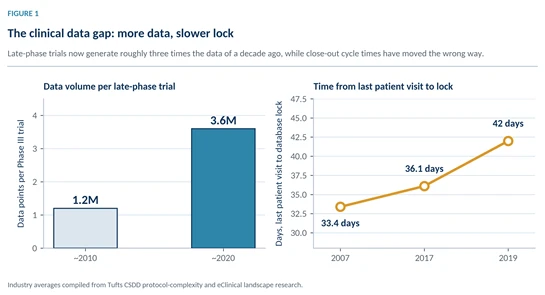
Figure 1: Rising data volume per late-phase trial set against lengthening close-out cycle times.
AI in Clinical Data Management Is No Longer an Experiment — ICH E6(R3) Made It an Expectation
The revised Good Clinical Practice guideline, ICH E6(R3), reached international adoption for its Principles and Annex 1 on 6 January 2025, took effect across the European Union on 23 July 2025, and was issued by the FDA as final guidance for industry on 8 September 2025. Annex 2 — covering decentralized elements, real-world data sources, and pragmatic and registry-based designs — was adopted at Step 4 on 3 June 2026 and comes into effect in Europe on 15 January 2027.
E6(R3) is deliberately technology-neutral. It does not require AI. What it requires is harder: quality by design, proportionate and continuous risk management, demonstrable fitness for purpose of every computerized system, and traceability of data from source through to the analysis supporting a submission. Those expectations are difficult to satisfy at contemporary data volumes using sampling-based monitoring and end-of-study cleaning. Annex 2 sharpens the problem, because the data types it legitimizes — sensor streams, remote assessments, secondary-use health records — are precisely the ones that overwhelm conventional edit-check logic.
The strategic reading for a US-headquartered sponsor is straightforward. Although the FDA has not yet published an Annex 2 implementation date, any organization running multi-regional trials is already inspected against E6(R3) expectations in Europe and the United Kingdom. The regulatory floor has moved. AI in clinical data management is now less a differentiator than a means of meeting a standard that manual processes were never designed to reach.
The Four Places AI Actually Earns Its Keep in Clinical Data Management
Executive skepticism is warranted, because the label “AI” is applied indiscriminately across the eClinical market. In practice, four applications carry most of the demonstrable value.
Anomaly detection and intelligent query triage: Models trained on historical study data learn what a plausible record looks like for a given visit, indication, and site, then flag patterns that rule-based edit checks miss because nobody wrote the rule — impossible vital-sign combinations, duplicated subject profiles, laboratory values inconsistent with the concomitant medication record.
Automated ingestion, mapping, and standards conformance: Machine learning shortens the mapping of heterogeneous vendor files into CDISC-conformant structures, a task that has historically consumed weeks of specification writing per external feed and remains a leading cause of late database build.
Autonomous medical coding: Language models match verbatim adverse event and concomitant medication terms to MedDRA and WHODrug dictionaries at high precision, converting a labor-intensive review queue into a much smaller exception queue.
Central statistical monitoring: Rather than sampling source documents, algorithms compare each site's data distribution against the wider study population to surface digit preference, improbable variance, and outlier profiles — the analytical core of risk-based quality management as E6(R3) envisages it.
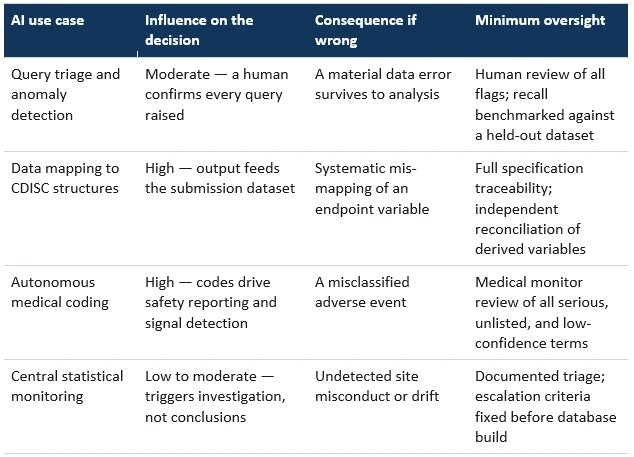
Table 1: Mapping AI use cases in clinical data management to model influence, decision consequence, and the oversight each tier demands.
Quality First: AI as a Continuous Surveillance Layer, Not a Cleanup Crew
The most common executive misreading of AI in clinical data management is that it is a faster cleanup crew. The more useful framing is surveillance: moving detection from the end of the study to the moment data arrives.
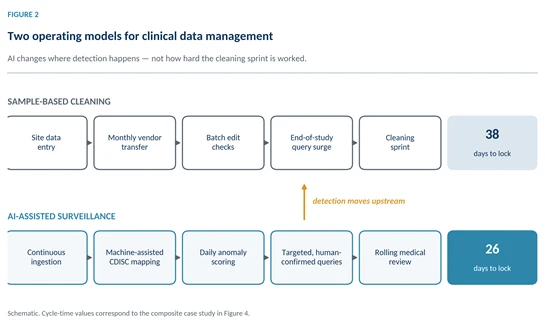
Figure 2: Where detection sits in each operating model, and what that does to the close-out clock.
The quality gain lies not only in what gets caught but in what stops being raised. Query volume has become its own tax. Sites absorb the cost of answering queries that carry no scientific consequence, and site burden translates directly into enrollment friction, staff turnover, and slower data entry. A 2025 peer-reviewed evaluation of a large-language-model-based data review system reported a roughly sixfold increase in cleaning throughput per reviewer session, a fall in reviewer error rates from about 55 percent to under 9 percent, and a fifteenfold reduction in false-positive queries. The last figure arguably matters most, because precision is what earns site cooperation.
For a chief medical officer, the quality argument is also an evidentiary one. Continuous surveillance produces a dated record of what was detected, when, and what was done about it. That is an inspection asset. Under a quality-by-design regime, the defensible position is not a clean database; it is a documented, risk-proportionate process that found the errors that mattered and can show its working.
Speed Second: How AI Compresses the Last Mile to Database Lock
Database lock sits on the critical path to filing, and days spent there are among the most expensive in a development program because they delay the entire downstream sequence: statistical analysis, clinical study report, submission, review clock, launch.
The same published evaluation projected roughly a one-third acceleration of database lock timelines — about five days off a typical 36.8-day close-out window — and estimated savings near $5.1 million per Phase III trial. Notably, the great majority of that figure, around $4.4 million, came not from labor savings but from earlier market entry; medical review and query management each contributed a few hundred thousand dollars.
That distribution should reframe the business case. Boards asked to fund AI in clinical data management often evaluate it as headcount substitution, then find the payback thin. Evaluated instead as cycle-time compression on a revenue-generating asset, the same investment looks materially different. For a product with meaningful peak-year sales, five days of earlier market presence is not a rounding error. The speed argument, properly constructed, is a commercial argument.
Compliance Third: Making an AI Model Defensible Under Part 11 and the FDA Credibility Framework
The compliance question is not whether AI is permitted. It is whether a sponsor can demonstrate that a specific model was fit for a specific purpose.
The FDA's January 2025 draft guidance on the use of AI to support regulatory decision-making supplies the vocabulary. It sets out a seven-step, risk-based credibility assessment framework built around two ideas executives should internalize. The first is context of use: a precise statement of what the model does and how its output will be used. The second is model risk, which the agency frames as a function of model influence — how much the model contributes to a decision relative to other evidence — and decision consequence, the harm if that decision is wrong. A model triaging queries for human review carries very different obligations from one deriving an endpoint variable.
Figure 3: The seven-step credibility assessment sequence, and the two steps that most often determine whether the rest holds up.
Two further constraints apply. Part 11 expectations for electronic records still govern: audit trails must capture model version, configuration, and the human disposition of each output, which in practice means freezing model versions for the duration of a study and treating an update as a change control event. And in January 2026, the FDA and the EMA jointly issued guiding principles for good AI practice in drug development, reinforcing that AI supports rather than replaces human accountability and that data provenance and processing steps must be documented in a traceable, verifiable manner consistent with GxP. Sponsors operating in Europe must additionally map their obligations under the EU AI Act.
None of this is exotic. It is validation discipline applied to a probabilistic system — and it is the difference between an efficiency program and an inspection finding.
Case Study: What an AI-Enabled Clinical Data Management Rebuild Looks Like in Practice
The following case is a composite drawn from published peer-reviewed evaluations and publicly reported sponsor deployments. Figures are directional; no single organization's results are represented.
A mid-cap US biopharmaceutical sponsor entered two concurrent Phase III immunology programs covering roughly 1,400 subjects across 190 sites in four regions, with eight external data sources including a wearable activity sensor and central imaging. Previous close-outs had run 38 days from last patient visit to lock, with reconciliation of external feeds consistently on the critical path.
The rebuild had three components. External data were ingested continuously into a single study data hub rather than arriving in monthly vendor transfers, with machine-assisted mapping to CDISC structures reviewed by a standards lead. An anomaly detection layer then scored incoming records daily and routed only high-probability findings to data managers, with every flag subject to human confirmation. Finally, autonomous coding handled routine adverse event and medication terms, escalating serious, unlisted, and low-confidence terms to the medical monitor.
Governance ran alongside the technology rather than behind it. Each model received a written context of use, a risk classification, a validation report against a held-out historical dataset, and a frozen version identifier recorded in the audit trail.
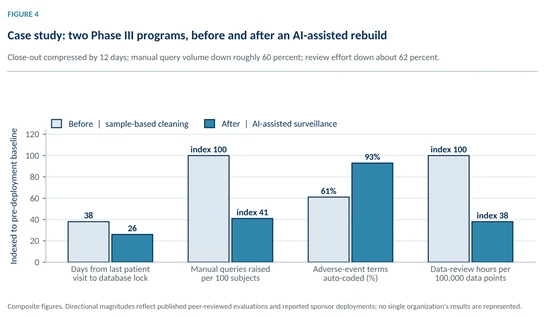
Figure 4: Composite outcomes across four clinical data management metrics, indexed to the pre-deployment baseline.
The outcomes are shown in Figure 4. Close-out compressed from 38 to 26 days. Manual query volume fell by roughly 60 percent. Autonomous coding coverage rose from 61 to 93 percent of terms. Data review effort per 100,000 data points fell by about 62 percent. The team itself was not reduced; it was redeployed to protocol-specific risk assessment and medical review — the work E6(R3) actually asks for.
Five Questions the Pharmaceutical C-Suite Should Ask Before Funding AI in Clinical Data Management
- What is the documented context of use for each model, and who signed it?
- Where does each model sit on the influence-and-consequence matrix, and does our validation evidence match that tier?
- Can our audit trail reproduce, for any inspected record, which model version acted on it and which human accepted the result?
- Are we measuring precision — false-positive queries avoided — and not only recall? Site burden is a quality risk, not an inconvenience.
- Is the business case built on cycle time and asset value, or only on headcount? The second case rarely survives contact with a finance committee.
Conclusion: AI Will Not Replace the Clinical Data Manager — It Will Reprice the Role
The trajectory is now clear enough to plan against. Data volume and diversity will keep rising. E6(R3) and its second annex have established a risk-proportionate, quality-by-design standard that manual, sampling-based practice cannot meet economically. And regulators have supplied a workable framework for demonstrating that a model is credible for a defined purpose.
What follows is less a technology decision than an operating-model decision. Sponsors that bolt AI onto an unchanged process will get modest savings and a difficult inspection conversation. Sponsors that rebuild clinical data management around continuous surveillance, defined contexts of use, and documented human accountability will get shorter close-outs, cleaner evidence packages, and a data function whose scarce expertise is spent on judgment rather than transcription.
The clinical data manager does not disappear in that model. The role moves up the value chain — from finding errors to designing the systems that find them, and from defending a database to defending a method. For the C-suite, that is the investment thesis worth underwriting.

Lakshmi is a science writer with a foundation in the laboratory. She earned her master's in biotechnology and trained through research internships at ICGEB (JNU) and DIPAS, DRDO, with her work appearing in the Egyptian Journal of Veterinary Sciences. Now APCRM-certified and part of the editorial team at Pharma Focus America and Pharma Focus Europe, she reports on pharmaceutical technology, research, and innovation — giving complex science a clear and confident voice for industry leaders.