AI-Powered Clinical Trials: Accelerating Study Design and Execution
Lakshmi, Editorial Team, Pharma Focus America
Clinical development remains the slowest and costliest stage of bringing a medicine to patients, and much of that loss is self-inflicted through over-complex protocols, avoidable amendments and sites that never enroll. Artificial intelligence is now moving from isolated pilots into production across design, feasibility, recruitment and monitoring. This article examines where the value is demonstrable, what regulators now expect, and which decisions senior leadership cannot delegate.
Introduction: The Molecule Was Never the Slow Part
For more than a decade, the industry's capital and attention have flowed toward the front of the pipeline. Target identification, generative chemistry and structural prediction have all been genuinely transformed. Yet the median interval from first-in-human dosing to approval has barely moved. The reason is uncomfortable but well understood inside every development committee: the constraint is no longer finding a plausible molecule. It is designing and running the study that proves the molecule works.
Commentators have become blunt about this. Artificial intelligence has not yet visibly increased the number of drug approvals, and trial execution remains the prime bottleneck. That framing should interest every chief executive and chief medical officer, because it relocates the opportunity. The most valuable near-term applications of AI are not in discovery at all. They sit in the unglamorous machinery of protocol design, feasibility assessment, patient identification and study conduct — where cycle time is lost in months and can be recovered in weeks.
The Anatomy of a Preventable Delay
Begin with the number that belongs on every development dashboard. In a landmark multi-sponsor benchmark of more than 800 protocols, 57 percent carried at least one substantial global amendment, and roughly 45 percent of those amendments were judged avoidable by the sponsors themselves. More recent analyses across Phase I–IV portfolios place the amendment rate considerably higher. The median direct cost of implementing a single substantial amendment was USD 141,000 in Phase II and USD 535,000 in Phase III — figures that exclude internal staff time, translation and local resubmission. Protocols carrying at least one amendment took, on average, three unplanned additional months to complete and enrolled fewer patients than originally planned.
What triggers amendments matters more than what they cost. Modifications to eligibility criteria and participant demographics accounted for 53 percent of substantial amendments, safety assessment changes for 38 percent and endpoint modifications for 27 percent. These are design decisions, taken before the first patient is screened, on the basis of assumptions nobody tested. In oncology the burden compounds: Phase II and III oncology protocols have been found to require 50 to 70 percent more substantial amendments than non-oncology studies, while only 5 to 7 percent of adult cancer patients ever enroll in a trial at all.
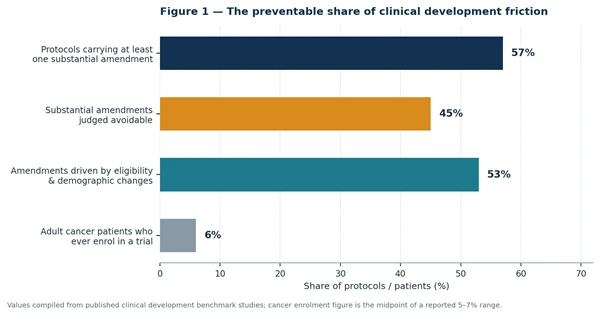
This is the target — not “AI in pharma” as a portfolio theme, but a quantified pool of avoidable rework with a known owner.
From Static Document to Simulated Design
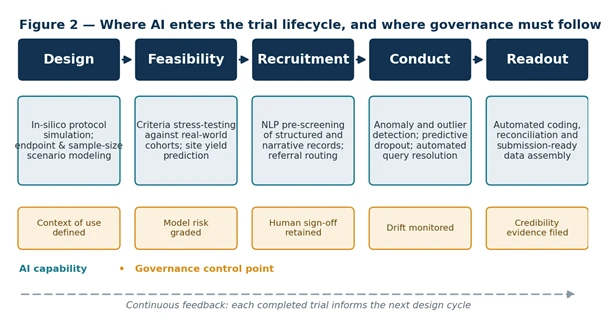
The first shift is structural rather than algorithmic. A protocol has traditionally been a narrative document: readable by people, opaque to machines. The emerging practice is to author it as a structured design object, in which every objective, endpoint, eligibility criterion, visit and procedure exists as discrete, queryable data. Sponsors adopting this model increasingly designate the digital protocol as the enterprise system of record, so that study build, data capture and downstream regulatory documents all derive from one authoritative source rather than being re-keyed from a PDF.
Once the protocol is data, it becomes testable before it becomes expensive. Eligibility criteria can be run against de-identified real-world cohorts to quantify how many otherwise-suitable patients each individual criterion removes; a laboratory threshold that excludes a third of the addressable population is a finding worth having in week three, not month fourteen. Schedule-of-assessment burden can be scored procedure by procedure, exposing collection that serves no endpoint and no safety purpose. Sample size, dropout and interim-analysis assumptions can be stress-tested across hundreds of simulated scenarios instead of a single base case.
Survey data suggests the sequencing is now visible across the industry. Data integration and standardization is the most widely deployed use case, with roughly seven in ten organizations already active, while protocol design and optimization is emerging as the next breakout application. The link between the two is not coincidental: design intelligence is only as good as the historical trial data it can learn from.
The Recruitment Equation, Rewritten
Recruitment is where the operational case is most thoroughly evidenced. Natural-language processing applied to both structured fields and clinical narrative allows eligibility screening to run continuously across an entire health system, rather than as a periodic and labor-intensive manual chart review.
The published results are concrete. One academic health-system deployment screened more than 98,000 patients across 29 trials, surfacing 825 eligible candidates and supporting 117 enrollments; it reduced chart-review workload roughly tenfold and cut per-chart screening time by 41 percent, while matching manual review with full sensitivity in validation. Earlier automated eligibility screening work in oncology reduced the number of patients a physician needed to review per trial by 85 percent. Applied at feasibility stage, the same class of model predicts site-level enrollment yield from historical performance and catchment data, allowing sponsors to concentrate spend on sites that will actually recruit rather than activating a long tail that never does.
One caution belongs in the boardroom rather than the operations meeting. Models trained on historical enrollment inherit historical exclusion. If a site network has never recruited well from particular communities, a naive yield model will rationally recommend avoiding them. Subgroup performance testing is therefore a commercial and regulatory requirement, not a compliance afterthought.
Execution: From Rear-View Mirror to Windshield
In study conduct, the value lies in shortening the distance between an event and its detection. Anomaly detection across accumulating data flags site-level outliers, implausible value distributions and protocol deviations while the study can still respond. Predictive models identify participants at elevated risk of discontinuation early enough for retention outreach to matter. Automated reconciliation and coding compress the interval between last patient out and database lock.
This is also what makes genuinely adaptive and continuous designs operationally realistic. The statistical methods have existed for years; what was missing was the ability to interpret protocol changes, reconfigure study databases and manage amendments fast enough for adaptation to be worth attempting.
The evidence on returns carries a warning for leadership. Organizations that deployed early report above-expectation outcomes far more frequently than the broader population — not because their models are more sophisticated, but because value compounds only when AI is embedded across interconnected workflows. Isolated pilots do not move key performance indicators. One analysis anticipates an 18-to-24-month window before the gap between AI-enabled leaders and everyone else becomes structural, and difficult to close through technology purchase alone.
Case Study: Eleven Weeks Recovered Before First Patient In
The following is an illustrative composite, drawn from patterns reported across published deployments rather than from a single named program.
A mid-sized sponsor was preparing a Phase II study of a biomarker-defined agent in advanced solid tumors, with 42 planned sites across five countries. Its predecessor study had absorbed three substantial amendments and taken fourteen months to enroll against a nine-month plan. The development committee treated that history as a design problem rather than an execution problem, and intervened before protocol finalization.
Four interventions were applied. First, the draft protocol was authored as a structured design object rather than a narrative document, making every criterion and procedure individually addressable. Second, each eligibility criterion was simulated against a de-identified real-world oncology cohort; two criteria — a cap on prior lines of therapy and a hematology threshold — were found to exclude approximately 38 percent of otherwise eligible patients while carrying no independent safety rationale. Both were revised, with the change formally reviewed and signed off by the medical monitor. Third, schedule-of-assessment burden scoring identified eleven procedures per patient that mapped to no endpoint; these were removed. Fourth, the site model was rebuilt on predicted yield rather than prior relationship, reducing the footprint from 42 sites to 31 and replacing fourteen low-yield locations.
At nine high-volume sites, NLP pre-screening was run against the health system record to surface candidates continuously. The composite outcome: screen-failure rate fell from 61 to 38 percent, last-patient-in arrived roughly eleven weeks earlier than the comparable historical benchmark, and no substantial amendment was required during the enrollment period.
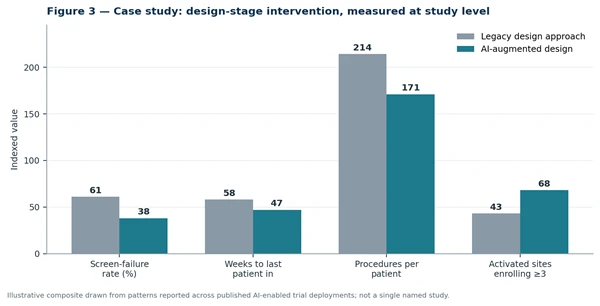
Two features of this case deserve emphasis. The decisive interventions all occurred before the first patient was screened — the window in which design changes are cheap. And every model output was routed to a named human decision-maker rather than executed automatically, which is precisely what regulators now expect to see documented.
The Regulator Is Already in the Room
Any executive treating regulatory acceptance as the open question is working from outdated information. The FDA's draft guidance on the use of AI to support regulatory decision-making, issued in January 2025, sets out a seven-step, risk-based credibility assessment framework organized around a defined context of use. Model risk is graded by the influence of the model's output on a given decision and the consequence of that decision being wrong; the credibility evidence expected scales accordingly. The agency has noted that it had already received more than 500 drug and biologic submissions containing AI components.
In January 2026, the FDA and the EMA jointly published ten Guiding Principles of Good AI Practice in Drug Development, spanning human-centric design, a risk-based approach, data governance and documentation, life-cycle management and clear essential information. The principles are voluntary and create no enforceable obligation on their own, but they signal a convergence between the two agencies that matters to any sponsor running a global program.
The practical implications are narrower and sharper than most summaries suggest. Scope turns on context of use, so the same model may fall inside or outside the framework depending on the decision it informs. Tools adopted purely for operational efficiency are not automatically out of scope where they can affect patient safety or the reliability of study results. And cross-border AI workflows carry independent data-protection obligations, which is why federated approaches that leave patient-level data in place are gaining ground.
Conclusion: Speed Is a Governance Outcome
The case for AI in clinical development no longer rests on projection. Protocol design can be simulated before it is committed. Eligibility criteria can be tested against real populations rather than clinical intuition. Recruitment can be screened continuously instead of episodically, and conduct can be monitored predictively rather than retrospectively. Each of these is demonstrable today, with published evidence attached.
What remains unresolved is organizational. The evidence is consistent that value compounds across connected workflows and dissipates in isolated pilots, which makes this a question of enterprise architecture and accountability rather than tool selection. Regulators have already supplied the framework; they are waiting for sponsors to supply the credibility evidence.
The companies that pull ahead over the next two years will not be those with the most sophisticated models. They will be those that have made a deliberate, funded decision about where machine judgment ends and human accountability begins, and have written that decision into how every study is designed. That is not a technology choice. It is a leadership one.

Lakshmi is a science writer with a foundation in the laboratory. She earned her master's in biotechnology and trained through research internships at ICGEB (JNU) and DIPAS, DRDO, with her work appearing in the Egyptian Journal of Veterinary Sciences. Now APCRM-certified and part of the editorial team at Pharma Focus America and Pharma Focus Europe, she reports on pharmaceutical technology, research, and innovation — giving complex science a clear and confident voice for industry leaders.