

AI-Powered Pharma Supply Chains: From Visibility to Predictive Control
Lakshmi, Editorial Team, Pharma Focus America
American pharmaceutical supply chains are now extensively instrumented, yet shortages persist and two federal-facing shortage counts disagree by a factor of two. This article argues that visibility has reached its ceiling, examines what predictive models actually deliver when measured honestly, shows how serialization data became the fuel for them, and sets out the governance framework US regulators have already published for supply chain AI.
The Visibility Era Has Reached Its Ceiling
American pharmaceutical supply chains have never been better instrumented. Serialized packages, electronic transaction records, connected cold chain sensors, control towers and executive dashboards now generate more data about the movement of medicines than at any point in the industry's history. And yet patients still cannot reliably get their drugs.
The numbers make the point with uncomfortable clarity. In the first quarter of 2024, pharmacist-reported active drug shortages in the United States reached 323 — the highest figure since national tracking began in 2001. By mid-2026 the count stood at 223 and had risen for two consecutive quarters. These are not the shortages of an industry that cannot see its own supply chain. They are the shortages of an industry that can see a great deal and still cannot act early enough.
That gap — between knowing and acting in time — is the actual business case for artificial intelligence in pharmaceutical distribution. Not better dashboards. Better decisions, made sooner, with a defensible account of why.
Why Pharma Supply Chain Visibility Stopped Being Enough
Consider a problem that should embarrass the sector: the United States does not have one authoritative shortage number. It has two, and they diverge sharply.
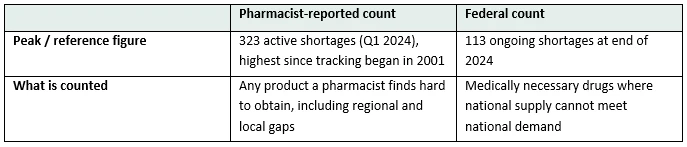
Two US shortage counts, two definitions. Pharmacist-reported figures are compiled by a national pharmacists' society with a university drug information service; the federal figure is the FDA's own ongoing-shortage count. Peak figure Q1 2024; federal figure as of year-end 2024.
Neither count is wrong. They answer different questions. The federal measure asks whether the nation can supply a necessary medicine; the pharmacist measure asks whether a specific site can fill a specific prescription today. For a chief supply chain officer, the lesson is not that one dataset should win. It is that a shortage is a local, time-bound event that a national aggregate systematically hides.
“Visibility tells you a product is scarce. Predictive control tells you which of your sites will feel it, when, and what to move before they do.”
This is precisely the class of problem machine learning handles better than reporting. Aggregation smooths away the signal; models trained on site-level consumption, substitution behaviour and prior disruption history retain it. The strategic shift is from a system that describes the present accurately to one that ranks what is about to go wrong, by site and by severity.
The Data Dividend Hiding Inside DSCSA Serialization
The most underused asset in American pharmaceutical distribution was built for a different purpose entirely. The Drug Supply Chain Security Act required trading partners to exchange transaction data electronically, verify products at the package level, and confirm that counterparties are authorized trading partners. Most of that exchange now runs on a single global standard for event data.
Where DSCSA compliance now stands
- Large dispensers (26 or more full-time licensed pharmacists or qualified pharmacy technicians): stabilization grace period expired November 27, 2025.
- Small dispensers (25 or fewer): original compliance date of November 27, 2026 extended by FDA exemption through November 27, 2027.
- Core obligations: electronic exchange of transaction information and statements, package-level verification, authorized trading partner verification, suspect and illegitimate product handling.
Executives have largely treated this as a compliance cost centre, and the extensions have encouraged that reading. It is a strategic misclassification. Serialization produces exactly what a predictive model requires and the industry historically lacked: time-stamped, item-level event data describing where product physically is, who holds it, and how long each hop took. A control tower built on shipment confirmations sees intentions. A model built on serialized event data sees behaviour.
The organizations that will convert DSCSA spending into commercial advantage are those treating the resulting event stream as a forecasting input rather than an audit archive — and that decision is architectural. Data retained only in a compliance repository, with no analytical access path, cannot be retrofitted into a demand signal later without substantial rework.
The staggered deadlines create a second, subtler exposure. While smaller dispensers operate under exemption, the electronic record across a manufacturer's downstream network is incomplete by design, and any model trained on that period inherits the gap. Leaders should know which share of their distribution footprint is currently exempt, and treat that proportion as a stated confidence limit on every downstream prediction rather than discovering it during a validation review.
Case Study: What a Predictive Shortage Model Actually Delivered
Vendor claims about AI in supply chain are abundant and rarely verifiable. A peer-reviewed study published in a health care management journal in 2023 is more useful precisely because it reports its limitations.
Researchers built machine learning models to predict shortages across the most-dispensed interchangeable drug groups using sales data from 22 community pharmacies combined with historical shortage records. The design constraint is the interesting part: the models used no manufacturer or supplier inventory data at all. They worked from variables a dispenser already holds — average and total days of supply per patient, prior shortage history for the molecule, and the therapeutic class and interchangeable group hierarchy.
The models sorted shortage severity into four classes — none, low, medium and high — and predicted the class one month ahead. Four-class accuracy was 69 percent, with a Cohen's kappa of 0.44, indicating moderate agreement beyond chance. Of the shortages classified as most impactful, 59 percent were predicted in advance.
Read those numbers as an executive, not as a data scientist. Sixty-nine percent accuracy is not automation-grade; it would be indefensible as an unsupervised reordering trigger. But capturing 59 percent of high-impact shortages a month ahead, using data a pharmacy chain already owns and no supplier cooperation whatsoever, is a material change in decision quality — a month is enough to qualify an alternate source, pre-position inventory, or begin a therapeutic substitution review.
The study was conducted on Canadian pharmacy data, so the specific coefficients do not transfer to US operations. The method does, and the governing insight is transferable: useful predictive control was achieved with modest data, modest accuracy and a human decision-maker in the loop. Organizations waiting for a model that is right nine times out of ten before acting are optimizing for the wrong threshold.
From Visibility to Predictive Control: What AI Changes in the Decision Itself
Predictive control is not a technology upgrade; it is a change in who decides what, and on what evidence. Three shifts separate it from the visibility era.
The first is from exception reporting to ranked risk. A dashboard flags what has already breached a threshold. A model orders the portfolio by probability and consequence before anything breaches, which means scarce mitigation capacity — qualified alternate suppliers, buffer capital, air freight budget — goes to the exposures that matter rather than the ones that shouted first.
The second is from site-level reaction to network-level pre-positioning. Once risk is scored by location, inventory becomes a portfolio to be allocated rather than a number to be minimized at each node. This is where AI-powered supply chains pay for themselves, and it requires finance to accept a deliberate, modelled increase in working capital at specific nodes — a conversation that fails if the model cannot explain itself.
The third is from intuition to documented rationale. In a regulated distribution network, a decision to allocate constrained product has to withstand scrutiny. A model that produces a traceable reason for each recommendation is not merely more accurate than experienced judgement; it is more auditable.
None of these shifts is primarily technical, which is why so many programmes stall. Site-level consumption data usually sits with commercial operations, serialized event data with quality and compliance, and inventory policy with finance. A predictive model needs all three, and no vendor can resolve an ownership dispute between three functions. The organizations that get this working tend to be those where a single executive holds accountability for the forecast and the inventory consequences of it — not those with the largest data science headcount.
US Regulators Have Already Published the Governance Model for Supply Chain AI
Pharmaceutical leaders frequently assume AI governance in this sector is unsettled. For regulatory-facing models, it is less unsettled than they think.
On January 7, 2025, the FDA issued draft guidance on the use of artificial intelligence to support regulatory decision-making for drug and biological products. It proposes a seven-step, risk-based credibility assessment framework: define the question of interest; define the context of use; assess the model's risk; develop a credibility assessment plan; execute it; document the results; and determine whether the model is adequate for its context of use. Crucially, risk is set by two factors — model influence, meaning how much weight the AI output carries relative to other evidence, and decision consequence, meaning the severity of harm if the decision is wrong. The guidance remains in draft.
On January 14, 2026, the FDA and the European Medicines Agency jointly published guiding principles of good AI practice in drug development — ten high-level principles spanning the AI lifecycle from design and data through monitoring and communication, intended to harmonize transatlantic expectations and inform future binding guidance.
Neither document was written for supply chain forecasting. Both are nonetheless the most useful governance template available, because the model influence and decision consequence matrix is exactly the right question for a logistics model: a system recommending where to stage buffer inventory carries low consequence, while one driving allocation of a scarce oncology product in shortage carries high consequence and deserves commensurate validation. Boards that adopt this framework voluntarily will be ahead of the requirement rather than behind it.
Conclusion: Buy the Decision, Not the Dashboard
The American record is clear enough. Shortages reached a two-decade high in 2024, remain elevated, and the country cannot agree on their count because national aggregates and local availability are genuinely different measurements. Serialized data mandated for security purposes sits largely unexploited in compliance repositories. And the honest published evidence on predictive models shows moderate accuracy producing material operational value when a human remains in the loop.
Taken together, these point to a single conclusion for US pharmaceutical leadership: the next increment of supply chain spending should buy earlier decisions, not better reporting. That means routing serialization data to analytics rather than archives, setting an accuracy threshold appropriate to the decision rather than to a vendor demonstration, and governing each model by its influence and consequence as federal guidance already describes.
Visibility told the industry where its medicines were. Predictive control tells it where they will not be. For the patient at the counter, only the second one has ever mattered.

Lakshmi is a science writer with a foundation in the laboratory. She earned her master's in biotechnology and trained through research internships at ICGEB (JNU) and DIPAS, DRDO, with her work appearing in the Egyptian Journal of Veterinary Sciences. Now APCRM-certified and part of the editorial team at Pharma Focus America and Pharma Focus Europe, she reports on pharmaceutical technology, research, and innovation — giving complex science a clear and confident voice for industry leaders.