


Analytical Strategies for Characterizing Complex Biologics and ADCs
Lakshmi, Editorial Team, Pharma Focus America
For decades, the pharmaceutical industry equated therapeutic ambition with the ability to design a promising molecule. That equation no longer holds. As portfolios pivot toward complex biologics and antibody-drug conjugates (ADCs), the decisive competitive advantage has shifted from what you can make to what you can prove. A molecule you cannot fully characterize is a molecule you cannot reliably manufacture, defend before regulators, or scale into a franchise. Analytical strategy has quietly become the boardroom issue that separates biologics winners from expensive cautionary tales.
Introduction
This is not a laboratory footnote. It is a capital-allocation reality. The most sophisticated therapeutic modalities in modern medicine are also the most analytically demanding, and the organizations that treat characterization as a strategic capability—rather than a downstream compliance chore—are the ones capturing durable value.
The Complexity Tax No One Warned You About
A conventional small-molecule drug is a defined, reproducible chemical entity. A monoclonal antibody, by contrast, is a large glycoprotein subject to dozens of subtle variations: glycosylation patterns, charge variants, oxidation, deamidation, aggregation, and fragmentation. Each of these micro-variations can influence efficacy, immunogenicity, and safety. The molecule is not a single structure but a distribution of closely related structures—what regulators politely call "heterogeneity."
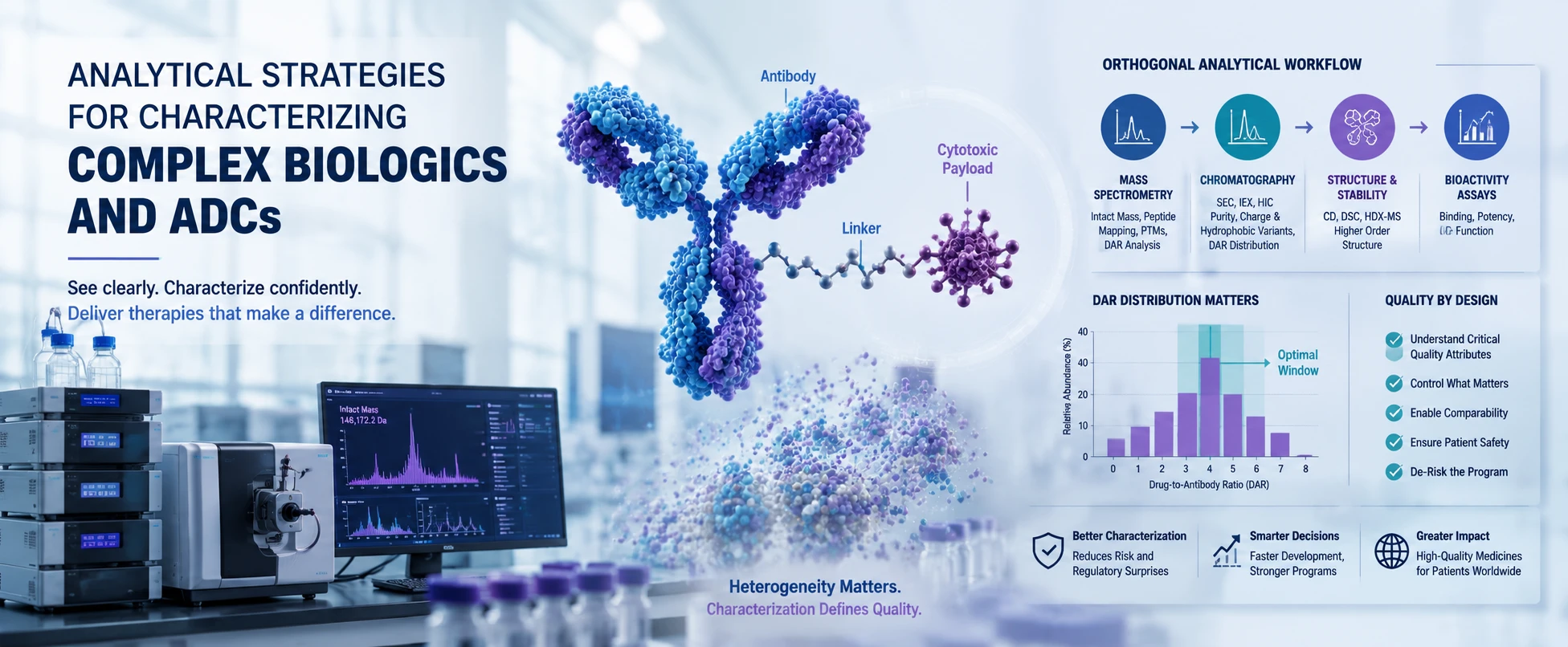
ADCs multiply this challenge by orders of magnitude. An ADC fuses three distinct problems into one product: a biologic antibody, a small-molecule cytotoxic payload, and the chemical linker that binds them. The critical quality attribute here is the drug-to-antibody ratio (DAR)—the average number of payload molecules attached per antibody. DAR is not a single number but a distribution across the entire product population. Too low, and the therapy underdelivers; too high, and toxicity and instability climb. Between those extremes lies a narrow window where efficacy and safety coexist, and characterizing that window with confidence is where many programs stumble.
The strategic implication is stark. Every additional layer of molecular complexity imposes what might be called a "complexity tax"—more analytical methods, more orthogonal confirmation, more time, and more specialized talent. Leaders who underprice this tax in their development budgets discover it later, at the worst possible moment: during a regulatory review, a technology transfer, or a manufacturing deviation investigation.
Why One Instrument Never Tells the Whole Truth
The foundational principle of modern biologics characterization is orthogonality—the deliberate use of multiple independent analytical techniques that interrogate the same molecule through different physical or chemical lenses. No single method captures the full picture, and any attribute that matters clinically deserves confirmation from at least two independent angles.
Mass spectrometry has become the analytical backbone of this effort. High-resolution mass spectrometry can confirm intact molecular mass, map post-translational modifications, and—critically for ADCs—resolve the DAR distribution and identify exactly where payloads attach on the antibody. Peptide mapping, in which the protein is enzymatically digested and its fragments analyzed, delivers near-complete sequence confirmation and can localize modifications down to the individual amino acid. This granularity is what allows a team to distinguish a benign variant from one that threatens potency.
Chromatographic separation techniques complement mass spectrometry by resolving the molecule's population into its component species. Size-exclusion chromatography quantifies aggregates and fragments—aggregation being a particular concern because it can drive immunogenic responses in patients. Ion-exchange chromatography separates charge variants. For hydrophobic ADC species, hydrophobic interaction chromatography separates molecules by payload loading, providing an orthogonal readout of the same DAR distribution that mass spectrometry describes.
Higher-order structure—the way the protein folds and assembles in three dimensions—demands its own toolkit. Circular dichroism, differential scanning calorimetry, and increasingly hydrogen-deuterium exchange mass spectrometry probe conformational integrity and stability. These matter because a molecule can have a perfect amino acid sequence yet be functionally compromised by misfolding. And underpinning everything, potency and binding assays confirm that structural fidelity actually translates into biological function.
The executive takeaway is that a credible characterization package is not a single hero technique but a coherent architecture of complementary methods. Boards and development committees should be skeptical of programs leaning too heavily on any one instrument to answer every question.
Case Study: The DAR Deception
Consider a mid-stage ADC program—drawn from a composite of common industry experience—that appeared to be progressing smoothly. Early batches showed an average DAR near the target value, and the team advanced toward scale-up with confidence. The average, however, concealed a problem.
When the program adopted an orthogonal approach—pairing hydrophobic interaction chromatography with high-resolution mass spectrometry—the DAR distribution, not just its average, came into view. The batches contained a meaningful subpopulation of highly loaded species alongside underloaded ones. The convenient average masked a bimodal reality. That high-DAR fraction carried disproportionate risk: greater aggregation propensity, faster clearance, and elevated toxicity potential.
Had the team relied on a single average value, this heterogeneity might have surfaced only in clinical toxicity signals or a manufacturing consistency failure years and hundreds of millions of dollars downstream. Instead, early orthogonal characterization allowed a conjugation process adjustment that tightened the distribution before pivotal manufacturing. The lesson resonates at the executive level: an average is a summary, not a characterization, and the difference between the two can determine a program's fate.
The Regulatory Conversation Has Changed—Have You?
Regulators no longer accept characterization as a box-ticking exercise. The prevailing expectation is a Quality by Design philosophy: sponsors must identify their product's critical quality attributes, understand how manufacturing process parameters influence those attributes, and demonstrate control across the entire lifecycle. This is a fundamentally analytical undertaking. You cannot control what you cannot measure, and you cannot claim understanding of an attribute you have characterized only superficially.
Comparability is where this expectation becomes acute. Every biologics program inevitably faces manufacturing changes—a new production site, a scaled-up bioreactor, a revised purification step, a switch in a raw material supplier. Each change requires a rigorous demonstration that the post-change product remains equivalent to the pre-change product across all meaningful quality attributes. The strength of that comparability argument rests entirely on the sensitivity and breadth of the analytical package. Teams that invested in deep characterization early hold a decisive advantage: they can show, attribute by attribute, that nothing meaningful shifted. Teams that skimped find themselves generating data reactively, under time pressure, with a regulatory clock running.
The strategic reframe here is important. Analytical investment is not a cost center that competes with clinical spend. It is an insurance policy against the far larger costs of manufacturing failures, regulatory delays, and comparability disputes. The characterization data generated in early development becomes the reference standard against which every future change is judged for the entire commercial life of the product—often more than a decade. A glycan shift introduced by a routine scale-up, for instance, is manageable only if the organization already understands which glycan species affect function and which do not. That understanding is built years earlier, at the bench, or it is not available when it matters.
The Talent and Data Bottleneck Behind the Bench
Instruments do not characterize molecules—people do, supported by data infrastructure. The scarcest resource in biologics analytics today is not capital equipment but the expertise to design orthogonal strategies, interpret complex datasets, and translate analytical findings into development decisions. A high-resolution mass spectrometer in the hands of an inexperienced team produces expensive noise. The same instrument, guided by seasoned analytical scientists, produces the insight that de-risks a billion-dollar program.
Data presents an equally consequential bottleneck. Modern characterization generates enormous, heterogeneous datasets across dozens of methods and hundreds of batches. Organizations that manage this data in disconnected silos—one method's results locked away from another's—forfeit the ability to see patterns across their molecular knowledge base. The leaders are building integrated data environments where characterization results flow into a coherent, queryable picture of product quality over time. Increasingly, machine learning approaches are being applied to these datasets to flag anomalies, predict stability, and accelerate method development. The competitive frontier is shifting from generating analytical data to connecting and learning from it.
For executives, this reframes the analytical function as a strategic asset requiring deliberate investment in talent development and data architecture—not a service function to be squeezed. The organizations treating their analytical scientists as interchangeable technicians are the ones most likely to be blindsided.
A Boardroom Framework for Analytical Strategy
How should senior leaders engage with a domain this technical? Not by mastering mass spectrometry, but by asking the right strategic questions. Three deserve a permanent place on the development-review agenda.
First, do we understand our molecule's heterogeneity, or only its averages? The DAR case illustrates how averages conceal risk. Leaders should insist on distribution-level understanding of critical attributes, not just summary statistics.
Second, is our characterization orthogonal and lifecycle-ready? A program relying on single-method conclusions, or one that has not built the reference data needed for future comparability, is carrying hidden risk that will surface at the least convenient moment.
Third, are we investing in the talent and data infrastructure to sustain analytical advantage? The instruments are increasingly commoditized; the human expertise and integrated data capability are not.
The organizations that internalize these questions treat analytical characterization not as a gate to pass but as a capability to compound. Every molecule characterized deepens the institutional knowledge base. Every orthogonal method validated strengthens the platform for the next program. Over time, this compounds into a genuine and defensible competitive moat.
The Strategic Bottom Line
Complex biologics and ADCs represent the most promising frontier in modern therapeutics—and the most analytically unforgiving. The molecule you design is only as valuable as your ability to see it clearly, prove its quality, and defend that proof through years of manufacturing and regulatory scrutiny. Analytical strategy is no longer the province of the laboratory alone; it is a determinant of program success, capital efficiency, and franchise durability.
The executives who grasp this are reallocating attention accordingly, elevating analytical characterization from an operational afterthought to a strategic priority. In an industry where a single uncharacterized variant can derail a program and a single comparability failure can interrupt a franchise, the ability to characterize with confidence has become inseparable from the ability to lead. The molecule, in the end, is only as good as your ability to see it—and the organizations that see most clearly will define the next era of biologics medicine.

Lakshmi is a science writer with a foundation in the laboratory. She earned her master's in biotechnology and trained through research internships at ICGEB (JNU) and DIPAS, DRDO, with her work appearing in the Egyptian Journal of Veterinary Sciences. Now APCRM-certified and part of the editorial team at Pharma Focus America and Pharma Focus Europe, she reports on pharmaceutical technology, research, and innovation — giving complex science a clear and confident voice for industry leaders.