


Automation Revolution: A Strategic Blueprint for Modern Industrial Production
Amit Malviya, Vice President Quality Assurance, Zest Pharma
The trajectory of global manufacturing is defined by the powerful convergence of robotics, sensors, and computer numerical control. Together, these technologies create a self-reinforcing cycle of precision and growth, enabling manufacturers to shatter the limitations of manual production and achieve unprecedented scales of efficiency. As the industry advances, the capacity to minimise human intervention while maximising output remains the definitive hallmark of a successful enterprise. Automation machinery manufacturing is no longer a peripheral service; it is the indisputable cornerstone of global industrial transformation and the essential engine for competitive scalability in the 21st century.
Introduction:
The New Industrial Baseline
In the contemporary industrial landscape, the fundamental architecture of manufacturing is undergoing a profound and irreversible transformation. Historically, the strength of an industrial enterprise was often measured by its physical scale—specifically, the size of its workforce and its ability to manage massive manual operations. However, we have entered an era where this traditional model is no longer a viable strategy for long-term growth. The strategic shift from manual labor to technology-driven systems has moved beyond being a simple upgrade or a luxury for high-end firms. Today, the adoption of advanced production technologies has become a baseline requirement for survival. Companies that fail to integrate these systems find themselves unable to compete with the speed, accuracy, and cost structures of modernised competitors. Automation is the primary catalyst for this shift, redefining what it means to be a viable player in the modern market. The evolution of modern production systems represents more than just the introduction of new machines; it is a systemic pivot in how value is created. For decades, global manufacturing strategy was dominated by a focus on labor costs. Organisations moved production across borders in a constant search for lower wages to protect their margins. This labor-centric model, however, is being replaced by an algorithm-driven focus.
Automation machinery manufacturing—the specialised sector dedicated to designing and building the sophisticated systems that facilitate production with minimal human intervention—has re-engineered the economic framework of production. By prioritising the deployment of efficient algorithms over the search for cheap labor, companies can achieve levels of productivity that were previously unimaginable. This shift transitions the industrial focus from the quantity of workers to the capability of systems. In this new framework, dominance is not achieved through human scale but through technological sophistication. The ability to lower labor overhead while simultaneously enabling high-volume, scalable output allows organisations to achieve massive operating leverage. As this technological maturation continues, it dictates the pace of the entire market, forcing every stakeholder to reconsider their operational foundations. The hallmark of the modern era is no longer "who has the most workers," but rather "who has the most capable systems." This comprehensive shift in the industrial baseline necessitates a deeper look at the specific tools driving the transformation and how they function as a unified force.
The Integrated Toolkit: Robotics, Sensors, and CNC
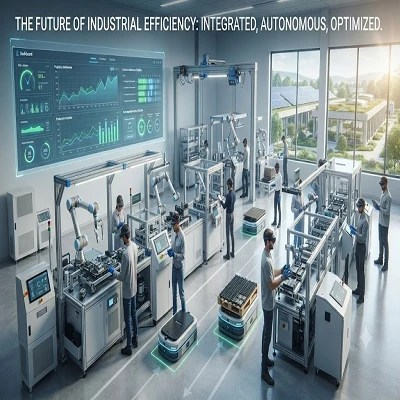
The true power of modern industrial growth does not come from a single piece of hardware or a specific software update. Instead, the catalyst for the current revolution is the high-level integration of different technologies working in concert. When tools are used in isolation, their impact is limited by the manual gaps and "siloed" workflows between them. The true breakthrough occurs when Robotics, Advanced Sensors, and Computer Numerical Control (CNC) are combined into a single, cohesive ecosystem. This integrated toolkit replaces the inherent inconsistency of physical labor with a model of synchronised, programmable execution that can run continuously and without deviation. To understand the impact of this toolkit from a systems architecture perspective, we must evaluate the specific roles and interdependencies of its core components:
- Robotics: This is the physical arm of the operation. Robotics provides the strength, endurance, and repetitive consistency that human labor can’t match. In an integrated system, robotics handles the movement and manipulation of materials with a level of speed and durability that ensures the production line never tires.
- Advanced Sensors: If robotics represents the muscles, sensors represent the nervous system. These components provide the high-frequency data streams necessary for the system to understand its environment. Sensors monitor every variable of the production process—from temperature and pressure to spatial positioning—feeding information back into the control systems in millisecond loops.
- Computer Numerical Control (CNC): CNC acts as the brain of the operation. It is the programmable logic that translates digital designs into physical kinematics. As a systems architect would observe, the CNC interprets the sensor data to make real-time adjustments to the robotics. For example, if a sensor detects a microscopic misalignment, the CNC instantly recalibrates the robotic end-effector's path to maintain perfect execution. The convergence of these three technologies renders traditional manufacturing methods obsolete. In a legacy environment, there is a constant need for manual checks and downtime for retooling. An integrated toolkit eliminates these friction points. By creating a system where the "brain," "nerves," and "muscles" are digitally linked, manufacturers achieve a level of coordination that manual systems can never replicate. This transition to a high-tech toolkit manifests as a set of core operational advantages that redefine the standard of manufacturing performance.
Pillar I: Precision and the Elimination of Human Error
In the modern competitive environment, quality is no longer a feature used to distinguish a premium product; it is a non-negotiable requirement for market entry. As customers and industrial partners demand tighter tolerances and higher reliability, the margin for error has shrunk to near zero. Strategic success now depends on a manufacturer's ability to deliver perfect results every time. This demand for perfection makes the displacement of organic inconsistency a top strategic priority for any organisation looking to maintain its market position. The primary challenge of legacy production is the inherent fluctuation of human-centric workflows. Regardless of skill, human intervention is prone to fatigue, distraction, and subjective judgment. Even the most expert worker will experience a dip in performance over a long shift. Automation machinery addresses this vulnerability by replacing human variability with "algorithmic precision." The synergy between advanced sensors and algorithmic control creates a "closed-loop system." In this environment, sensors provide constant, real-time feedback to the control unit. If a minute deviation is detected, the system corrects itself instantly. This creates a safeguard against error that functions at a level of "surgical accuracy" that no person could ever achieve.
The strategic impact of this shift is profound. By moving away from human-dependent processes, a manufacturer transforms quality from a "managed variable" something that must be constantly checked and corrected by supervisors, into a "mathematical certainty." When the production process is built on programmable logic and real-time sensor data, quality is inherently baked into every movement of the machine. This ensures that every unit produced is a perfect replication of the original specification, regardless of whether it is the first unit of the day or the ten-thousandth. In high-performance manufacturing, this certainty is a game-changer, reducing waste and ensuring that the brand’s reputation for reliability remains unshakeable. This built-in quality through precision is the foundation upon which the broader goals of maximising output and uptime are built.
Pillar II: Operational Efficiency and Revenue Expansion
For any capital-intensive business, efficiency is the ultimate operational imperative. When a company invests millions of dollars into production facilities and equipment, the primary driver of financial success is the utilisation rate of those assets. Every minute that a machine is not running, or is running at sub-optimal speeds, represents a direct loss of potential value. Therefore, the strategic focus of modern manufacturing is to transform the factory floor into a high-performance engine of value creation by maximising output and purging operational downtime. Automated production lines are specifically engineered to achieve this state of maximum utilisation. Unlike manual lines, which are subject to shift changes, breaks, and human limitations, automated systems are designed to operate continuously. The economic logic is clear: in high-output environments, even a 1% increase in uptime can lead to exponential revenue gains. This occurs because, in a capital-intensive setup, fixed costs are high and constant. Once those fixed costs are covered by the initial volume of production, every additional percentage of uptime contributes almost entirely to margin expansion. By ensuring that capital assets are utilised at their theoretical maximum, automation machinery transforms the factory floor into a high-performance engine of value creation.
The economic impact of this efficiency is a fundamental shift in the cost structure of the business. Traditional manufacturing is often burdened by high fixed labor costs that do not scale. When production needs to increase, more workers must be hired, trained, and managed, increasing the overhead and complexity. Automation machinery manufacturing flips this model by creating a system of "scalable variable output." Once the automated system is in place, the cost of producing additional units is significantly lower than in a manual environment. This allows a business to scale its production volume up or down based on demand without the financial drag of an inflexible workforce. The resulting operating leverage allows for steady, predictable, and highly profitable growth. This steady state of efficient production provides the financial stability necessary to pursue flexibility in a volatile market.
Pillar III: Strategic Scalability and Market Agility
In today's global economy, volatility is the only constant. Market demands can shift overnight due to changing consumer preferences or technological breakthroughs. For a manufacturer, the ability to pivot in response to these changes is a strategic necessity. Companies locked into rigid, human-centric workflows often face "debilitating lag" when they try to adapt. Retraining a large workforce or manually retooling a factory can take weeks or even months, during which time competitors may have already captured the new market opportunity. Strategic scalability is the solution to this problem. Scalability, in this context, refers to the ability of a manufacturer to adapt its output volume or product mix with minimal friction. This is achieved through the flexible automated systems designed by the machinery manufacturing sector. Because these systems are driven by programmable CNC logic and versatile robotics, changing a production line to manufacture a different product is often as simple as updating a software file and making minor mechanical adjustments. This allows organisations to capitalise on new opportunities in real-time.
This agility acts as a critical hedge against market volatility, ensuring that the manufacturer remains productive even when the external environment is in flux. Furthermore, this scalability enhances a company's competitive positioning. A manufacturer with a flexible, automated footprint can dominate emerging niches before larger, more cumbersome competitors can even react. By maintaining a lean and responsive operation, the business can experiment with new products or enter new markets with lower risk. If a new product takes off, the system can scale production almost instantly to meet the demand. If market tastes change, the system can pivot back. This level of agility transforms the manufacturer from a reactive player into a proactive market leader. These abilities lead directly to the specific, actionable takeaways that stakeholders must consider when planning their own modernisation efforts.
The Modernisation Roadmap: Strategic Take-Home Pointers
Transitioning from a legacy manufacturing model to a modernised, autonomous one is a complex undertaking that requires a fundamental shift in management logic. For stakeholders, distilling these technological shifts into actionable strategic pointers is essential. The following four points represent the core logic of the modernisation roadmap.
Risk Management through Algorithmic Certainty
The first step in modernising production is recognising that human-centric bottlenecks are a significant business risk. In a manual environment, every step of the process is a potential point of failure due to organic inconsistency. By displacing manual intervention in favor of algorithmic precision, a company fundamentally changes its approach to risk management. When a process is controlled by a closed-loop system, the risk of a "bad batch" or a series of defective units is virtually eliminated. This certainty ensures that quality is maintained at scale, protecting the brand's reputation and minimising the costs associated with waste and rework. For stakeholders, this means that the "cost of quality" drops significantly, and the predictability of the output becomes a core asset of the business.
Operating Leverage and Profitability
The second pointer focuses on the direct correlation between machine uptime and profit margins. In an automated system, the goal is to keep the "engine" running at all times. Because these systems transform high fixed labor costs into scalable variable output, they create superior operating leverage. This means that as production volume increases, the cost per unit decreases at a much faster rate than in manual environments. For a management team, this shift allows for more aggressive financial planning. Production becomes steady and predictable, which in turn makes revenue and profit margins predictable. Maximising efficiency by eliminating downtime is a financial strategy designed to ensure the enterprise remains highly profitable across the entire business cycle.
Price Leadership and Market Responsiveness
Modernisation provides a dual economic advantage that creates a "pincer move" against competitors. First, by lowering labor overhead and increasing output volume, automation machinery allows a company to achieve price leadership. You can produce goods at a lower cost than your competitors while maintaining higher, more consistent quality. Second, the flexibility of these systems provides the responsiveness required to dominate emerging niches. While legacy firms are struggling with the lag of retooling, an automated firm can pivot its production to meet new demands instantly. This combination of being the lowest-cost provider and the fastest to market allows a manufacturer to capture market share in both stable and volatile sectors, effectively squeezing competitors out of the market.
The Integrated Toolkit as a Growth Engine
Finally, stakeholders must view the convergence of robotics, sensors, and CNC as the central engine of their growth, not just a series of isolated purchases. This integrated toolkit is what allows for the coordination and speed that define the leaders of the 21st-century industrial sector. To treat these tools as individual items is a strategic error; they must be viewed as a unified system that creates a competitive moat. The specialised sector of automation machinery manufacturing is responsible for designing these synergies, and the manufacturer who successfully implements them gains a self-reinforcing cycle of precision and growth. This integrated system is the primary driver of industrial transformation, rendering siloed, manual methods obsolete. These pointers serve as the bridge between current operational realities and the high-efficiency trajectory that defines the future of the industry.
Conclusion:
The Indisputable Cornerstone of the 21st Century
The trajectory of global manufacturing is clear and irreversible. We are moving toward a future defined by the powerful convergence of robotics, sensors, and computer numerical control. These technologies do not operate in a vacuum; they create a self-reinforcing cycle of precision and growth. As sensors provide better data, algorithms become more precise; as robotics becomes more capable, the scale of production increases. This cycle enables manufacturers to shatter the historical limitations of manual production, reaching scales of efficiency and levels of quality that were once considered impossible. As we look toward the future of the industry, the hallmark of a successful enterprise will be its capacity to minimise human intervention while maximising output. In this context, automation machinery manufacturing has moved from the periphery to the very centre of the strategic conversation. It is no longer a "support service" for the factory; it is the indisputable cornerstone of global industrial transformation. For any organisation, the failure to automate is no longer a passive delay it is an active choice to exit the market. These systems are the essential engine for competitive scalability, representing the only path toward long-term industrial dominance in a rapidly evolving world. Automation machinery manufacturing is the engine of the 21st century, and those who harness it will dictate the future of global production.

Amit Malviya is the Vice President, Quality Assurance at Zest Pharma and serves as a Technical Adviser at Emorphis Technologies, contributing to its Artificial Intelligence (AI)-powered quality compliance and pharmaceutical manufacturing automation division. He brings over two decades of experience in the pharmaceutical industry, with expertise spanning manufacturing operations, quality management systems, process improvement, and regulatory affairs.