


Beyond GLP-1: Emerging Biologic Therapies Reshaping Chronic Disease Care
Lakshmi, Editorial Team, Pharma Focus America
GLP-1 receptor agonists redrew the commercial map of chronic disease, but they are a preview rather than a peak. A second wave of pharmaceutical biologics — TL1A antibodies, engineered bispecifics, CD19-directed cell therapies and half-life-extended constructs — is moving treatment from indefinite suppression toward durable remission. This article examines what that shift demands of pharma portfolio strategy, evidence generation, payer negotiation and manufacturing, and where the risk concentrates.
The Class That Changed the Conversation — and the Question It Left Behind
For most of the last decade, the strategic argument inside pharmaceutical boardrooms about chronic disease was an argument about incrementalism. Franchises were defended with line extensions, device improvements and marginal tolerability gains. Then a peptide class built for glycaemic control turned into a cardiometabolic platform, absorbed indications in cardiovascular risk, liver disease and sleep-disordered breathing, and forced payers, employers and health systems to rebuild their budgets around a single mechanism.
That was the disruption. The question it left behind is more consequential for pharma leadership: if one mechanism can reorganise an entire category that quickly, which mechanism does it next — and is your organisation structured to recognise it eighteen months before your competitors do?
The honest answer is that the next reorganisation is unlikely to come from another appetite-regulating peptide. It is far more likely to come from the biologic modalities now maturing in immunology, cell therapy and protein engineering, where the ambition is not better control of a chronic disease but the possibility of ending it.
Why the Metabolic Boom Is a Preview, Not a Peak
The structural signal is visible in approval data. Biologics accounted for roughly a third of novel drug approvals from the FDA's drug centre in 2024, and industry forecasts widely cited across the pharmaceutical sector project that biologics and gene therapies together will represent more than sixty percent of new approvals by the end of the decade. The pipeline mix is not drifting toward biologics; it has already moved.
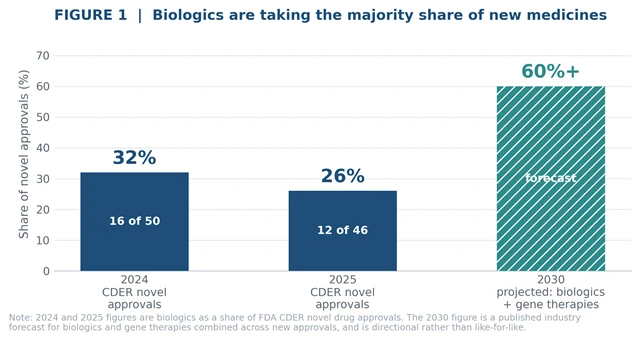
Figure 1: Biologics as a share of new medicines, with the 2030 forecast shown for direction rather than like-for-like comparison.
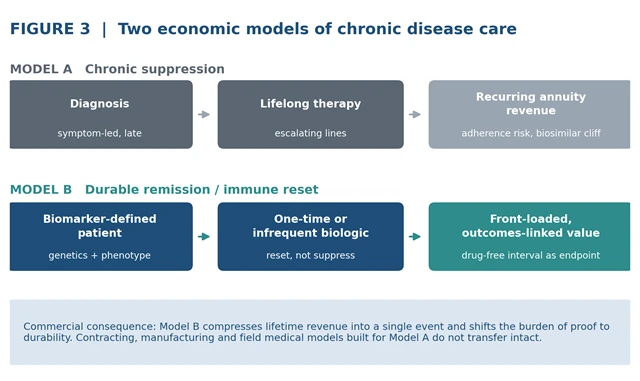
What makes this wave different from the monoclonal antibody boom of the 2000s is intent. The first generation of biologics in chronic disease was designed to suppress a pathway indefinitely. The current generation is being designed around three harder objectives: reach patients earlier through biomarker selection, hold the pathway with far less frequent dosing, and in the most ambitious programmes, reset the underlying immune abnormality rather than manage its output.
The Immune Reset: When One Infusion Replaces a Lifetime of Suppression
The most disruptive development in chronic disease biologics did not originate in chronic disease at all. CD19-directed chimeric antigen receptor T-cell therapy, built for B-cell malignancies, has been redirected at autoantibody-driven autoimmune conditions — systemic lupus erythematosus, inflammatory myopathies and systemic sclerosis among them — with early clinical experience reporting deep remission in patients who had already failed multiple targeted biologics.
Data presented at major rheumatology meetings during 2026 sharpened the picture in both directions. Investigators reported high rates of drug-free clinical remission alongside encouraging safety, with no severe cytokine release or neurotoxicity events in some dose cohorts. They also reported what the field needed to hear: relapse happens, and cell persistence is often measured in months rather than years. The therapeutic hypothesis is no longer whether an immune reset is possible, but how durable it is and in whom.
Behind the autologous programmes sit allogeneic constructs and natural killer cell platforms designed to remove the apheresis-to-infusion bottleneck. For pharmaceutical executives, that is the line where a scientific story becomes an operating model question. An autologous therapy in a disease affecting hundreds of thousands of Americans is a manufacturing problem disguised as a clinical breakthrough.
An autologous therapy in a disease affecting hundreds of thousands of Americans is a manufacturing problem disguised as a clinical breakthrough.
Breaking the Efficacy Ceiling: The Cytokine Engineering Race
In inflammatory bowel disease, the strategic obsession is the response ceiling that even the best-performing biologics have failed to break. Antibodies targeting TL1A, a tumour necrosis factor superfamily member with strong genetic association to IBD, have advanced to Phase 3 in both ulcerative colitis and Crohn's disease, and several developers are pursuing enrolment enriched by genetic risk signatures rather than broad symptomatic populations.
That design choice is a commercial choice. Enriching a Phase 3 population by biomarker is an explicit bet that payers will reimburse more readily for a therapy that arrives with a companion argument about who responds. It also concedes something important: in a crowded pharmaceutical market, average efficacy is no longer a differentiator.
The next iteration is bispecific. Constructs pairing TL1A blockade with IL-23 inhibition are entering first-in-human studies, offering dual pathway coverage inside a single molecule — and, just as importantly, inside a single formulary line rather than two. The engineering is not trivial. Earlier TL1A-directed bispecifics generated anti-drug antibodies in every subject dosed in Phase 1 work, most of which neutralised target engagement. Immunogenicity, not mechanism, is the discipline that will separate winners here.
Quality of Weight, Not Quantity: The Body Composition Correction
Even within cardiometabolic disease, the competitive question has moved. With multiple agents now delivering weight reduction that approaches surgical benchmarks, the differentiating claim is shifting from how much weight patients lose to what kind of tissue they lose. Bifunctional fusion proteins combining receptor agonism and antagonism, selective amylin receptor agonists, and biologics acting on the activin and myostatin pathways are all being positioned around lean mass preservation and visceral or hepatic fat reduction.
Early human data has, for the first time, demonstrated therapeutic engagement of a genetically validated pathway regulating adipose fat storage. For pharma strategy teams, this matters less as science than as segmentation: body composition is becoming a distinct clinical claim, and claims create markets.
The Half-Life Arms Race
The quietest competitive front is protein engineering for persistence. Candidates now in development are being designed for human half-lives measured in months, formulated for high-concentration, low-viscosity subcutaneous delivery. A therapy that moves a chronic patient from weekly injection to quarterly administration changes adherence economics, site-of-care mix, cold chain load and payer total-cost modelling before a single efficacy comparison is made.
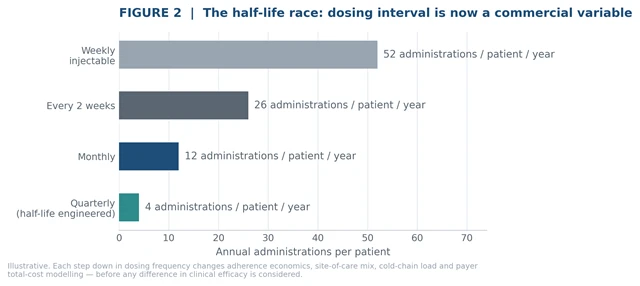
Figure 2: Dosing interval is a commercial variable, not merely a convenience feature.
Case Study: How a Mid-Cap Immunology Developer Reset Its Chronic Disease Franchise
The following composite case study is drawn from patterns observed across several mid-cap pharmaceutical developers in immunology. Details have been anonymised and no individual organisation is described.
The situation: A mid-cap developer held a maturing anti-inflammatory biologic facing biosimilar entry within four years. Its Phase 2 asset in a related inflammatory indication had produced a respectable but unremarkable remission rate against placebo in an all-comers population. The default path was a large, conventional Phase 3 and a price-driven launch into a category with six established competitors.
The decision: A retrospective analysis of the Phase 2 dataset showed a materially higher remission rate in the subset of patients carrying a defined genetic risk signature. Leadership faced a familiar trade-off: enrich the Phase 3 population and shrink the addressable market, or run broad and compete on price. The medical affairs organisation supplied the argument that broke the tie. Field insights gathered from gastroenterology and rheumatology specialists indicated that prescribers were already sequencing biologics informally and would welcome a therapy that arrived with a selection rationale. Payer advisors, consulted separately, indicated that a narrower, evidence-anchored population would face materially less utilisation management.
The execution: The company enrolled a biomarker-enriched Phase 3, built the diagnostic pathway in parallel rather than after approval, and rebuilt its field medical model around molecular pathology and testing infrastructure rather than product messaging. It also renegotiated its manufacturing arrangements toward smaller, more frequent batches to match a narrower launch volume.
The outcome: The programme launched into roughly forty percent of the population its broad-label competitors addressed, at a premium, with faster formulary placement and a substantially lower field footprint. Two lessons transfer. First, the biomarker decision was a commercial and manufacturing decision made under a clinical heading. Second, the insight that unlocked it came from the field, not from the clinical development plan — which is an argument for how a pharmaceutical organisation is wired, not for what is in its pipeline.
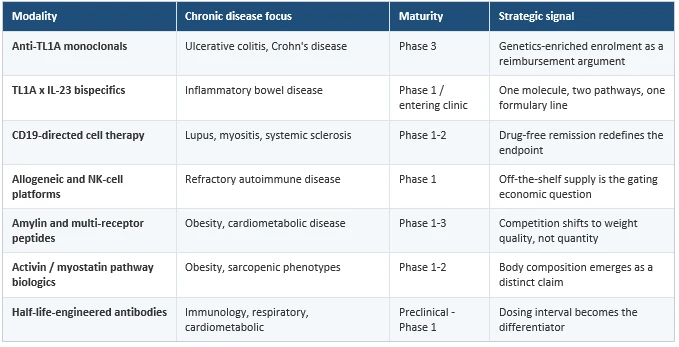
The Emerging Biologic Landscape at a Glance
The C-Suite Calculus: Four Decisions That Will Not Wait
Rebuild the value model before the asset arrives: A therapy priced on durable remission cannot be contracted like a therapy priced on chronic suppression. Outcomes-based agreements, annuity payment structures and warranty provisions require actuarial and legal capability that most pharmaceutical commercial organisations have not yet built.
Treat manufacturing as portfolio strategy: Cell therapy at chronic disease scale, high-concentration subcutaneous formulation and multi-specific construct production are not interchangeable capabilities. Capital allocation decisions taken in 2026 will constrain which modalities a company can credibly pursue in 2032.
Fund the diagnostic, not only the drug: Biomarker-enriched development shifts a meaningful share of launch risk onto testing infrastructure a pharmaceutical company does not control. Companies that treat companion diagnostics as a post-approval workstream will be outpaced by those that treat it as a co-development programme.
Reorganise evidence generation around durability: Regulators may accept remission at twelve months. Payers will ask about year five. Registries, long-term follow-up commitments and real-world evidence infrastructure need to be commissioned during Phase 2, not negotiated after a complete response letter.
Conclusion:
The Chronic Disease Franchise of 2035 Is Being Designed Right Now
The GLP-1 era taught the pharmaceutical industry an expensive lesson about the speed at which a chronic disease category can be rewritten. The biologics arriving behind that class are aimed at a more fundamental target: not the daily management of chronic illness, but its interruption. Anti-TL1A antibodies and engineered bispecifics are pursuing an efficacy ceiling that has held for two decades. Cell therapies are pursuing drug-free remission in diseases that have never had it. Protein engineering is quietly converting dosing interval into a competitive weapon.
None of these is a certainty. Immunogenicity, manufacturing economics, durability and access will each eliminate credible programmes over the next five years. But the direction is not in question, and the strategic risk for pharmaceutical leadership is not backing the wrong mechanism. It is running a 2015 operating model — broad populations, annuity pricing, suppression-based endpoints, product-led field teams — against a portfolio that no longer fits it.
The organisations that lead the next decade of chronic disease care will not simply be the ones holding the best molecules. They will be the ones that rebuilt their evidence, access and manufacturing architecture early enough to carry them.

Lakshmi is a science writer with a foundation in the laboratory. She earned her master's in biotechnology and trained through research internships at ICGEB (JNU) and DIPAS, DRDO, with her work appearing in the Egyptian Journal of Veterinary Sciences. Now APCRM-certified and part of the editorial team at Pharma Focus America and Pharma Focus Europe, she reports on pharmaceutical technology, research, and innovation — giving complex science a clear and confident voice for industry leaders.