Beyond Patent Expiry: The Next Decade of Biosimilars Will Be Won Through Commercial Excellence
Avishek Basu, Account Manager, Indegene
As biosimilar markets mature beyond price-led competition, future success will increasingly depend on physician confidence, real-world evidence, patient support and digital engagement contributing to a differentiated commercialisation strategy. This article explores how manufacturers can create sustainable competitive advantage by shifting focus from biosimilarity alone to delivering measurable value across the provider-patient
Introduction
The global biosimilar industry has reached an important inflexion point. During the first wave of biosimilar development, competitive advantage was largely defined by the ability to demonstrate analytical similarity, obtain regulatory approval and offer meaningful cost savings compared with reference biologics. A 30% to 50% price reduction was the sole metric of success. That era is over. Today, the competitive landscape is quite different. Multiple biosimilars often compete within the same therapeutic class, regulatory pathways have become more established, and healthcare providers have gained greater confidence in biosimilar adoption. In many mature markets, analytical similarity has now become a minimum requirement for market participation.
The patent cliff between 2024 and 2032 is unprecedented, unlocking competition for biologics with over $200 billion in global reference sales, including blockbuster franchises in immunology and oncology like Stelara, Keytruda, and Eylea. Consequently, the next phase of biosimilar success will depend less on proving similarity and more on demonstrating value.
Commercial excellence is emerging as the principal differentiator through physician engagement, real-world evidence generation, patient-centric support programmes, digital health capabilities and lifecycle management strategies. Organisations that can successfully integrate these capabilities into their commercial model are likely to create sustainable competitive advantage beyond pricing alone.
A New Competitive Landscape
The biosimilar market has matured considerably over the past decade. During the turn of the century, the commercial model was a pale imitation of the generic small-molecule playbook, constructed on the assumption that interchangeable, cheaper versions would be adopted automatically. While pricing remains important to this day, particularly in tender-driven healthcare systems, it is becoming increasingly difficult to sustain competitive advantage through discounts alone. Originator companies have deployed complex defense strategies, not merely through contracting and rebate walls, but through deep, years-long investment in prescriber comfort and patient services.
Furthermore, treatment decisions are influenced by a broader group of stakeholders than ever before. Physicians evaluate clinical confidence and switching evidence. Hospital administrators focus on procurement efficiency and long-term supply reliability. Patients expect convenient administration devices, educational resources and continuous support throughout therapy. Regulators and payers increasingly emphasise pharmacovigilance, post-marketing evidence and health-economic outcomes.
These converging expectations require a broader strategic perspective - from a "cost-play" to a "value-play".
Table: Evolution of Competitive Advantage in Biosimilars
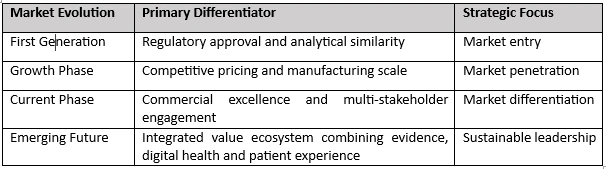
Take the burgeoning oncology biosimilar market, particularly for trastuzumab and rituximab, as a case study in this maturation. Early entrants attempted to compete on price alone and found themselves locked out by bundled purchasing arrangements. Later winners approached the market with a "therapeutic area solution," offering not just a vial but a suite of services including chemo-compounding compatibility studies, on-body injector devices for subcutaneous formulations, and nurse-training modules that reduced preparation time by 20%.
The Five Pillars of Commercial Excellence
As biosimilars transition from emerging alternatives to established therapeutic options, commercial success increasingly depends on creating value for every stakeholder within the healthcare ecosystem.
These five interconnected pillars represent the next frontier of competitive differentiation.
1. Physician Confidence: Building Trust Beyond Clinical Comparability
Physicians remain the principal decision-makers in biosimilar adoption, particularly for complex biologics used in chronic and specialty care. While comparative analytical and clinical studies establish biosimilarity, prescribing confidence often extends beyond regulatory approval.
Several factors influence physician acceptance, such as 1) familiarity with the molecule, 2) confidence in manufacturing quality, 3) post-marketing safety data, switching evidence and 4) peer experience. This is particularly relevant in therapeutic areas such as oncology, rheumatology and inflammatory diseases, where treatment continuity and patient outcomes remain paramount.
Consequently, medical engagement strategies are evolving from traditional promotional activities towards evidence-driven scientific exchange. Structured educational programmes, advisory boards, continuing medical education initiatives and publication of real-world outcomes help strengthen physician confidence while promoting informed decision-making.
2. Real-World Evidence: Extending Value Beyond Registration Trials
Randomised clinical trials remain the foundation of regulatory approval. However, they are conducted under carefully controlled conditions and may not fully represent routine clinical practice. Healthcare providers, payers and policy makers increasingly rely on real-world evidence (RWE) to understand long-term safety, effectiveness, treatment persistence and healthcare utilisation across diverse patient populations.
For biosimilar manufacturers, investment in observational studies, patient registries, pharmacovigilance programmes and health-economic analyses provides opportunities to demonstrate value beyond initial approval. Robust real-world datasets can support physician confidence, inform reimbursement decisions and strengthen discussions with healthcare authorities.
The gold standard is the "switch study," which provides the clinical confidence that moving a patient from originator to biosimilar, or between biosimilars, does not compromise outcomes. The Norwegian NOR-SWITCH trial and its extensions fundamentally changed the biosimilar conversation in immunology by providing randomised data that switching was non-inferior.
3. Patient-Centric Support: From Product Supply to Treatment Success
Successful biosimilar adoption extends beyond product availability. Long-term treatment outcomes depend heavily on patient understanding, adherence and persistence.
Patients receiving biologic therapies frequently require education on self-administration, injection techniques, adverse event management and long-term disease monitoring. Financial assistance programmes, nurse educator support, helplines and digital reminders can reduce treatment discontinuation while improving patient confidence.
Increasingly, manufacturers are recognising that patient support programmes are not merely commercial initiatives but important components of holistic healthcare delivery. Well-designed support ecosystems improve treatment experience while generating valuable insights into patient needs and adherence behaviour.
4. Digital Engagement: Creating Connected Healthcare Ecosystems
Digital transformation is reshaping almost every aspect of pharmaceutical commercialisation, and biosimilars are no exception.
Healthcare professionals increasingly expect personalised scientific engagement delivered through integrated omnichannel platforms. At the same time, patients are becoming more comfortable using digital tools to monitor symptoms, receive treatment reminders and access educational resources.
Artificial intelligence, predictive analytics and connected health platforms offer opportunities to improve patient engagement, strengthen pharmacovigilance and generate real-world evidence more efficiently. Digital technologies can also facilitate communication between manufacturers, healthcare providers and patients, creating a more connected treatment ecosystem.
5. Lifecycle Management: Sustaining Value Beyond Product Launch
Historically, commercial focus has often centred on achieving a successful product launch and market access. However, as biosimilar portfolios expand and competition increases, lifecycle management has become equally important.
Strategic lifecycle planning includes 1) indication expansion, 2) formulation improvements, 3) delivery device innovation, 4) manufacturing optimisation and 5) evidence generation throughout the product's commercial life. Continuous investment in stakeholder education and market development further supports long-term brand sustainability.
Device innovation provides one example of this evolution. Specialty physicians like rheumatologists and endocrinologists value the ergonomics, click-confirmation, and hidden-needle features of premium autoinjectors. User-friendly autoinjectors, prefilled syringes and improved administration systems can enhance patient experience while differentiating products that otherwise demonstrate comparable clinical performance.
The Commercial Excellence Framework
Sustainable Market Leadership
▲
│
Lifecycle Management
│
Digital Engagement
│
Patient Support Programmes
│
Real-World Evidence
│
Physician Confidence
│
────────────────────────────────────────────
Bio-Similarity (Foundation)
Learning from Mature Biosimilar Markets
As biosimilars enter a more competitive era, valuable lessons can be drawn from markets where adoption has progressed beyond the initial phase of regulatory acceptance. While healthcare systems differ in funding models and procurement practices, several common themes have emerged that demonstrate how commercial excellence can accelerate sustainable biosimilar adoption.
Europe: Trust Built Through Evidence and Policy
European Union nations remains the most mature biosimilars market globally, supported by a well-established regulatory framework and over fifteen years of real-world clinical experience. Rather than relying solely on price incentives, several European healthcare systems have combined evidence-based prescribing guidance, physician education and transparent switching policies to increase confidence among healthcare professionals. The European best practice that has thus emerged is a move away from purely price-based tenders toward criteria-based procurement that values supply resilience and service offerings.
Scandic countries like Norway and Denmark have demonstrated that well-designed national switching programmes, supported by robust clinical evidence and stakeholder engagement, can achieve high biosimilar uptake while maintaining physician and patient confidence. They have also shown that rotating supply contracts between multiple qualified manufacturers sustains a competitive, healthy market over the long term. The commercial lesson for a global manufacturer is clear: in any market trending toward a tender model, the pre-tender investment in relationship equity, RWE generation, and a sterling supply reputation is the only insurance against a purely transactional future.
The United States: Commercial Differentiation in a Competitive Market
The United States presents a different set of commercial dynamics. Despite a growing number of approved biosimilars, market penetration has often depended on factors extending well beyond regulatory approval. For years, a thicket of originator patent exclusivities, rebate traps, and regulatory hurdles stifled biosimilar uptake. The inflexion point was the introduction of interchangeable designations and the disruptive market-shaping strategies of players like Amgen.
Manufacturers increasingly compete through contracting strategies, provider education, reimbursement support, patient services and commercial partnerships. Interchangeability designations, payer formulary decisions and health-system contracting all influence market success, creating a complex competitive environment where scientific comparability alone is insufficient.
The key US-derived best practice is "the art of the PBM (Pharmacy Benefit Manager) deal." In a system where formulary access dictates commercial success, the ability to craft a value proposition that aligns with a PBM’s rebate economics while also addressing employer-plan demand for cost certainty is crucial. The biosimilar adalimumab market in 2023 and 2024 broke the myth that originator rebate walls were unbreachable. This was achieved not just by low list prices, but by offering a dual- or triple-branded strategy across different PBM formularies, effectively partnering with payers to segment the market.
The Next Decade of Biosimilars: Four Predictions for Industry Leaders
Looking forward to the next decade, I predict a fundamental reshaping of the biosimilar competitive landscape, culminating in the emergence of what we call the "branded biosimilar" as opposed to the generic" mindset applied to biologics. As more interchangeable and next-wave biosimilars for complex monoclonal antibodies and eventually fusion proteins and ADCs (antibody-drug conjugates) come to market, the success factors will shift even further.
Prediction 1: Commercial Excellence Will Become the Primary Competitive Advantage
As more biosimilars enter established therapeutic categories, price competition alone will become increasingly unsustainable. Companies that combine scientific credibility with strong physician engagement, medical education, patient support and digital capabilities will establish more durable market positions than organisations relying primarily on commercial discounts.
Commercial excellence will no longer be viewed as a post-launch activity but as a strategic capability developed throughout the product lifecycle.
Prediction 2: Real-World Evidence Will Carry Greater Strategic Weight
Regulatory approval will remain the prerequisite for market entry, but post-marketing evidence will increasingly influence physician confidence, payer decisions and treatment guidelines.
Manufacturers investing in longitudinal registries, comparative effectiveness studies and health-economic outcomes research will be better positioned to demonstrate value throughout the product lifecycle.
Prediction 3: Digital Health Will Become an Integral Component of Biosimilar Strategy
Digital technologies will increasingly support patient adherence, pharmacovigilance, remote monitoring and omnichannel scientific engagement.
Artificial intelligence, predictive analytics and connected health platforms will enable manufacturers to generate actionable insights while delivering more personalised experiences for healthcare professionals and patients.
Prediction 4: Value-Based Partnerships Will Replace Transactional Relationships
Healthcare systems are under increasing pressure to improve patient outcomes while managing finite resources. As a result, manufacturers will increasingly collaborate with providers, payers and healthcare organisations through integrated value-based initiatives rather than traditional product-focused interactions.
Success will depend upon demonstrating measurable improvements in clinical outcomes, treatment persistence and healthcare efficiency rather than competing solely on acquisition price.

Avishek is a pharmaceutical professional with over 12 years of experience in marketing and project management across biosimilars & biologics therapies. Having worked with global and Indian pharmaceutical organisations, he focuses on commercialisation strategy, lifecycle management and digital transformation projects within the life sciences industry.