

Beyond the Chiral Blind Spot: Agentic AI and the Future of Stereochemistry-Aware Drug Discovery
Sivakumar Thanikachalam, PhD, Independent Researcher, Former Senior Formulation Scientist, Nemaura Medical Inc.,
Valliappan Kannappan, PhD, Founder, Chiralpedia
Artificial intelligence is transforming drug discovery, yet stereochemistry remains a major blind spot. This article explores how Agentic AI could integrate stereochemical reasoning across molecular design, asymmetric synthesis, chiral analysis, ADMET assessment and regulatory intelligence. It proposes Stereochemistry-Aware Agentic Intelligence (SAI) as a future direction for autonomous, collaborative and human-centred chiral drug discovery.
Introduction
Artificial intelligence (AI) is rapidly changing pharmaceutical research. From target identification and literature analysis to molecular design and biological prediction, AI is becoming an increasingly important research partner. Generative AI has accelerated molecular ideation and expanded the chemical space scientists can explore.
Yet one fundamental challenge remains: chirality. Two molecules can share the same molecular formula and connectivity but differ in three-dimensional arrangement. In biological systems, that difference can be decisive. One stereoisomer may provide the desired therapeutic effect, while another may behave differently in potency, pharmacokinetics, or safety. The next evolution of pharmaceutical AI may therefore not simply be more powerful AI, but AI that understands chirality.
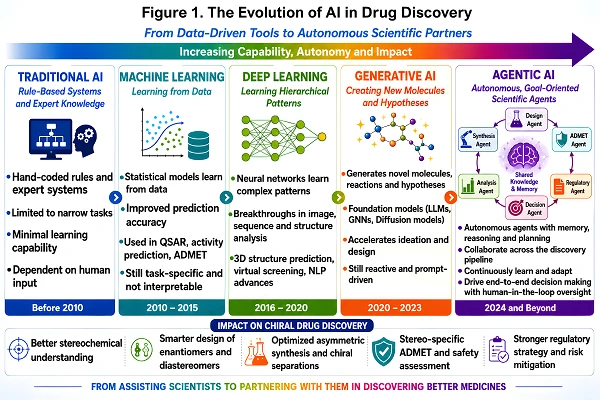
Figure 1 illustrates the progression from traditional AI and machine learning to Generative AI and Agentic AI, highlighting the increasing autonomy and potential relevance to stereochemistry-aware drug discovery.
Why Chirality Remains AI's Greatest Challenge
Chirality is fundamentally a three-dimensional problem. Receptors, enzymes, and transporters are themselves chiral and can distinguish between stereoisomers. Consequently, stereochemistry can influence efficacy, selectivity, metabolism, and toxicity.
Many AI workflows have traditionally relied on molecular graphs, SMILES, and related representations that may not fully capture complex three-dimensional stereochemical relationships. Modern three-dimensional models are improving this capability, but the challenge extends beyond identifying chiral centres. A useful pharmaceutical AI system must connect stereochemistry with molecular conformation, stereoselective interactions, asymmetric synthesis, chiral separation, and stereo-specific ADMET.
The problem is also fragmentation. One model may generate a molecule, another predict activity, another plan synthesis, and another evaluate ADMET. If stereochemical information is not preserved between these systems, an important part of the molecule's identity can effectively disappear as the candidate moves through the pipeline. This is the chiral blind spot: AI may understand a molecule as chemical data while still struggling to understand it as a three-dimensional pharmaceutical entity.
From Generative AI to Agentic AI
Generative AI has changed how scientists interact with computational tools. It can generate molecular structures, summarise scientific information, propose hypotheses and support prediction and optimisation. But Generative AI is generally reactive: a scientist asks a question and the model responds.
Drug discovery is different. It is iterative, with one decision influencing the next. A promising molecule must also be synthesizable, analytically measurable, biologically active, developable and compatible with regulatory expectations.
Agentic AI offers a new direction. Agentic systems can use goal-oriented agents that plan tasks, employ specialised tools, exchange information, evaluate results and adapt strategies. Instead of one model performing one task, multiple agents can collaborate around a shared scientific objective. For chiral drug discovery, this could mean moving from AI that predicts to AI that coordinates scientific reasoning.
Agentic AI Across the Chiral Drug Discovery Pipeline
Imagine a digital research team in which each AI agent has a specialised role. A target agent could identify opportunities where stereochemistry may influence therapeutic performance. A molecular design agent could generate and compare stereoisomers while considering potency, selectivity and developability. A synthetic planning agent could propose asymmetric routes and identify stereochemical risks.
A chiral analytical agent could recommend separation strategies and optimise chromatographic conditions. An ADMET agent could compare stereoisomers for metabolism, pharmacokinetics and toxicity. A regulatory intelligence agent could monitor relevant guidance and precedents.
The real value would come from their collaboration. Information from molecular design could influence synthesis; analytical results could feed back into optimisation; ADMET findings could change candidate prioritisation; and regulatory considerations could be incorporated earlier. The objective is not to replace scientists, but to create an intelligent layer that connects expertise, data and decisions.
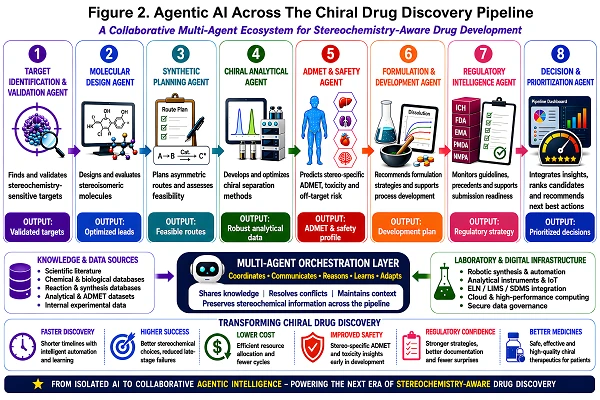
Figure 2 illustrates a conceptual multi-agent ecosystem in which specialised AI agents collaborate across the chiral drug discovery workflow.
Opportunities for the Pharmaceutical Industry
For pharmaceutical organisations, the attraction of Agentic AI is practical. It could accelerate lead optimisation by evaluating stereoisomeric possibilities earlier and integrating chemistry, biology, synthesis and ADMET information. It could strengthen knowledge management by connecting publications, patents, laboratory records and analytical reports. It could also support adaptive laboratory workflows as automated synthesis and analytical platforms become more capable.
For industry, the potential outcome is straightforward: fewer unnecessary experiments, faster decisions, better prioritisation and earlier identification of stereochemistry-related risks. Organisations that combine AI capabilities with strong scientific expertise and responsible governance may be better positioned to benefit from this transition.
Challenges and Future Outlook
The path to stereochemistry-aware Agentic AI is not without obstacles. High-quality, experimentally validated stereochemical data are essential, while inconsistent annotation can compromise AI performance. Explainability is equally important: scientists need to understand why an AI system recommends one stereoisomer over another.
Governance is another critical requirement. Autonomous systems need clearly defined boundaries, validation, cybersecurity, traceability and human oversight. Regulatory expectations for AI in pharmaceutical development will also continue to evolve.
The future is therefore unlikely to be AI versus scientists. It is more likely to be scientists working with increasingly capable AI collaborators.
Future Vision: Toward Stereochemistry-Aware Agentic Intelligence
The next frontier could be an AI ecosystem designed from the beginning to understand stereochemistry. We envision Stereochemistry-Aware Agentic Intelligence (SAI) as a conceptual direction in which autonomous AI agents preserve stereochemical information while collaborating across molecular design, synthesis, analysis, pharmacology and regulatory decision-making.
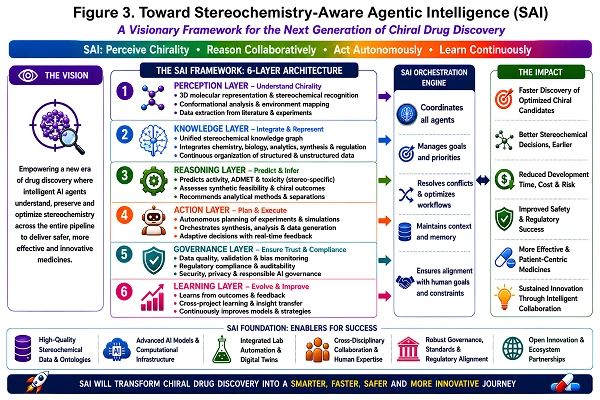
Figure 3 presents a conceptual vision of SAI, integrating stereochemical reasoning, collaborative agents, computational modelling, laboratory automation, explainability and human oversight.
SAI is not presented as a mature technology or established industry standard. Rather, it represents a forward-looking concept for how pharmaceutical AI might evolve. The ultimate transformation is from AI that understands molecules primarily as data to AI that can reason about molecules as three-dimensional, dynamic and stereochemically meaningful pharmaceutical entities.
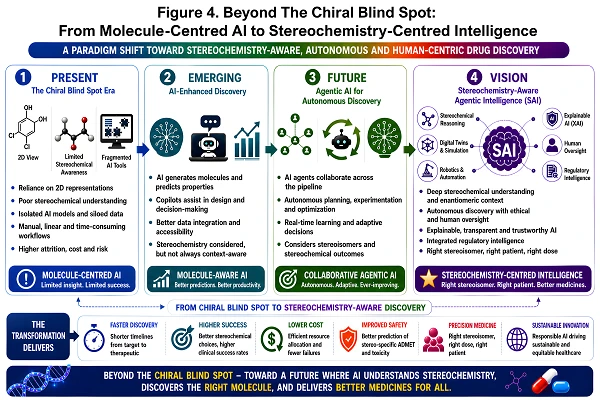
Figure 4 summarises the proposed paradigm shift from today's molecule-centred AI toward stereochemistry-centred, autonomous and human-centric drug discovery.
The pharmaceutical industry's AI journey is moving from prediction toward reasoning, collaboration and increasingly autonomous workflows. The next opportunity is to ensure that stereochemistry does not remain behind. Stereochemistry-aware Agentic AI could eventually connect molecular design, asymmetric synthesis, chiral analysis, stereo-specific ADMET and regulatory intelligence within a continuously learning ecosystem. Such systems would augment, not replace, medicinal chemists and other pharmaceutical scientists.
If successful, the result could be a new model of drug discovery in which AI asks not only “Which molecule works?” but also “Which stereoisomer, for which biological context, and with what evidence?” That shift—from molecule-centred AI to stereochemistry-centred intelligence—could help pharmaceutical research move beyond the chiral blind spot toward faster, safer and more precise medicines.
References:
- Jumper J, Evans R, Pritzel A, et al. Highly accurate protein structure prediction with AlphaFold. Nature. 2021;596:583–589.
- Senior AW, Evans R, Jumper J, et al. Improved protein structure prediction using potentials from deep learning. Nature. 2020;577:706–710.
- Vamathevan J, Clark D, Czodrowski P, et al. Applications of machine learning in drug discovery and development. Nat Rev Drug Discov. 2019;18:463–477.
- Zhavoronkov A, Vanhaelen Q, Oprea TI. Will artificial intelligence for drug discovery impact clinical pharmacology? Clin Pharmacol Ther. 2020;107:780–785.
- Walters WP, Murcko MA. Assessing the impact of generative AI on medicinal chemistry. Nat Biotechnol. 2020;38:143–145.
- Schneider G. Automating drug discovery. Nat Rev Drug Discov. 2018;17:97–113.
- Ekins S, Puhl AC, Zorn KM, et al. Exploiting machine learning for end-to-end drug discovery and development. Nat Mater. 2019;18:435–441.
- Brown N. Artificial intelligence in chemistry. Nat Rev Chem. 2021;5:451–452.
- International Council for Harmonisation (ICH). ICH Q6A: Specifications: test procedures and acceptance criteria for new drug substances and new drug products: chemical substances. Geneva: ICH; 2000.
- International Council for Harmonisation (ICH). ICH Q14: Analytical procedure development. Geneva: ICH; 2023.
- United States Food and Drug Administration. Development of New Stereoisomeric Drugs: FDA policy statement. Rockville: FDA; 1992.
- World Health Organization. Quality assurance of pharmaceuticals: a compendium of guidelines and related materials: volume 1: good practices and related regulatory guidance. 10th ed. Geneva: World Health Organization; 2024.
- Leach AG, Jones HD, Cosgrove DA, et al. Matched molecular pairs as a medicinal chemistry tool. J Med Chem. 2006;49:6672–6682.
- Gasteiger J, Engel T. Chemoinformatics: a textbook. Weinheim: Wiley-VCH; 2003.
- Todeschini R, Consonni V. Molecular descriptors for chemoinformatics. Weinheim: Wiley-VCH; 2009.
- Smith MB. March's advanced organic chemistry: reactions, mechanisms, and structure. 8th ed. Hoboken: Wiley; 2020.
- Chiralpedia. Chiral ToolBox. Chiralpedia; 2026 [cited 2026 Aug 15]. Available from: https://chiralpedia.com/chiral-toolbox.php
- Pharma Focus America. The chiral blind spot: why AI in drug discovery needs stereochemistry [Internet]. London: Ochre Media; 2024 [cited 2026 Aug 15]. Available from: pharmafocusamerica.com
- Pharma Focus Europe. Chiral biosensors: precision tools for safer drugs [Internet]. London: Ochre Media; 2023 [cited 2026 Aug 15]. Available from: pharmafocuseurope.com
- Boston Consulting Group. GenAI in life sciences: from autonomous workflows to agentic R&D pipelines [Internet]. Boston: Boston Consulting Group; 2024 [cited 2026 Aug 15]. Available from: bcg.com

Sivakumar Thanikachalam, Ph.D, is a pharmaceutical scientist with over 25 years of experience in formulation development, analytical sciences, transdermal drug delivery, and pharmaceutical R&D. He has held research and consulting positions in both academia and the pharmaceutical industry, including Nemaura Pharma Ltd., UK. His current research focuses on artificial intelligence in drug discovery and development, computational chemistry, chiral pharmaceutical analysis, and next-generation formulation technologies.

Valliappan Kannappan, PhD, is the Founder of Chiralpedia and a former Professor of Quality Assurance at Annamalai University, India. With over three decades of experience in medicinal chemistry, he has focused his work on chiral analysis and separation techniques to address real-world challenges in pharmaceuticals and biomedical research. In 2021, he launched Chiralpedia.com to promote accessible education and collaborative research in chiral science.