

Blockchain in Pharmaceutical Clinical Trials
Hamid Omidian, PhD, Professor of pharmaceutical sciences at Nova Southeastern University
Research underscores blockchain's potential in healthcare, enhancing clinical trial integrity, securing systems, and improving Electronic Health Records (EHR) and pharmaceutical supply chains. It highlights its data management and security capabilities, offering optimism for its transformative impact, though further evidence and implementation strategies are needed.
INTRODUCTION
Blockchain technology is increasingly recognized as a transformative force in healthcare, particularly in enhancing clinical trials and data integrity. Its applications range from automated smart contracts 1 improving research quality, to permissioned blockchain frameworks 2 3 4 ensuring robust data security. Innovations like BlockTrial 5 and Scrybe 6 utilize platforms such as Ethereum for tamper-resistant data management and compliance. The technology also extends to patient consent management 7, health information exchange 8, and virtual clinical trials 9, advocating for decentralized, patient-focused care.
In specialized sectors like opioid research 10 and neuro-oncology 11, blockchain's ability to ensure data integrity is critical. It is also transforming Electronic Health Record (EHR) systems 12 13 14 15 and public health data management 16. Within the pharmaceutical field, it is optimizing drug lifecycle management 17 18 19 20 and enabling precision medicine 21.
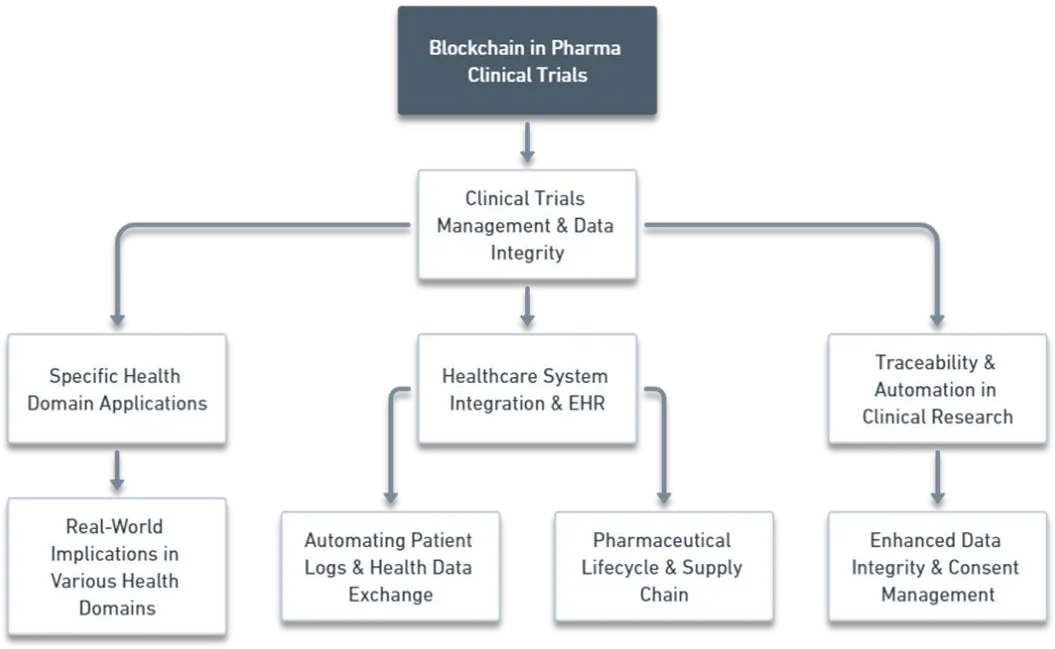
The following studies offer a comprehensive look into how blockchain technology is radically transforming the field of clinical trials, emphasizing its potential to enhance data integrity, security, transparency, and efficiency. Here's a coherent discussion of the mentioned studies:
Technical and Architectural Aspects of Blockchain in Clinical Trials:
- Enhancing Clinical Research 1: This study highlights blockchain's ability to enhance data integrity, sharing, and privacy in clinical trials. By utilizing a decentralized approach, the technology ensures traceability and prevents unauthorized reconstruction of data. Smart Contracts further automate and streamline the trials, promoting higher quality and efficiency in clinical research processes.
- Permissioned Blockchain Framework 2: Here, a permissioned blockchain framework is proposed to address data quality issues in multi-organizational clinical trials. The framework's use of private channels, smart contracts, and distributed ledgers provides a secure and efficient means of managing data, enforcing regulatory guidelines, and generating audit trails. This scalable solution addresses the complexities and costs associated with fragmented data in multi-site trials.
- Platform for Clinical Trial Services 3: Researchers introduced a permissioned blockchain-based platform that enhances data transparency and security in clinical trials. The platform's case study demonstrates its feasibility and efficiency, offering a promising solution to improve transparency and trust in clinical trials.
- Blockchain-Based Data Management System 4: This study focused on validating a blockchain-based data management system for breast cancer research trials. It showcased the system's resilience against data tampering and external disruptions, emphasizing the enhanced integrity and trustworthiness of clinical research facilitated by blockchain technology.
- BlockTrial System 5: The BlockTrial system utilizes Ethereum-based Smart Contracts to manage clinical trial data securely. This proof-of-concept system showcases how blockchain can safeguard data integrity, compliance, and empower patients, although it acknowledges the need for further development and policy creation.
- Safeguarding Clinical Trials Data 22: This study suggests using blockchain and smart contracts to safeguard clinical trial data, ensuring transparency, and resistance to manipulation. It proposes a technological solution to restore trust in clinical trials by addressing prevalent issues such as data manipulation and selective publication.
- Scrybe for Clinical Trial Data Provenance 6: Scrybe is a permissioned blockchain designed to store proof of clinical trial data provenance, enhancing data security and maintaining compliance with regulatory standards. It integrates with existing systems, offering a tamper-resistant audit trail and addressing the reliability of electronic records in trials involving advanced technologies like wearable IoT devices.
- Blockchain-Based Framework for Clinical Trials 23: This study developed a blockchain-based framework that emphasizes protocol compliance and data transparency. By using Ethereum smart contracts and IPFS for file storage, the framework maintains data integrity and transparency, showcasing effectiveness in promoting stakeholder transparency and protocol adherence.
- Running Clinical Trials in Untrustworthy Environments 24: The proposed blockchain-based system aims to ensure the immutability, traceability, and reliability of trial data, particularly in untrustworthy environments. It improves the management of trial data by offering a traceable audit trail, enhancing the reporting of adverse events, and contributing to more trustworthy clinical trials.
Implementation and Feature-Specific Blockchain Applications in Clinical Trials
The following studies focus on the practical application and specific features of blockchain technology in enhancing the management, efficiency, and integrity of clinical trials. Let's discuss each in detail:
- Dynamic Consent Management 7: SCoDES is introduced as a blockchain-based approach for managing dynamic consent in clinical trials. The private blockchain technology facilitates decentralized, trusted management of consent, addressing issues related to the granularity and changeability of consent over time. By integrating with external services and utilizing the Hyperledger framework, SCoDES offers a robust infrastructure that improves participant data management and consent procedures. This system provides a more nuanced and flexible approach to consent, which is crucial for participant trust and ethical standards in clinical trials.
- Improving Informed Consent Process 25: This study employs a Hyperledger Fabric-based blockchain system in a clinical trial to improve the informed consent process and enhance patient engagement. The system is credited with reducing monitoring time and costs while increasing patient trust and transparency. This pilot demonstrates the potential of blockchain to make trial management more patient-centric and efficient without sacrificing quality. The success of this application indicates that blockchain can significantly streamline and improve the informed consent process, a critical component of all clinical trials.
- Health Information Exchange and Monitoring 8: A private blockchain model was implemented for Health Information Exchange and clinical trials monitoring. Utilizing smart contracts, the system can emulate healthcare process scenarios, providing tailored access levels and ensuring data privacy. This proof-of-concept work addresses the challenges of consistent and secure monitoring in clinical trials across different regions. The decentralized validation and data integration functions of blockchain make it a suitable tool for overcoming geographical and logistical barriers in trial monitoring.
- Blockchain Framework for Virtual Clinical Trials 9: This study developed a blockchain framework specifically tailored for Virtual Clinical Trials (VCTs), which are becoming increasingly relevant in the modern healthcare landscape. The framework addresses common challenges in the recruitment, engagement, and monitoring of VCTs using smart contracts for automated and secure computational solutions. By providing security, a peer-to-peer design, and data transparency, the blockchain framework enhances the efficacy of healthcare applications. This application is particularly noteworthy for its relevance to VCTs, which require robust digital infrastructures to operate effectively.
Application and User-Centric Evaluation of Blockchain in Clinical Trials
The following studies explore the practical application and evaluation of blockchain technology from the user perspective in clinical trials, as well as its specific applications in certain health domains. Here's a detailed discussion of each:
- Blockchain-Enabled Clinical Trials Management 26: This study evaluates a blockchain-enabled tool for managing clinical trials, focusing on its usability and feasibility from the patient's perspective. Key aspects investigated include electronic consenting and participant engagement. Participants appreciated the transparency and data access the technology provided, which contributed to a positive experience and enhanced trust in blockchain's ability to improve clinical trial care quality. The study indicates that user-centric design and transparency are crucial for the successful adoption of blockchain in clinical trials.
- METORY: Blockchain-Based Dynamic Consent Platform 27: METORY is introduced as a blockchain- based dynamic consent platform, tailored for the specific needs of clinical trials. It integrates a private blockchain (Hyperledger Fabric) with an accessible web and mobile interface. Key features include identity and role-based access control, data encryption, and secure data transmission protocols. The platform's design ensures data integrity and security while maintaining high user acceptance, indicating a balance between technical security and user-friendliness in clinical trial settings.
- Blockchain in Outcomes Research on Opioids 10: This study assesses blockchain's potential applications in outcomes research related to opioids, examining its role across five key areas: clinical trials, data donation incentives, e-prescription management, supply chain, and secondary data use. While the literature is limited, expert panels helped assess the feasibility and strengths of blockchain in these areas. The conclusion is optimistic about blockchain's ability to address significant challenges in health data management, sharing, interoperability, and security, particularly in the context of opioid research.
- Elsy: Blockchain in Neuro-Oncology Research 11: Elsy is a blockchain-based software aimed at improving data quality in neuro-oncology research. It facilitates secure and accurate data collection across multiple centers by integrating with hospital systems and employing robust patient identifiers and data encryption methods. Customized data forms and advanced analytical tools further enhance its efficiency and security. The study showcases the application of blockchain technology in a specific health domain, emphasizing its potential to improve data integrity and streamline research processes in complex, multi-center studies.
Healthcare System Integration and EHR
The following studies explore the integration of blockchain technology in healthcare systems, particularly in electronic health records (EHR) and its broader implications for security, interoperability, and data management in healthcare. Here's a discussion of each study:
- Blockchain-Based EHR System 12: The study designed a blockchain-based EHR system to automate and secure health data exchange among providers. Utilizing smart contracts for automated agreements and a Modified Merkle Tree for immutable patient logs, the system aims to provide efficient updates and secure information exchange. Performance trials indicated promising results in resource utilization and transaction latency, suggesting its potential for an effective e-health system. This study demonstrates how blockchain can specifically enhance the security and efficiency of EHR systems, a critical component in healthcare.
- Review of Blockchain in Healthcare 13: This systematic review explores the various potential applications of blockchain in healthcare, including EHRs, clinical trial management, and patient data interoperability. It emphasizes the technology's role in enhancing data privacy, security, and trustworthiness. The review also discusses the synergy between blockchain, Artificial Intelligence (AI), and the Internet of Things (IoT), while noting the need for more evidence on long-term outcomes. This comprehensive review underscores blockchain's multifaceted benefits in healthcare, although it acknowledges the nascent stage of its practical applications.
- Addressing Cybersecurity with Blockchain 14: The study focuses on how blockchain can address cybersecurity challenges in healthcare, given its decentralized nature and difficulty to hacking. It discusses applications in clinical trials, health data exchange, and supply chains, highlighting the potential improvements in interoperability, security, and universal access to healthcare services. While recognizing deployment challenges, the study is optimistic about blockchain's role in strengthening healthcare cybersecurity.
- Blockchain in E-Healthcare Systems 15: This study illustrates the application of blockchain in e-healthcare systems, emphasizing data security, interoperability, integrity, and scalability. It particularly notes the use of Ethereum for developing distributed applications and enhancing data management in healthcare through the elimination of third parties and consensus proof-of-work mechanisms. The proposed system indicates a proof-of-concept for blockchain's capability to enhance clinical trials and healthcare data management.
- Combatting COVID-19 with Blockchain 16: The study reviews blockchain applications in managing COVID-19 pandemic data, proposing a trustworthy tracking system. Using Ethereum smart contracts and oracles, the system aims to enhance data integrity, security, and transparency among stakeholders. It demonstrates economic feasibility and a solution-oriented approach to managing pandemic data, showcasing blockchain's potential in emergency and public health situations.
Pharmaceutical Lifecycle and Supply Chain
The following studies focus on the application of blockchain technology in the pharmaceutical lifecycle and supply chain, emphasizing its potential to enhance transparency, integrity, efficiency, and security across various stages. Here's a discussion of each study:
- Proof-of-Concept Pilots in Healthcare 17: Angeles discusses three successful proof-of-concept pilots utilizing blockchain in healthcare, focusing on areas such as data exchange, drug supply chain integrity, and clinical trials. The applications analyzed include MEDRec for patient records, Patientory for healthcare data management, and the AmerisourceBergen/Merck alliance with SAP/CryptoWerk for pharmaceutical supply chains. These examples highlight blockchain's potential to ensure data interoperability, maintain drug supply chain integrity, and enhance clinical research by providing a transparent and secure environment for data management.
- Blockchain in Pharmaceutical Lifecycle 18: This communication provides a detailed look at the transformative potential of blockchain technology in managing the entire pharmaceutical lifecycle, from drug discovery to disposal. It discusses the general advantages of blockchain and smart contracts and predicts significant improvements in transparency, efficiency, and security across the pharmaceutical sector. By enabling a transparent and immutable record of transactions and data management, blockchain is positioned as a game-changer for pharmaceutical lifecycle management.
- Blockchain for Drug Traceability 19: The study discusses the application of blockchain technology in tracing drugs throughout their lifecycle. It highlights the enhanced transparency, traceability, and efficiency that blockchain can bring to the pharmaceutical industry's complex operations. The paper also acknowledges challenges such as scalability and energy consumption, which need to be addressed for blockchain technology to be widely adopted in this context. Despite these challenges, the potential for blockchain to improve drug traceability and integrity is emphasized.
- Blockchain in Healthcare Supply Chain 20: Rani and colleagues discuss blockchain's potential in healthcare for securing data and improving supply chain management. The study emphasizes the need for fast, reliable, and transparent methods for accessing patient data in clinical trials and managing healthcare supply chains effectively, especially during crises like the COVID-19 pandemic. Blockchain is posited as a solution due to its ability to record every change and validate transactions across a peer- to-peer network, ensuring the integrity and traceability of supply chains.
- Blockchain Platform for Clinical Trials and Precision Medicine 21: The research proposes a blockchain platform architecture specifically designed for clinical trials and precision medicine. They identify four crucial architectural components: distributed parallel computing for big data analytics, application data management, verifiable anonymous identity management for privacy, and trust data sharing management. Together, these components aim to build a trusted medical data ecosystem for collaborative research and precision medicine, enhancing the integrity and privacy of data sharing.
CONCLUDING REMARKS
The reviewed studies collectively emphasize the transformative and versatile role of blockchain technology in various aspects of healthcare and clinical trials. Each study contributes a critical perspective on the potential improvements blockchain offers:
- Clinical Trial Integrity and Efficiency: Highlighting the capacity for enhanced data management, security, and compliance, blockchain is posited as a key to improving the overall integrity and transparency of clinical research processes.
- Customizable and Secure Systems in Clinical Trials: The use of Hyperledger and private blockchain models points towards a trend of developing customizable, secure, and efficient systems, indicating a shift towards more sophisticated and tailored applications of technology in healthcare.
- User-Centric Design and Specific Health Domains: It focuses on user-centric designs and specific applications, such as in METORY, opioid research, and neuro-oncology, underscores the detailed and specific understanding of blockchain's potential and challenges, demonstrating its capacity to cater to diverse and specific needs within healthcare.
- Enhancing EHR Systems and Broader Healthcare Issues: Blockchain's role in creating more efficient and secure Electronic Health Records (EHR) systems and its broader application in addressing critical global health issues highlight its potential as a foundational technology in transforming healthcare systems.
- Pharmaceutical Lifecycle and Supply Chain Revolution: The potential for blockchain to significantly impact drug traceability, supply chain integrity, and the broader pharmaceutical lifecycle points towards its capacity to address various challenges in healthcare, from improving precision medicine to ensuring supply chain efficiency.
These areas, as discussed in the studies, not only showcase the multifaceted applications of blockchain technology but also the growing interest and optimism in its potential to address long-standing challenges in healthcare. While acknowledging the need for further evidence and consideration of practical implementation challenges, the collective narrative remains positive about the future integration and impact of blockchain in healthcare.
Disclosure: Author partly used OpenAI large-scale language model to maximiza accuracy, clarity, and organization.
REFERENCES
- Benchoufi M, Ravaud P. Blockchain technology for improving clinical research quality. Trials. Jul 19 2017;18(1):335. doi:10.1186/s13063-017-2035-z
- Choudhury O, Sylla I, Fairoza N, Das A. A Blockchain Framework for Ensuring Data Quality in Multi-Organizational Clinical Trials. In: 2019 IEEE International Conference on Healthcare Informatics (ICHI). IEEE; 2019:1-9.
- Hang L, Kim B, Kim K, Kim D. A Permissioned Blockchain-Based Clinical Trial Service Platform to Improve Trial Data Transparency. Biomed Res Int. 2021/07/29/ 2021;2021:5554487. doi:10.1155/2021/5554487
- Hirano T, Motohashi T, Okumura K, et al. Data Validation and Verification Using Blockchain in a Clinical Trial for Breast Cancer: Regulatory Sandbox (Preprint). preprint. 2020. 2020/03/28/. Accessed 2024/01/06/16:47:01. http://preprints.jmir.org/preprint/18938
- Maslove DM, Klein J, Brohman K, Martin P. Using Blockchain Technology to Manage Clinical Trials Data: A Proof-of-Concept Study. JMIR Med Inform. Dec 21 2018;6(4):e11949. doi:10.2196/11949
- Oakley J, Worley C, Yu LU, et al. Scrybe: A Secure Audit Trail for Clinical Trial Data Fusion. Digit Threat. Jun 2023;4(2):1-20. doi:10.1145/3491258
- Albanese G, Calbimonte J-P, Schumacher M, Calvaresi D. Dynamic consent management for clinical trials via private blockchain technology. J Ambient Intell Human Comput. 2020/11// 2020;11(11):4909-4926. doi:10.1007/s12652-020-01761-1
- Zhuang Y, Sheets L, Shae Z, Tsai JJP, Shyu CR. Applying Blockchain Technology for Health Information Exchange and Persistent Monitoring for Clinical Trials. AMIA Annu Symp Proc. 2018 2018;2018:1167-1175.
- Zhuang Y, Sheets L, Gao X, et al. Development of A Blockchain Framework for Virtual Clinical Trials. AMIA Annu Symp Proc. 2020 2020;2020:1412-1420.
- Gonzales A, Smith SR, Dullabh P, et al. Potential Uses of Blockchain Technology for Outcomes Research on Opioids. JMIR Med Inform. Aug 27 2021;9(8):e16293. doi:2196/16293
- Ray A, Sanka A, Prathapa K, et al. Qlti-20. Digital Solutions to Improve Data Quality in Neurooncology Research. Neuro-Oncology. 2022/11/14/ 2022;24(Supplement_7):vii238-vii239. doi:10.1093/neuonc/noac209.922
- Chelladurai U, Pandian S. A novel blockchain based electronic health record automation system for healthcare. J Ambient Intell Human Comput. 2022/01// 2021;13(1):693-703. doi:10.1007/s12652- 021-03163-3
- Fatoum H, Hanna S, Halamka JD, Sicker DC, Spangenberg P, Hashmi SK. Blockchain Integration With Digital Technology and the Future of Health Care Ecosystems: Systematic Review (Preprint). preprint. 2020. 2020/05/04/. Accessed 2024/01/06/16:47:01. http://preprints.jmir.org/preprint/19846
- Hemalatha K, Hema K, Deepika V. Utilization of Blockchain Technology to Overthrow the Challenges in Healthcare Industry. In: Venkata Krishna P, Obaidat MS, eds. Emerging Research in Data Engineering Systems and Computer Communications. Springer Singapore; 2020:199-208.
- Jeny JR, Sekaran K, Dandyala SS. Improved interop blockchain applications for e-healthcare systems. In: Balusamy B, Chilamkurti N, Beena LA, Poongodi T, eds. Blockchain and Machine Learning for e-Healthcare Systems. Institution of Engineering and Technology; 2020:267-293.
- Marbouh D, Abbasi T, Maasmi F, et al. Blockchain for COVID-19: Review, Opportunities, and a Trusted Tracking System. Arab J Sci Eng. 2020/12// 2020;45(12):9895-9911. doi:10.1007/s13369-020- 04950-4
- Angeles R. Blockchain-Based Healthcare: Three Successful Proof-of-Concept Pilots Worth Considering. Journal of International Technology and Information Management. 2019/01/01/ 2019;27(3):47-83. doi:10.58729/1941-6679.1390
- Omidian H, Omidi Y. Blockchain in pharmaceutical life cycle management. Drug Discov Today. Apr 2022;27(4):935-938. doi:10.1016/j.drudis.2022.01.018
- Omidian H, Razmara J, Parvizpour S, Tabrizchi H, Masoudi-Sobhanzadeh Y, Omidi Y. Tracing drugs from discovery to disposal. Drug Discov Today. May 2023;28(5):103538. doi:10.1016/j.drudis.2023.103538
- Rani M, Verma P, Kumar S, Tayal N, Pant S. Transforming Healthcare system with Blockchain. IJSRST. 2021/08/20/ 2021:613-620. doi:10.32628/cseit217434
- Shae Z, Tsai JJP. On the Design of a Blockchain Platform for Clinical Trial and Precision Medicine. In: 2017 IEEE 37th International Conference on Distributed Computing Systems (ICDCS). IEEE; 2017:1972- 1980.
- Nugent T, Upton D, Cimpoesu M. Improving data transparency in clinical trials using blockchain smart contracts. F1000Res. 2016 2016;5:2541. doi:10.12688/f1000research.9756.1
- Omar IA, Jayaraman R, Salah K, Simsekler MCE, Yaqoob I, Ellahham S. Ensuring protocol compliance and data transparency in clinical trials using Blockchain smart contracts. BMC Med Res Methodol. Sep 7 2020;20(1):224. doi:10.1186/s12874-020-01109-5
- Wong DR, Bhattacharya S, Butte AJ. Prototype of running clinical trials in an untrustworthy environment using blockchain. Nat Commun. Feb 22 2019;10(1):917. doi:10.1038/s41467-019-08874-y
- Mak BC, Addeman BT, Chen J, et al. Leveraging Blockchain Technology for Informed Consent Process and Patient Engagement in a Clinical Trial Pilot. Blockchain Healthc Today. 2021/10/14/ 2021;4doi:10.30953/bhty.v4.182
- Feldman J, Pugliese L, Mateo K, Kachnowski S. Patient Perspective of Blockchain Technology in Clinical Trial Management: A Proof of Concept Study (Preprint). preprint. 2019. 2019/02/01/. Accessed 2024/01/06/16:03:36. http://preprints.jmir.org/preprint/13597
- Huh KY, Jeong SU, Moon SJ, et al. METORY: Development of a Demand-Driven Blockchain-Based Dynamic Consent Platform Tailored for Clinical Trials. Front Med (Lausanne). 2022/05/13/ 2022;9:837197. doi:10.3389/fmed.2022.837197

With 35+ years in research and industry, specializing in material and pharmaceutical formulations, Dr. Omidian is a Professor of pharmaceutical sciences at Nova Southeastern University. With past roles at Abbott Laboratories and Kos Pharmaceuticals, he's an expert in patent litigation and academic writing, holding a Ph.D. in Polymer Engineering, and leveraging emerging technologies in his work.