

Building Resilient Pharma Supply Chains Through Digital Twins and AI
Lakshmi, Editorial Team, Pharma Focus America
Supply disruption remains the most persistent operational risk facing US pharmaceutical manufacturers. This article examines how digital twins of the supply network, paired with artificial intelligence, shift resilience from contingency planning to continuous simulation. It sets out the maturity stages, the data foundation that makes twins viable, a US case study, and what the capability changes for American pharmaceutical leadership teams.
Introduction: The Warning Always Arrives Too Late
Ask a US pharmaceutical executive when they learned about their last serious supply disruption and the answer is rarely encouraging. Not when the upstream supplier's yield began drifting. Not when a second-tier vendor quietly extended lead times. Usually the news arrived when a purchase order could not be filled, a hospital customer escalated, or a shortage notification became unavoidable. By then the options had narrowed to expedited freight, allocation and apology.
This is not a failure of effort. American pharmaceutical companies have invested heavily in planning systems, control towers and supplier scorecards over the past decade. What they have built, almost without exception, is a very good rear-view mirror. These systems describe what has already happened across the network with increasing accuracy and speed. They do not answer the question that actually matters to a chief executive: if this node fails next month, what happens to my customers, and what should I do about it today?
Answering that question requires a fundamentally different instrument. A digital twin of the supply network — an executable model of the physical system, continuously fed by operational data and interrogated by artificial intelligence — turns supply chain management from a reporting discipline into an experimental one. It is the difference between knowing your network and being able to test it.

What a Pharmaceutical Supply Chain Digital Twin Is — and Why It Is Not Another Dashboard
The term has been diluted by enthusiastic marketing, so precision matters. A supply chain digital twin is not a visualization layer, a data lake or a refreshed planning module. It is a computational replica of the network — sites, lines, suppliers, inventory positions, lead times, qualification status, transport lanes and regulatory constraints — that behaves the way the physical network behaves when you change something inside it.
Three properties separate a genuine twin from a dashboard wearing the label. It is executable: you can run it forward in time under altered conditions and it produces an outcome rather than a chart. It is synchronized: it draws live operational data and its state reflects the network as it stands this morning, not as it was described in last quarter's master data cleanup. And it carries constraints that are specific to pharmaceutical manufacturing — approved supplier status, site registration, stability-limited shelf life, batch genealogy and lot traceability — because a supply model that can freely reroute a product to an unqualified site is producing fiction, not insight.
That third property is why generic supply chain software transplanted from consumer goods consistently disappoints in this industry. In most sectors, an alternative source is a commercial decision. In pharmaceuticals, it is a regulatory one, and any model that ignores the distinction will recommend actions the organization cannot legally take.
The Blind Spots That Make American Pharmaceutical Networks Fragile
Resilience investment tends to follow visibility, which means it concentrates where companies can already see. Logistics performance is tracked closely; finished goods inventory is reported weekly; contract manufacturer output is reviewed at governance meetings. Meanwhile the deepest exposure sits several tiers upstream, in active ingredient and key starting material supply, where a US manufacturer may not know which plant produces the intermediate its supplier depends on.
Figure 1 shows the resulting asymmetry. The nodes generating the largest share of disruption events are also those where problems surface last. A cold chain excursion is known within days because the network is instrumented for it. An upstream yield problem at a sub-tier supplier may take two months to reach the manufacturer, by which time inventory buffers have already absorbed the shock and the remaining response options are expensive ones.
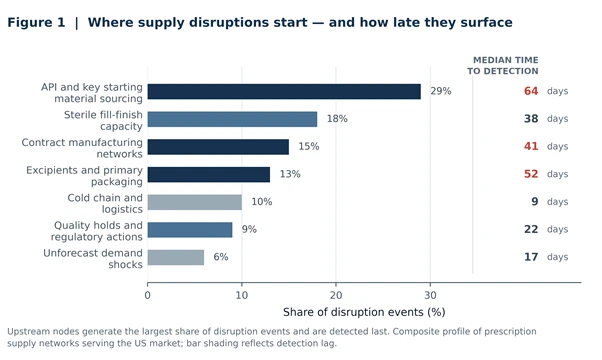
Figure 1: Disruption origin and detection lag across pharmaceutical supply network tiers.
The strategic implication is uncomfortable. Detection lag, not disruption frequency, is the variable that determines whether a company manages an event or is managed by it. A network twin is valuable precisely because it converts weak upstream signals — a lead time creeping out, a supplier's quality metric drifting, a lane's variance widening — into a modeled consequence long before those signals would otherwise cross an executive's desk.
From Visibility to Foresight: How AI Turns a Supply Chain Twin Into a Decision Engine
A twin on its own is an instrument. Artificial intelligence is what makes it a decision engine, and the two capabilities mature in a recognizable sequence. Early stages deliver connected visibility and root-cause attribution — useful, but essentially descriptive. Value begins to accumulate when machine learning models trained on the network's own history start forecasting where disruption and shortage risk are building, and it accelerates sharply when the system moves from predicting problems to ranking mitigations.
Figure 2 sets out the five stages. Most American pharmaceutical networks sit at stage one or two, having built visibility without building the ability to act on it. The organizations pulling ahead are those operating at stages three and four, where the twin does not merely warn that a node is at risk but evaluates thousands of response combinations — expedite, requalify, reformulate the campaign sequence, reallocate across customers — and presents the small number that satisfy service, cost and regulatory constraints simultaneously.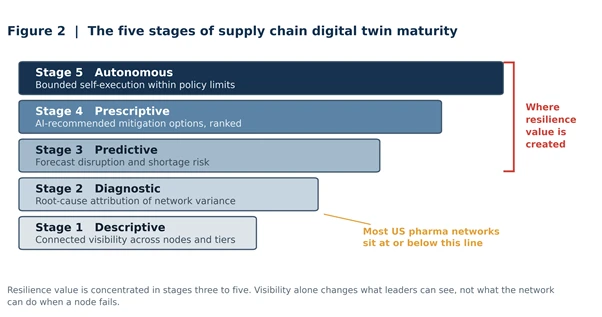 Figure 2: The maturity ladder for supply chain digital twins in pharmaceutical manufacturing.
Stress-Testing the Pharmaceutical Network Before the Disruption Arrives
The most consequential use of a supply chain twin is not real-time response but rehearsal. Executives can pose the questions that governance meetings usually leave unanswered because nobody has the means to answer them. What happens to fill rate if the sole-source supplier of a key intermediate goes offline for eight weeks in the fourth quarter? Which three products break first? How much earlier would we need to know in order to avoid a shortage notification altogether?
Figure 3 shows a modeled comparison of three responses to the same upstream interruption. The reactive case, with no twin, produces a deep and prolonged service trough. A static contingency playbook — the response most companies actually have — performs better but is still calibrated to a scenario written years ago. Twin-guided response compresses both the depth of the failure and the time to recovery, because mitigation begins before the shortfall is visible in orders and because the chosen action is tested against the network rather than argued in a meeting.
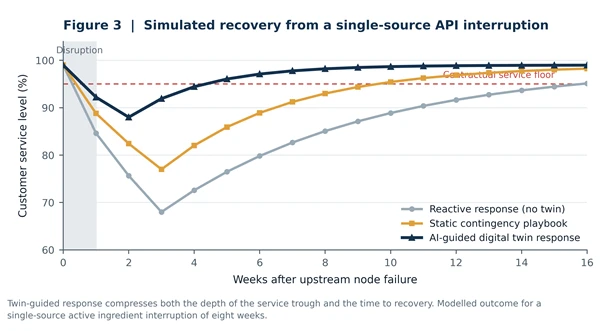
Figure 3: Modeled service level recovery under three response strategies following an upstream node failure.
The Data Problem Nobody Wants to Own — and Why Traceability Changed the Arithmetic
Every twin programme runs into the same obstacle: the model is only as trustworthy as the network representation beneath it. Supplier master data is incomplete, lead times are stale assumptions rather than measured distributions, sub-tier relationships are undocumented, and the same material carries three different identifiers in three systems. This is unglamorous work and it is the reason most initiatives stall.
What has shifted the arithmetic in the United States is the traceability infrastructure the industry was already obliged to build. Interoperable, lot-level electronic tracing across the prescription supply chain was implemented for regulatory reasons, but it produced something strategically valuable as a by-product: a standardized, event-level record of product movement that can serve as the spine of a network model. Companies that treat that data purely as a compliance artifact are leaving the most expensive component of a twin sitting unused.
The remaining gap is upstream, where no equivalent mandate exists. Closing it requires commercial insistence — making sub-tier disclosure a condition of supply agreements — rather than technology, which is why this is a chief executive's problem rather than a supply chain director's.
Case Study: How a US Specialty Manufacturer Rebuilt Resilience Around a Network Twin
A US-headquartered specialty pharmaceutical manufacturer, supplying hospital and clinic channels from two domestic sites and a network of external partners, had experienced three shortage events in four years. Each triggered the same cycle: an internal review, a longer supplier scorecard, an increase in safety stock, and a return to normal until the next event. Buffer inventory had risen by more than half over the period without measurably reducing the frequency of disruption.
The company's reset began with an unusual decision: it modeled the network before attempting to improve it. Eleven months went into building an executable representation covering both internal sites, all external manufacturing partners and — critically — the two tiers above its direct suppliers for the twelve products representing the majority of gross margin. Sub-tier disclosure was written into supply agreements at renewal, and three suppliers who declined were replaced over the following year.
Machine learning models were then trained on the company's own disruption history, supplier performance records and lot-level movement data to score each node weekly for emerging risk. When a score crossed threshold, the twin automatically ran mitigation scenarios and presented ranked options to a standing cross-functional review. Figure 4 summarizes the position after twenty-four months.
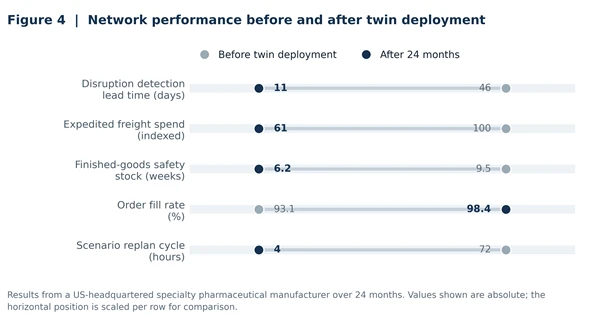
Figure 4: Network performance at a US specialty pharmaceutical manufacturer, before and after twin deployment.
Two results deserve particular attention. Safety stock fell from 9.5 weeks to 6.2 while order fill rate improved — the combination that conventional resilience thinking treats as impossible, achievable only because buffer was repositioned according to modeled exposure rather than spread evenly as a precaution. And the scenario replan cycle collapsed from three days to four hours, which changed the character of executive decision-making. Options could be tested during the meeting in which they were proposed.
What Digital Twins and AI Change for the American Pharma C-Suite
The first change is to the definition of preparedness. A contingency plan is a document describing what an organization intended to do about a disruption it imagined some years ago. A twin is a live capability for answering questions about disruptions nobody imagined. Boards that currently review a business continuity plan annually should be asking instead how quickly the organization can simulate an unfamiliar failure, and how often it does so.
The second change is to capital allocation. Twin programmes do not fit the payback profile of conventional supply chain projects, because the foundational investment in network modeling and data quality produces no return until the analytical layer sits on top of it. Funded as a series of individually justified initiatives, they die in year one. Funded as infrastructure with a three-year horizon, they compound.
The third is to accountability. A model that recommends actions the organization does not take is an expensive report. The companies achieving results have made the twin's output the default course of action within defined bounds, with documented exception handling — and have accepted that this shifts real authority from experienced individuals to a system those individuals must be able to challenge and improve. That is a cultural negotiation, and it belongs to executive leadership rather than to the analytics function.
Conclusion: Resilience Is a Capability, Not a Contingency Plan
American pharmaceutical supply chains will keep breaking. Single-source dependencies, concentrated manufacturing geographies, weather exposure and demand volatility are structural features of the industry, not temporary conditions awaiting a fix. The realistic objective is not a network that never fails but one that detects failure early, evaluates its options quickly and recovers before patients or customers are affected.
Digital twins and artificial intelligence make that objective achievable, but not automatically and not quickly. They require modeling the network honestly, including the uncomfortable parts nobody has documented; insisting on visibility from suppliers who would rather not provide it; funding infrastructure that shows no return for two years; and changing who decides what happens when a node fails. Companies that do this work will spend less on inventory, ship more reliably and spend far less executive time in crisis rooms. Those that continue to buy visibility tools and call it resilience will keep learning about their disruptions the way they always have — from a customer.

Lakshmi is a science writer with a foundation in the laboratory. She earned her master's in biotechnology and trained through research internships at ICGEB (JNU) and DIPAS, DRDO, with her work appearing in the Egyptian Journal of Veterinary Sciences. Now APCRM-certified and part of the editorial team at Pharma Focus America and Pharma Focus Europe, she reports on pharmaceutical technology, research, and innovation — giving complex science a clear and confident voice for industry leaders.