


Closing the Bench-to-Bedside Gap: Biomarker Strategies That Actually De-Risk Development
The Translation Problem Nobody Wants to Own
Lakshmi, Editorial Team, Pharma Focus America
Roughly nine out of ten drug candidates that enter clinical testing never reach patients. The failure rate is brutal, and it clusters in the space where laboratory promise meets human biology—the bench-to-bedside gap. For decades, the industry has treated this as an unavoidable cost of doing business, a kind of tax on innovation. That resignation is getting harder to defend. The tools to predict which drugs will work, and in which patients, already exist. What separates programs that stumble from those that succeed is rarely the science at the bench. It is whether biomarker strategy was built into the plan from the very first experiment, or bolted on late—after a disappointing trial result—when it was already too expensive to help.
Introduction
Biomarkers are measurable signals of what is happening in the body: how a disease is progressing, whether a drug is hitting its target, or how a patient is responding. They have moved from supporting roles to leading ones in modern drug development. Yet many companies still use them reactively, digging for explanations after a trial fails instead of building a predictive framework before it begins. That difference is everything. A biomarker strategy that genuinely reduces risk is planned early, tied tightly to how the drug works, and wired directly into decision-making. Anything less is expensive theater.
Why Most Biomarker Programs Underdeliver
The distance between biomarker enthusiasm and biomarker impact is wide. Leadership teams happily fund large exploratory panels, then never decide in advance how those measurements will actually change a go/no-go call. The result is a pile of interesting correlations that arrive too late to matter.
Three recurring mistakes explain the shortfall. The first is choosing biomarkers for convenience rather than relevance—markers that are easy to measure but have no real link to how the drug works. A signal that moves but means nothing generates noise, not insight. The second is weak measurement: assays that lack the reliability and consistency needed to support decisions worth hundreds of millions of dollars. A biomarker is only as trustworthy as the test behind it. The third is bad timing—using a biomarker at the wrong stage, so the data cannot inform the decision it was meant to guide.
The Four Jobs a Biomarker Strategy Must Do
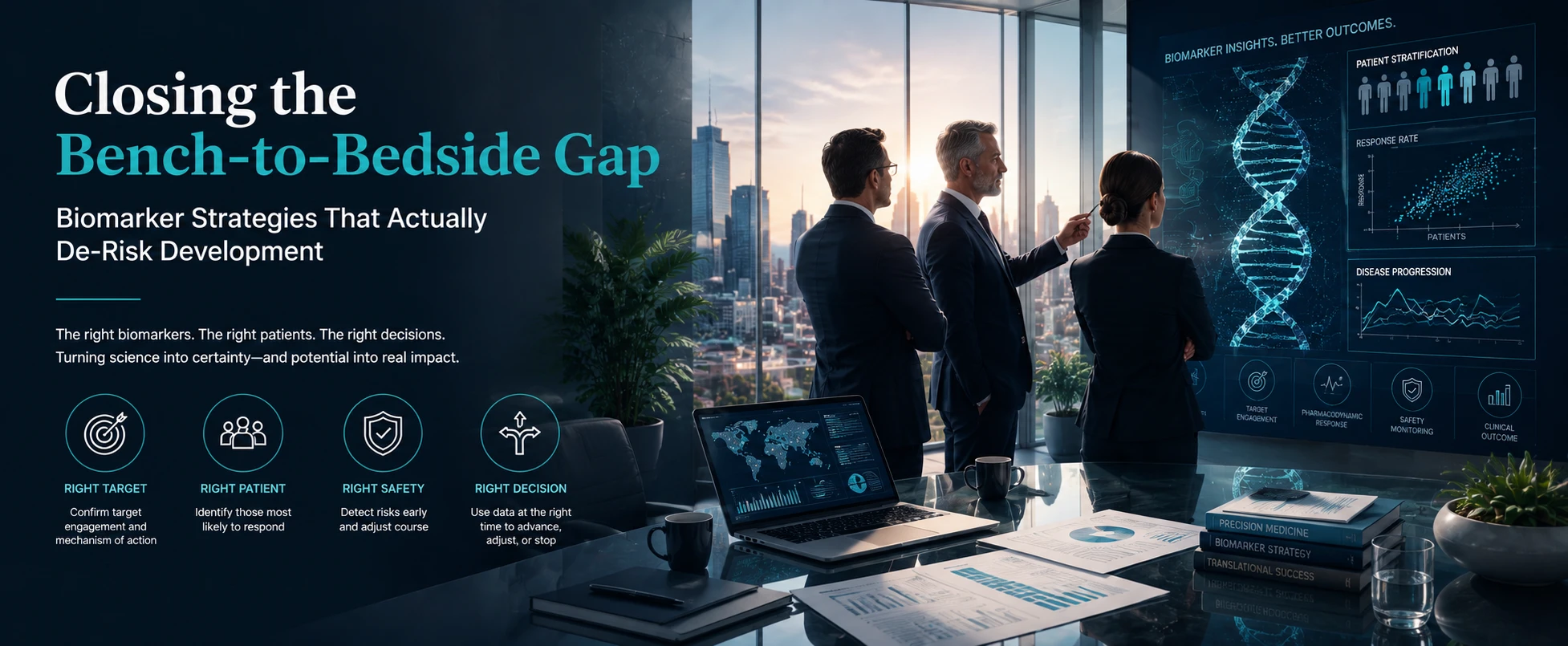
A biomarker program that truly lowers risk rests on four types of markers, each answering a different question.
The first asks the most basic question in drug development: did the molecule reach its target and do what it was designed to do? This is the question that, left unanswered, produces the most expensive failures—trials that fail not because the idea was wrong, but because the drug never engaged its target well enough at a safe dose. Answering it early turns a confusing negative result into one you can actually learn from.
The second type measures what happens downstream once the target is hit—confirming that engaging the target sets off the intended chain of biological effects. Together, these first two form the backbone of early proof that a drug is doing what the science predicted.
The third type identifies which patients are most likely to benefit. These are the workhorses of precision medicine. They turn a mixed, watered-down trial population into a focused group where the treatment effect is far easier to see. A drug that looks modest across everyone may look dramatic in the right subgroup—the difference between a dead program and a first-in-class approval.
The fourth type gives early warning of side effects, allowing a dose change or course correction before harm builds up. These markers protect patients and rescue programs that might otherwise be shut down over an unclear safety signal.
When a Failing Drug Was Actually a Winner in Disguise
Consider a mid-stage cancer drug aimed at a signaling pathway involved in solid tumors. Its first Phase II trial enrolled a broad group of patients with the relevant tumor type, and the results were disappointing—the response rate fell well short of the bar for continued investment. On paper, the program looked finished.
Instead of walking away, the team went back and tested stored tumor samples. They found that patients whose tumors showed high activity of the targeted pathway responded at roughly three times the rate of the overall group, while patients with low activity barely responded at all. The signal had been there the whole time. It was simply drowned out by a trial population that mixed likely responders with people who were never going to benefit.
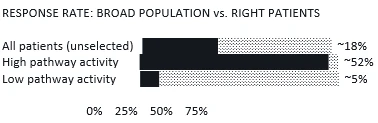
The team redesigned the next trial to enroll only high-activity patients and developed a companion test to identify them. This time, the trial succeeded. The point is not that biomarkers can rescue any failing drug—they cannot. It is that a plan to identify the right patients, built in from the start, would have delivered the same answer years earlier and at a fraction of the cost. The late rescue worked, but doing it upfront would have been cheaper, faster, and far less risky.
The same discipline works in reverse—to stop a drug before it drains resources. In one metabolic disease program, the team tracked a marker tied closely to how the drug worked. In mid-stage testing, that marker improved strongly, but the actual clinical outcome barely budged. Rather than advancing on hope, the team read the mismatch honestly: the drug was clearly active, but that activity simply wasn't enough to help patients meaningfully at a safe dose. They stopped the program before committing to an enormous late-stage trial, freeing money for more promising drugs. Reducing risk is not only about pushing winners forward. It is just as much about ending losers early, and biomarkers give you the evidence to do both.
You Can't Trust a Biomarker You Can't Measure Well
None of this works without solid, reliable tests behind the markers. A biomarker strategy is only as credible as the measurement underneath it. Not every marker needs the same level of rigor, though. A marker used for internal decisions needs to be reliable but doesn't need regulatory-grade proof. A marker that will support an approval claim or become a companion diagnostic must clear a much higher bar—proving it is accurate, reproducible, and genuinely useful for guiding treatment.
Bring Regulators In Early
Regulators have become active partners in biomarker-driven development. Formal qualification programs let a biomarker, once accepted for a defined use, be relied on across many programs without re-proving it every time. Talking to regulators early about biomarker plans—especially for trials that enrich for likely responders or that pair a drug with a companion test—prevents nasty surprises late in development. A trial design a regulator has already reviewed and accepted carries far less risk than one shown for the first time at submission.
What's Coming Next
The biomarker toolkit is growing beyond blood tests and tissue samples. Digital biomarkers—pulled from wearables and continuous sensors—capture how patients actually function day to day, with a level of detail no occasional clinic visit can match. Composite markers, which blend several signals into a single score, often predict better than any one measurement alone. And liquid biopsies, which detect tumor DNA circulating in the blood, are changing how early response and residual disease are tracked. What these advances share is a common promise: richer, earlier, more objective readouts that tighten the loop between giving a treatment and knowing whether it worked.
Turning Principle Into Practice
Good intentions aren't enough; this takes organizational discipline. The strongest teams write a biomarker plan alongside the target product profile, before the first trial protocol is drafted. They decide the rules in advance: which result means advance, which means adjust, and which means stop. They match assay validation to the timeline of the decisions each marker must support. They engage regulators early. And they make biomarker strategy a shared responsibility across translational science, clinical development, statistics, and regulatory affairs—rather than letting each group work in its own silo.
The companies that close the bench-to-bedside gap aren't the ones with the most biomarkers. They are the ones that pick the right few, measure them well, use them at the right moment, and—most importantly—commit ahead of time to letting the data drive the decision. Biomarkers don't reduce risk on their own. A strategy that treats them as tools for honest, disciplined decisions is what makes the difference.
The Bottom Line
The bench-to-bedside gap will never fully close. Biology is too complex and patients too different from one another. But the industry's long history of high failure rates reflects a strategy problem as much as a science problem. Programs fail because they advance on hope, measure the wrong things, or measure the right things too late. A biomarker strategy built in from the start—closely tied to how the drug works, backed by reliable tests, used at the right time, and locked to decisions made in advance—turns biomarkers from expensive curiosities into real tools for cutting risk. The science to do this already exists. What's left is the discipline to use it.

Lakshmi is a science writer with a foundation in the laboratory. She earned her master's in biotechnology and trained through research internships at ICGEB (JNU) and DIPAS, DRDO, with her work appearing in the Egyptian Journal of Veterinary Sciences. Now APCRM-certified and part of the editorial team at Pharma Focus America and Pharma Focus Europe, she reports on pharmaceutical technology, research, and innovation — giving complex science a clear and confident voice for industry leaders.