
Commercializing Cell and Gene Therapies: Strategic Models for Sustainable Growth
Lakshmi, Editorial Team, Pharma Focus America
Cell and gene therapies have proven they can transform outcomes for patients with rare and severe diseases, yet commercial performance has frequently lagged clinical promise. For American pharmaceutical leaders, the binding constraints are no longer only scientific: they are payment, site capacity, manufacturing economics and patient logistics. This article examines why early launches underperformed, how outcomes-based payment and federal access models are reshaping the market, what a recent hemoglobinopathy launch reveals about operational readiness, and which commercial models offer a sustainable path to growth as a larger late-stage pipeline approaches approval.
The Cell and Gene Therapy Paradox in American Pharma
Few areas of pharmaceutical innovation have delivered as much clinical excitement, or as much commercial disappointment, as cell and gene therapies. A single administration can now halt disease progression, end transfusion dependence or produce durable remission in cancers once considered untreatable. Yet launch curves have repeatedly undershot forecasts, investors have grown selective, and several developers have narrowed portfolios or exited programs despite regulatory success.
The paradox is not scientific. It is structural. Cell and gene therapies have entered a US healthcare system designed to pay for chronic medicines dispensed month by month, administered in community settings and manufactured at scale long before a patient is identified. A one-time, multimillion-dollar therapy that is manufactured for an individual patient, delivered in a specialized center and paid for upfront by an insurer that may not keep the member strains every assumption in that system. For the C-suite, sustainable growth depends on redesigning the commercial model, not simply refining the product.
A Wave Is Coming: Why the Cell and Gene Therapy Pipeline Raises the Commercial Stakes
The urgency is growing. Global landscape data show 46 approved gene therapies, including genetically modified cell therapies, and 76 approved non-genetically modified cell therapies as of mid-2026, with more than 4,400 gene, cell and RNA therapies in development. More telling is where the gene therapy pipeline is heading. Between the second quarters of 2025 and 2026, Phase I programs rose from 361 to 427, Phase II from 330 to 387 and Phase III from 45 to 59, even as the preclinical pool contracted.
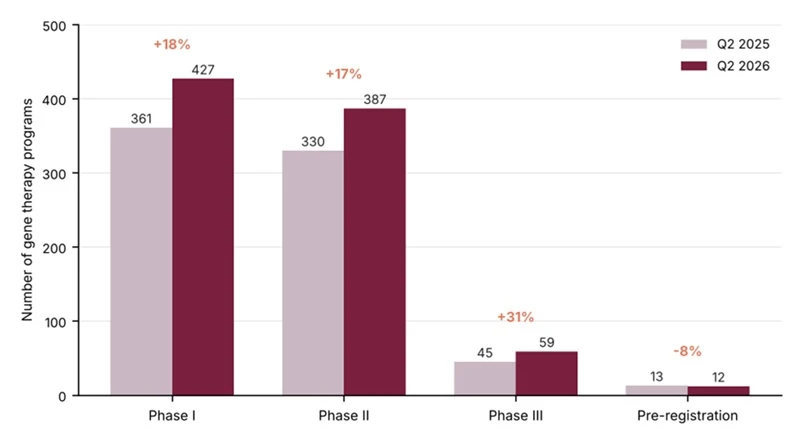
Figure 1: Gene therapy clinical pipeline by phase, Q2 2025 vs Q2 2026. Percentages show year-on-year change. Source: quarterly gene, cell and RNA therapy landscape data, Q2 2025 and Q2 2026.
A Phase III count up by nearly a third in a single year signals a wave of approvals over the next several years. Capital markets are reading the same signal: transaction volume in the sector rose 30 percent year on year in the second quarter of 2026, and start-up financing rebounded. The question for American executives is whether commercial infrastructure will be ready to absorb that wave, or whether a new generation of therapies will repeat the slow launches of the last.
Inside the Launch Gap: What Has Held Cell and Gene Therapy Revenue Back
Four bottlenecks recur across launches. The first is payment. Wholesale prices for recent hemoglobinopathy gene therapies sit between roughly USD 2.8 million and USD 3.1 million. Payers absorb the full cost on day one while benefits accrue over decades, often after the patient has moved to another plan. Prior authorization, single-case agreements and appeals add months to the patient journey.
The second is site capacity. Most therapies can be administered only at qualified treatment centers with apheresis, cell-processing capability and specialist staff. Each center must be contracted, trained and audited, and capacity at leading academic hospitals is finite. The third is the patient journey itself. Fertility preservation, conditioning, repeated cell collections and extended hospital stays make treatment a months-long commitment for families rather than a prescription.
The fourth is manufacturing economics. Autologous products carry a cost of goods that small-molecule leaders would barely recognize, along with vein-to-vein logistics that leave little room for error. Whenever collection or manufacturing must be repeated, cost rises and patients drop out.
Underlying all four is a forecasting problem. Many early launch models assumed eligible patients would convert quickly once a therapy was approved. In practice, the addressable population at any moment is limited to patients who are identified, referred, medically eligible, insured and willing to undergo an intensive procedure. Leaders who forecast from that funnel, rather than from disease prevalence, set credible expectations with investors and direct commercial resources to where conversion actually happens.
Paying for Cures: Outcomes-Based Models Reshaping the Cell and Gene Therapy Market
The most significant shift in US market access is federal. The Centers for Medicare & Medicaid Services launched its Cell and Gene Therapy Access Model to widen Medicaid access to gene therapies for sickle cell disease, a population that relies heavily on Medicaid coverage. CMS negotiated core terms with manufacturers, including discounts and outcomes-based rebates linked to clinical results, and states could then opt into standardized contracts. Thirty-two states, the District of Columbia and Puerto Rico now participate, jurisdictions that together account for roughly 84 percent of Medicaid enrollees living with the disease.
The model matters well beyond sickle cell disease. It establishes a federal template in which manufacturers share risk on durability, states adopt common access policies, and negotiation happens once rather than fifty times. Commercial payers are experimenting in parallel with warranties, installment payments and stop-loss carve-outs that pool the financial exposure of rare, high-cost events.
Execution, however, is demanding. Outcomes-based agreements require agreed endpoints, reliable follow-up over many years and data-sharing arrangements spanning manufacturers, treatment centers and payers. Patients relocate, change insurers and miss appointments, so long-term registries and patient-engagement programs are not optional extras. They are the financial infrastructure on which rebates and warranties depend.
For manufacturers, the lesson is that price is only one variable. Leaders who design contracts around measurable outcomes, invest in the real-world data systems needed to track them and accept a share of performance risk are finding that coverage decisions arrive faster and with fewer restrictions.
Case Study: Two Gene Therapy Launches and the Value of Operational Readiness
Real-world data presented in late 2025 on two gene therapies for inherited blood disorders, one for transfusion-dependent beta-thalassemia and a later product for sickle cell disease from the same developer, offer an unusually candid view of commercialization. Across both therapies, 312 patients had enrolled by mid-2025, but only 77, roughly a quarter, had been infused. Most patients needed around nine months to move from enrollment to treatment, and each additional stem cell collection added close to three months.
The more instructive finding concerns the second launch. Building on infrastructure created for the first product, the sickle cell therapy moved from approval to first enrollment twice as fast, and six times as many treatment centers were activated in its first quarter on the market. The developer also reported that enrolled patients had not faced a final coverage denial, even though authorization still required substantial documentation.
The lesson for American executives is that the capabilities that determine launch velocity, namely site networks, payer playbooks, patient navigation and collection protocols, are reusable assets. Companies that build them once and deploy them across a portfolio convert fixed commercial investment into compounding advantage. Single-asset companies carry the full cost of that infrastructure on one product, which helps explain the consolidation now under way.
Four Commercial Models Built for Sustainable Cell and Gene Therapy Growth
Several strategic models are emerging. The first is the portfolio platform: concentrating multiple therapies in one therapeutic area so that treatment centers, payer relationships and patient-support teams serve several products. This model rewards focus over breadth and favors leaders willing to acquire adjacent assets rather than diversify into unrelated indications.
The second is the hub-and-network delivery model. Rather than relying solely on a handful of flagship academic centers, manufacturers are working with health systems to extend administration and long-term follow-up into regional hospitals, supported by centralized cell processing. As safety management matures, particularly for cell therapies in oncology, outpatient and community administration could expand capacity significantly.
The third treats manufacturing as strategy. Whether through allogeneic off-the-shelf products, automated closed-system production or in vivo approaches that avoid ex vivo cell processing altogether, lowering cost of goods and vein-to-vein time directly expands the treatable population and makes outcomes-based contracts financially viable.
The fourth is the partnership model. Smaller developers increasingly license commercial rights, share infrastructure or co-promote with larger companies instead of building full commercial organizations alone. Steady acquisition activity through 2026 suggests large pharmaceutical companies value owning cell and gene therapy capabilities, but they are paying for platforms and operational know-how as much as for individual molecules.
Regulatory and Policy Signals Every Cell and Gene Therapy Board Should Track
Expedited FDA pathways, including Regenerative Medicine Advanced Therapy designation, have shortened development timelines for promising therapies, and the agency's growing openness to platform-based development could lower the cost of bringing related products forward. At the same time, Medicare drug-price negotiation and evolving rare-disease exemptions shape the lifetime revenue profile of every asset and should be modeled from the earliest investment decision, not at launch. Leaders who integrate regulatory, pricing and access strategy at the program level, rather than sequencing them, avoid late-stage surprises that erode value.
Supply-chain policy deserves equal attention. Growing federal emphasis on domestic manufacturing, together with closer scrutiny of foreign-sourced vectors, reagents and contract partners, raises the strategic value of US-based production capacity. Companies that secure domestic viral vector and cell-processing capacity early, through owned facilities or long-term agreements with contract manufacturers, reduce exposure to policy shifts and gain a credible resilience story for payers and regulators alike.
Conclusion:
From Breakthrough Science to a Durable Cell and Gene Therapy Business
Cell and gene therapies have already answered the scientific question. The commercial question, whether these medicines can deliver sustainable and predictable growth, is now being answered in payer negotiations, treatment-center networks and manufacturing suites. The evidence points in one direction: success depends less on any single product than on the operational system built around it.
For American pharmaceutical leaders, the next five years present a window. A larger late-stage pipeline, a federal outcomes-based template and a recovering investment climate are aligning. Companies that invest now in reusable delivery networks, risk-sharing contracts and lower-cost manufacturing will be positioned to turn the coming wave of approvals into durable revenue. Those that treat commercialization as an afterthought may again discover that a cure, by itself, is not a business.

Lakshmi is a science writer with a foundation in the laboratory. She earned her master's in biotechnology and trained through research internships at ICGEB (JNU) and DIPAS, DRDO, with her work appearing in the Egyptian Journal of Veterinary Sciences. Now APCRM-certified and part of the editorial team at Pharma Focus America and Pharma Focus Europe, she reports on pharmaceutical technology, research, and innovation — giving complex science a clear and confident voice for industry leaders.