


Continuous Manufacturing: The New Standard for Agile Pharma Production
Lakshmi, Editorial Team, Pharma Focus America
Continuous manufacturing has moved from demonstration to expectation. This article examines what it changes in the control strategy rather than merely the equipment, the economics American executives should be underwriting, and the regulatory runway that now favors early movers. An anonymized oral solid dose case traces a conversion, and a staged roadmap identifies where boards should commit capital and where programs most often fail.
Introduction: When the Batch Record Becomes a Balance Sheet Problem
American pharmaceutical executives have spent the past several years managing consequences that trace back to a production model designed for a different century. Shortages concentrated in older sterile injectables and thin-margin generics. Supply chains dependent on a small number of foreign facilities for critical intermediates. Political pressure to bring production home, arriving at precisely the moment that pricing reform compresses the margin available to pay for it. Each of these is usually discussed as a policy problem. Each is, at its root, a manufacturing architecture problem.
Batch production is discontinuous by design. Material is made in discrete lots, held, sampled, tested, released and moved forward, with equipment idle between steps and quality confirmed after the fact. Nearly every characteristic that frustrates a chief executive — long lead times, heavy inventories, painful scale-up, capacity that cannot flex to a demand signal, months between a shortage notification and additional supply — follows from that architecture rather than from any failure of execution by the people running it.
Continuous manufacturing changes the architecture rather than the effort. Material moves through an integrated line at a controlled rate, quality is measured while the product is being made, and the control system acts on those measurements in real time. The approach is well past demonstration: it has supported new approvals and post-approval conversions of established products, and the regulatory framework built to accommodate it is now written and in use. The question in front of American boards is no longer whether the technology works. It is whether their organization can absorb what it demands.
What Continuous Actually Changes — and It Is Not the Equipment
The most expensive executive misunderstanding is that continuous manufacturing is a purchase. It is not. The equipment is the visible portion of a change whose center of gravity sits in the control strategy, and programs that treat it as a capital procurement discover this at validation rather than at design.
In a batch process, a lot is a physical object with a boundary. In a continuous process, the lot is a definition — established by time, by quantity of input, or by a stated production period — and traceability must be established mathematically. Residence time distribution becomes the central scientific concept of the whole program. The plant must know, and be able to demonstrate to an inspector, how long material takes to traverse each unit operation and how a disturbance introduced at a feeder propagates downstream. That knowledge is what permits non-conforming material to be diverted automatically while the line keeps running, and it is what allows a defined quantity of output to be attributed to a defined quantity of input.
Process analytical technology moves from a nice-to-have to a load-bearing element.
Spectroscopic and imaging measurements taken in-line replace testing that batch operations perform after the fact, and the control system responds within seconds rather than within a shift. State of control becomes the operative phrase: the line is not qualified once and thereafter trusted, it is demonstrated to remain inside its design space continuously, with the evidence generated as the product is made. Figure 1 sets out the resulting configuration.
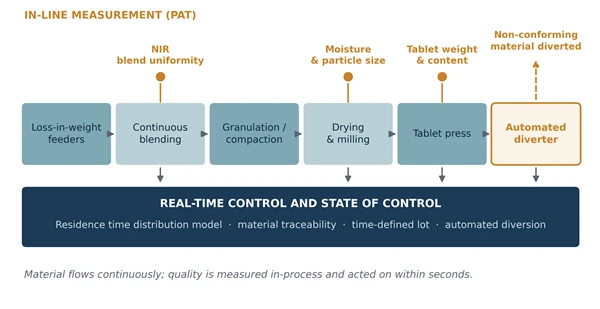
Figure 1: An integrated continuous line for oral solid dosage, showing in-line measurement points, the real-time control layer and automated diversion of non-conforming material.
The Economics an American CFO Should Be Underwriting
Continuous programs are frequently justified on unit cost, which is the weakest part of the case and the reason several have died at the investment committee. The stronger arguments are structural, and they are the ones a finance organization can actually model.
Scale-up largely disappears. The traditional path moves a process from bench to pilot to commercial scale, and each transition is a scientific project carrying its own risk of failure and its own months of calendar time. A continuous process scales by running the same line longer, or by adding a parallel line, which converts a development problem into a scheduling decision. Figure 2 compares the two pathways.
Capital intensity and footprint fall. Equipment is smaller, hold and staging space shrinks, and the installed cost per unit of annual output is typically lower — though automation, instrumentation and control content rise, and executives should expect the savings to land in facility and inventory rather than in the equipment line item.
Working capital is released. Weeks of in-process material disappear, and where real-time release testing is justified, the interval between production and shipment compresses substantially. For a portfolio under pricing pressure, cash freed from inventory is a real and immediate return that does not depend on volume growth.
Finally, there is resilience — the argument that has changed most in the American context. A domestic line at a fraction of the footprint alters the arithmetic of onshoring, and the ability to turn output up or down without a scale-up campaign is worth more against episodic shortages than nameplate capacity. The counter-case deserves equal candor: very low volumes, short remaining product life, and portfolios requiring frequent changeover between dissimilar products remain better served by batch.
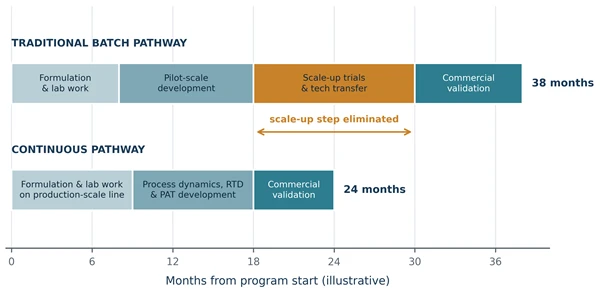
Figure 2: Illustrative development pathways from program start to commercial validation, showing where the scale-up sequence is removed rather than compressed.
The Regulatory Runway Is No Longer the Obstacle
Executives who last examined this in the previous decade often assume regulatory risk is the binding constraint. It is now among the more navigable parts of the program.
The harmonized international guideline for continuous manufacturing of drug substances and drug products addresses the questions that used to be argued case by case: how a lot may be defined, what a control strategy must contain, how process dynamics and material traceability should be characterized, and how equipment trains and production durations are handled in the filing. Alongside it, the Food and Drug Administration operates a mechanism through which sponsors can engage reviewers and investigators on novel technology well before a submission is assembled, and Congress has established a designation pathway intended to support advanced manufacturing methods, including the possibility of expedited review for eligible programs. Agency leadership has been publicly consistent for a decade that modernization of manufacturing technology is an objective rather than a tolerated deviation.
Conversion of an approved product is likewise a defined exercise rather than an unmapped one, handled through a comparability and post-approval change strategy that should be agreed in outline before capital is committed. The practical instruction for the C-suite is therefore narrow: engage the agency early, settle the lot definition and diversion strategy before the line is built rather than after, and treat the data infrastructure as part of the filing rather than as an IT deliverable that arrives later.
Conversion of a Mature Product: An Anonymized Case
The case that follows is a composite, assembled from patterns that recur across United States oral solid dose conversions; outcome figures are indexed to a pre-conversion baseline. The subject is a high-volume, long-established tablet product manufactured at a domestic site that had reached its capacity ceiling and faced a choice between a conventional expansion and a continuous line occupying a fraction of the floor area.
The first eight months produced no equipment. The team characterized raw materials and excipients across suppliers and lots, built and challenged a residence time distribution model, and established that the in-line methods proposed for blend uniformity and tablet attributes could be developed to a validatable standard. Only then was the line specified. Regulatory engagement began in the same period rather than at submission, which allowed the lot definition and the automated diversion strategy to be discussed while they could still be changed cheaply.
Two organizational decisions did more for the outcome than any piece of hardware. The site converted one product rather than attempting a portfolio, accepting a slower headline result in exchange for a program its quality organization could actually absorb. And the quality function was placed inside the design work from the first month, because batch release built around discrete lots and offline results does not transfer to a time-defined lot without being rebuilt.
The errors are as instructive as the results. Raw material variability was underestimated: feeder performance proved sensitive to excipient flow properties that had been immaterial in batch operation, which forced tighter supplier specifications and an uncomfortable conversation with a long-standing vendor. And the operating workforce needed considerably more retraining than budgeted, because moving from lot-based to flow-based reasoning changes what an operator is watching for and when an intervention is warranted.
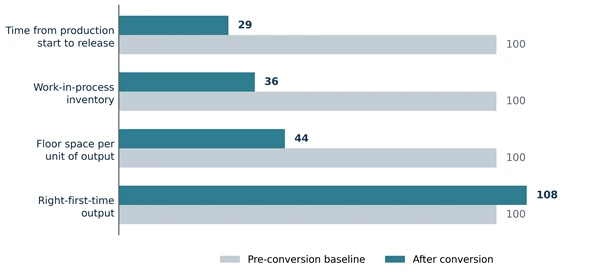
Figure 3: Illustrative outcomes following conversion of a mature oral solid dose product, indexed to a pre-conversion baseline of 100.
Where American Programs Fail
Three failure modes account for most abandoned programs, and none of them is technological. The first is treating the initiative as a capital purchase, which produces a well-specified line attached to an unchanged quality system. The second is underestimating material science: continuous processes are less forgiving of raw material variability than batch processes, and the supplier qualification work is part of the project rather than a precondition someone else handles. The third is sequencing the quality organization last, which reliably surfaces the hardest questions — lot definition, diversion, release logic — at the point when they are most expensive to answer.
Beneath all three sits a workforce question that boards consistently underfund. Operators, supervisors and quality reviewers trained on discrete lots must learn to reason about flow, and the transition is genuine rather than cosmetic. Sites that budget for it treat continuous manufacturing as an operating model change. Sites that do not tend to describe their program, some years later, as a technology that did not work for them.
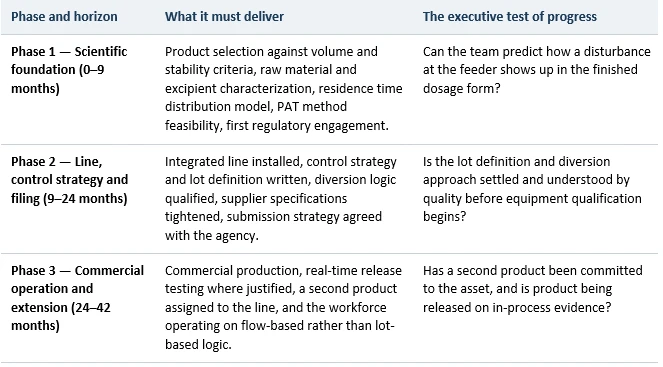
Table 1: A staged commitment — what each phase must deliver, and how progress should be tested at board level.
Conclusion: A Decision About Architecture, Not Equipment
The American pharmaceutical industry is being asked to do several things at once: hold down price, shorten supply chains, eliminate shortages in the products with the thinnest margins, and produce more of its own medicine domestically. Batch manufacturing can be optimized against those demands, but it cannot be reconciled with all of them simultaneously, because its limitations are architectural rather than operational.
Continuous manufacturing is the most developed alternative available, and the case for it is no longer speculative. Its regulatory pathway is written, its scientific requirements are understood, and its economics are strongest exactly where the pressure is greatest — in cycle time, working capital, footprint and the ability to flex output without a scale-up campaign. What it demands in return is a different kind of commitment: scientific work funded well before equipment, a quality organization inside the design from the first month, a workforce retrained to reason in flow, and a board willing to judge progress by the quality of the control strategy rather than the arrival of the machinery. Executives who make those commitments are not buying a faster plant. They are buying the ability to respond — which, in this market, is the scarcer asset.

Lakshmi is a science writer with a foundation in the laboratory. She earned her master's in biotechnology and trained through research internships at ICGEB (JNU) and DIPAS, DRDO, with her work appearing in the Egyptian Journal of Veterinary Sciences. Now APCRM-certified and part of the editorial team at Pharma Focus America and Pharma Focus Europe, she reports on pharmaceutical technology, research, and innovation — giving complex science a clear and confident voice for industry leaders.