

Cosolvency as Drug Delivery: PEGs, Glycerin and Polysorbates
Enhancing solubility and bioavailability across dosage forms
Chintan Shah, Director of Pharmaceutical Business Development, Vantage Specialty Chemicals
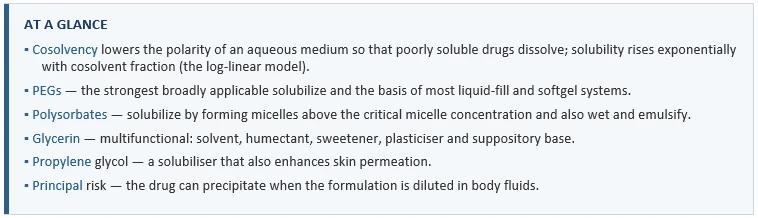
Poor aqueous solubility limits absorption of roughly 40% of marketed drugs, making solubilization central to formulation. Cosolvency, adding a water-miscible solvent to lower medium polarity, is among the oldest, most powerful solubility-enhancement strategies, described by the log-linear model. This article reviews its mechanism and four key excipients: PEGs, glycerin, polysorbates, and propylene glycol. Their use across syrups, semisolids, suppositories, tablets, and softgels is examined, alongside bioavailability gains and central risks like precipitation on dilution.
Introduction:
Poor aqueous solubility remains one of the defining constraints of pharmaceutical development. Around 40 per cent of marketed drugs, and a still larger share of pipeline candidates, dissolve poorly in water; most fall into Class II or Class IV of the Biopharmaceutics Classification System (BCS), the scheme that ranks compounds by their solubility and intestinal permeability.1,2 Because a molecule that will not dissolve cannot be absorbed, solubilization is frequently the most consequential decision a formulator makes.
Several strategies address the problem — among them salt formation, particle-size reduction, complexation and solid dispersion — but solvency remains one of the oldest, simplest and most broadly effective. A cosolvent is a water-miscible solvent added to an aqueous system to lower its polarity and so raise the solubility of a poorly soluble solute. The approach is pervasive: cosolvents appear in roughly 13 per cent of approved parenteral products, and four agents — propylene glycol, ethanol, glycerin and polyethylene glycol 400 — account for about two-thirds of those.6
This article outlines the physicochemical basis of solvency and then examines four mainstay excipients — the polyethylene glycols (PEGs), glycerin, the polysorbates and propylene glycol (PG) with particular attention to glycerin, the PEGs, and the polysorbates. Their behavior is then traced across the principal dosage forms: liquid syrups, semisolids and ointments, suppositories, tablets and soft gel capsules.
How cosolvency works
Water is an exceptionally polar, strongly hydrogen-bonded solvent, with a dielectric constant (ε, a measure of a medium’s polarity) of about 80. That high cohesive energy is precisely what excludes non-polar drug molecules from solution. A cosolvent reduces the overall polarity and cohesive energy of the medium, weakens the self-association of water, and eases the accommodation of a hydrophobic solute. The common cosolvents occupy the ground between water and a typical lipophilic drug: glycerin has a dielectric constant near 42 and propylene glycol near 32, while the polyethylene glycols fall within the glycol range — each less polar than water, yet more polar than most poorly soluble drugs, whose values generally lie below 20.4
A consistent observation follows from this ordering: the less polar the cosolvent, the greater its effect on a non-polar solute, so the more hydrophobic glycols tend to outperform the more water-like glycerin. In a comparative study of the poorly soluble anti-inflammatory drug etoricoxib, PEG 400, propylene glycol and glycerin each raised solubility, but the ranking followed hydrophobicity, with PEG 400 proving the most effective.5
The log-linear model
The quantitative foundation of cosolvency is the log-linear model developed by Yalkowsky and colleagues, which relates solubility to cosolvent content by log(Smix / Sw) = σ · fc. Here, Smix and Sw are the solubilities in the mixture and in water respectively, fc is the volume fraction of cosolvent, and σ (sigma) is the solubilizing power of the particular cosolvent–drug pair.2,3 Because solubility rises exponentially as cosolvent content increases linearly, even modest fractions can raise solubility by orders of magnitude.
The value of σ is not fixed but scales almost linearly with the hydrophobicity of the solute, expressed as its logarithmic octanol–water partition coefficient (log Kow). Reported solubilizing powers follow the same ordering seen in the polarities: for a moderately lipophilic drug, σ tends to be highest for ethanol, of the order of three to four; high for PEG 400 and propylene glycol, in the region of two to three and a half; and appreciably lower for glycerin, generally below two. These values are approximate and solute-specific. Millard, Alvarez-Núñez, and Yalkowsky derived predictive constants for the model from a set of 122 compounds spanning log Kow values from −5 to 7.5, so that solubilization can be estimated from the partition coefficient alone.2
The magnitude of the effect is evident in measured data. The solubility of phenytoin, for example, reaches roughly 26.7 mg/mL in an 80:20 (v/v) PEG 400–water mixture,8 and the solubility of the antiviral emtricitabine increases about eighteen-fold between water and neat PEG 400.9 The exponential relationship also carries a well-recognized hazard: a drug held in solution by a high cosolvent fraction may precipitate when that fraction falls on dilution into blood, gastrointestinal fluid or tissue water — a point returned to below.
The cosolvent toolkit
Polyethylene glycols
The polyethylene glycols are polymers of ethylene oxide supplied across a range of molecular weights; PEG 400 is the grade most often used as a liquid solubilizing vehicle. Their appeal lies in low toxicity, complete miscibility with water, and the capacity to dissolve a wide range of poorly soluble compounds.1 The effect on absorption can be pronounced: drugs that show poor and variable uptake as conventional solids often display high and more reproducible bioavailability when presented as PEG solutions, which is the basis of liquid-filled softgel capsules. The principal limitation is a strong affinity for water. Because solubility in PEG is highly sensitive to moisture, the ingress of even small amounts of water can precipitate the drug; low-molecular-weight grades may also contain trace peroxides and aldehydes capable of reacting with sensitive active ingredients.7
Glycerin
Glycerin (glycerol) is among the most versatile of pharmacopoeia excipients, functioning at once as solvent, cosolvent, humectant (a moisture-retaining agent), sweetener, viscosity modifier, and plasticiser.13 As a solubilizer for strongly lipophilic drugs, it is the weakest of the four considered here, because its comparatively high dielectric constant and dense hydrogen-bonding network make it the most water-like.2,4 Its value, therefore, lies in multifunctionality rather than in raw solubilizing power. In syrups, it contributes solvency while sweetening the preparation and, as a humectant, resisting the crystallization of sugar around the closure. In suppositories, it forms the basis of the classical glycerin–gelatin base and of glycerin suppositories themselves, in which it also acts as the osmotic agent. In semisolids, it retains moisture within the formulation and on the skin. Because high concentrations feel tacky, glycerin is commonly combined with propylene glycol to improve spreadability.
Polysorbates
The polysorbates are non-ionic surfactants rather than classical cosolvents, and the distinction matters. Whereas a cosolvent alters the bulk properties of the solvent, a polysorbate solubilizes by micellization: above a threshold termed the critical micelle concentration (CMC), individual molecules assemble into micelles whose hydrophobic interiors accommodate lipophilic drugs. Polysorbate 80 has an HLB (hydrophilic–lipophilic balance, a measure of a surfactant’s affinity for water relative to oil) of about 15 and a low CMC, of the order of 0.012 mmol/L, so micellar solubilization begins at very low concentrations and increases as more surfactant is added.10 Polysorbates also serve as emulsifiers and wetting agents and stabilize proteins against stress at interfaces. Two cautions apply. If a drug — or a preservative such as a paraben — partitions strongly into the micelle, its free and pharmacologically active concentration can fall.14 Polysorbate quality also varies between batches, and oxidative degradation is a recognized stability concern.
Propylene glycol
Propylene glycol is a low-viscosity diol, more hydrophobic than glycerin and generally a stronger solubiliser for non-polar drugs.5,14 Beyond bulk solubilization, it is among the best-characterized promoters of skin penetration: it partitions into the stratum corneum (the outermost barrier layer of the skin), where it can extract and disorder the intercellular lipids and interact with keratin, thereby increasing drug flux.11,12 It is frequently combined with glycerin, and with PEG or surfactants, across liquid, semisolid and softgel systems.
From solubility to bioavailability
For a poorly soluble drug, dissolution is usually the step that limits the rate and extent of absorption. By presenting the drug already in solution, or by accelerating its dissolution, cosolvent and surfactant systems raise the concentration available for transport across the intestinal wall or the skin. The consequences reported repeatedly include a greater extent of absorption, a faster onset of action, reduced variability between individuals and, in topical use, enhanced permeation.1 The counterpart to these benefits, rooted in the exponential nature of cosolvency, is precipitation on dilution. Controlling it — through crystallization inhibitors such as povidone, through surfactants that provide additional micellar solubilization, or through self-emulsifying designs — is a central objective of robust formulation.
Across dosage forms
Liquid syrups and oral solutions
Oral liquids are the natural home of cosolvency, since the drug must remain dissolved in a palatable vehicle, and the excipients usually act together. Glycerin contributes solvency while sweetening the preparation, building mouthfeel, and, as a humectant, resisting crystallization and lowering water activity. PEG 400 and propylene glycol supply the primary solubilizing power for the more lipophilic actives, with propylene glycol additionally dissolving many preservatives. A small amount of polysorbate 80 keeps sparingly soluble flavor oils and actives in solution. The chief constraints are precipitation on dosing and, in pediatric products, the toxicological limits that apply to propylene glycol and ethanol.
Semisolids, ointments and creams
In semisolids, the cosolvents serve both as solvency vehicles and as modulators of penetration. Propylene glycol dissolves the active and, on application, promotes flux through the stratum corneum. Glycerin acts chiefly as a humectant, typically at 2 to 5 per cent of the aqueous phase, hydrating the skin and preventing the product from drying; at higher levels, it is combined with propylene glycol to offset stickiness. Liquid PEGs act as water-miscible bases, and the polysorbates are the non-ionic emulsifiers that hold oil-in-water creams together while solubilizing the drug. A common design carries the active in a propylene glycol–glycerin–water system emulsified with a polysorbate and a sorbitan ester balanced to the required HLB.
Suppositories
Suppositories show these agents as base-forming materials. Water-soluble bases built from solid and liquid PEGs dissolve in the rectal fluid rather than melting, tolerate warm climates, and can improve the release of poorly soluble drugs, although their tendency to draw in water must be managed. Glycerin is central to the classical glycerin–gelatin base and to glycerin suppositories, in which it is itself the osmotic agent. Polysorbates are incorporated into fatty bases as emulsifiers and wetting agents to improve dispersion and aid the release of lipophilic actives.
Tablets
In a solid tablet, cosolvency acts only briefly, at the moment of dissolution. Polysorbate 80 blended into the formulation lowers interfacial tension, wets hydrophobic particles and forms solubilizing micelles in the gastrointestinal fluid, improving the dissolution of BCS Class II drugs. PEG and propylene glycol serve as granulating liquids, as plasticizers in film coats and as carriers in liquisolid systems, in which a drug predissolved in a non-volatile cosolvent is adsorbed onto a carrier to give a free-flowing, compressible powder that releases the drug in a partly presolubilized state. Solid PEGs also act as matrices for solid dispersions, which markedly raise dissolution.
Softgel capsules
Softgels are the clearest expression of cosolvency in a solid product: a liquid solution of the drug is enclosed in a plasticized gelatin shell, delivering a presolubilised dose. PEG 400 is the hydrophilic fill vehicle most often used; small amounts of ethanol, propylene glycol or water may be added, but usually below about 10 per cent, because volatile and hydrophilic components migrate into the shell.1 Surfactants such as polysorbate 80 create self-emulsifying fills, and inhibitors such as povidone help to keep the drug in solution. Glycerin functions here chiefly as a plasticizer for the shell. The benefit can be substantial: a solution-filled softgel of the protease inhibitor saquinavir provided roughly three times the exposure of a hard-shell capsule.1 The principal difficulty is water migration; an uptake of about 6 per cent of water into a PEG 400 fill has been shown to reduce drug solubility by some 45 per cent and to precipitate the drug.7
Formulation cautions
Cosolvent and surfactant solubilization is powerful but bounded. Precipitation on dilution follows directly from the exponential model and is mitigated by additional solubilizers, polymeric inhibitors, and self-emulsifying designs. PEG systems are sensitive to moisture, so water ingress must be anticipated, particularly in softgels. Surfactant micelles can retain drugs or preservatives and so lower the free, active concentration. Toxicological limits apply to propylene glycol, ethanol, and certain other cosolvents, especially in neonates, and excipient impurities such as peroxides and aldehydes can degrade actives and cross-link gelatin. Sensory and physical properties — the tackiness of glycerin, the moisture sensitivity of PEG, the taste of surfactants — are usually balanced by combining excipients.
Outlook
Cosolvency endures because it is simple, effective, and well understood, and the log-linear model provides a predictive framework, driven by the partition coefficient, for selecting a cosolvent before the first experiment. Within the toolkit, the roles divide clearly: the PEGs provide the strongest and most broadly applicable solubilization in liquid vehicles and underpin the softgel and solid-dispersion platforms; the polysorbates add a distinct micellar mechanism that also wets and emulsifies; glycerin contributes multifunctional solvency, moisture retention, and base-forming behavior; and propylene glycol bridges solubilization and the enhancement of skin permeation. Applied with due regard for precipitation, moisture sensitivity, and toxicological limits, these long-established excipients continue to convert otherwise intractable compounds into products with reliable and improved bioavailability.
References:
- Gullapalli RP. Soft gelatin capsules (softgels). J Pharm Sci. 2010;99(10):4107–4148.
- Millard JW, Alvarez-Núñez FA, Yalkowsky SH. Solubilization by cosolvents: establishing useful constants for the log-linear model. Int J Pharm. 2002;245(1–2):153–166.
- Yalkowsky SH, Roseman TJ. Solubilization of drugs by cosolvents. In: Techniques of Solubilization of Drugs. New York: Marcel Dekker; 1981.
- Rubino JT, Yalkowsky SH. Cosolvency and cosolvent polarity. Pharm Res. 1987;4(3):220–230.
- Nayak AK, Panigrahi PP. Solubility enhancement of etoricoxib by cosolvency approach. ISRN Phys Chem. 2012:820653.
- Nema S, Washkuhn RJ, Brendel RJ. Excipients and their use in injectable products. PDA J Pharm Sci Technol. 1997;51(4):166–171.
- Serajuddin ATM, et al. Water migration from soft gelatin capsule shell to fill material and its effect on drug solubility. J Pharm Sci. 1986;75(1):62–64.
- Cosolvent solubilisation of phenytoin in PEG 400–water systems (maximum solubility ~26.7 mg/mL at 80% v/v PEG 400).
- Solubility and thermodynamic behaviour of emtricitabine in PEG 400–water mixtures (mole-fraction solubility data).
- Polysorbate 80 physicochemical data: HLB ≈ 15; critical micelle concentration ≈ 0.012 mmol/L.
- Glycols as solvents and permeation enhancers in dermal formulations. Eur J Pharm Biopharm. 2024.
- Trottet L, et al. Effect of propylene glycol on the skin penetration of drugs. Int J Pharm. 2019.
- Handbook of Pharmaceutical Excipients: glycerin — solvent, humectant, sweetener, plasticiser and suppository-base component.
- Chintan S, Vantage Specialty Chemicals, forum discussion

Chintan Shah is Director of Pharmaceutical Business Development at Vantage Specialty Chemicals, where he leads sales and growth strategy across the company’s pharmaceutical portfolio. With nearly two decades of experience spanning the pharmaceutical, nutraceutical, personal care, and adjacent industries, he brings deep expertise in sales management and business development to a role focused on connecting customer needs with innovative, value-driven solutions.