


Decentralized Clinical Trials: A Strategic Shift for Faster Drug Development
Lakshmi, Editorial Team, Pharma Focus America
Decentralized clinical trials were justified to boards as a cost reduction and have largely underdelivered against that promise. This article argues the real return is cycle time, and that the correct unit of decision is the individual assessment rather than the whole trial. It examines assessment-level design, FDA expectations, site economics and an anonymized case study for US biopharma leadership.
Why Decentralized Clinical Trials Are a Timeline Decision, Not a Technology Purchase
Few operating ideas in drug development have traveled as far, as fast, in both directions as decentralization. Necessity made it mainstream in 2020. Enthusiasm carried it into board presentations as a structural cost play. Then the invoices arrived, the savings proved elusive, and a number of well-funded programs were quietly folded back into business as usual.
That retreat was a strategy error, not a verdict on the model. It happened because decentralization was measured against the wrong objective. Judged on cost per participant, a hybrid trial frequently looks worse than a site-based one: sponsors are paying for connected devices, home health vendors, courier networks, additional monitoring and validated electronic systems that a conventional protocol never needed. Judged on cycle time, the same trial often looks materially better.
Regulators, meanwhile, have kept moving. In September 2024 the FDA finalized its guidance on conducting clinical trials with decentralized elements, and in December 2025 it finalized guidance on enhancing participation in clinical trials, which explicitly points to remote assessments and hybrid designs as a way to reduce participant burden and broaden enrollment. The direction of travel is settled even where sponsor enthusiasm has cooled.
For US biopharma executives, this creates an unusual moment. The regulatory ambiguity that justified waiting has largely resolved, the technology has commoditized, and much of the competition has disengaged. The advantage now belongs to whoever reframes the decision correctly.
The Cost Story Was Always the Wrong Story
Start with the arithmetic that kills most decentralization proposals. A study manager builds a per-participant comparison, adds device provisioning, home nursing, logistics and system validation, and produces a number that exceeds the site-based baseline. Finance declines. The proposal dies, correctly, on the terms it was argued.
Those terms are wrong because they price only the operating line. The value of a decentralized element sits in the enrollment curve — in how quickly a study reaches last participant enrolled, and therefore how quickly it reaches database lock, submission and, if the program succeeds, market. For a Phase III asset with meaningful peak-year revenue, a single month pulled out of the development timeline is typically worth more than the entire incremental cost of every decentralized component in the protocol.
This is a governance problem before it is an operational one. The costs land in a clinical operations budget that is managed to a target. The benefits land in a commercial forecast that nobody in the room owns. Unless the decision is elevated to where both sides of the equation are visible — which in practice means the chief medical officer and the chief financial officer looking at the same slide — the structurally correct answer will keep losing to the locally rational one.
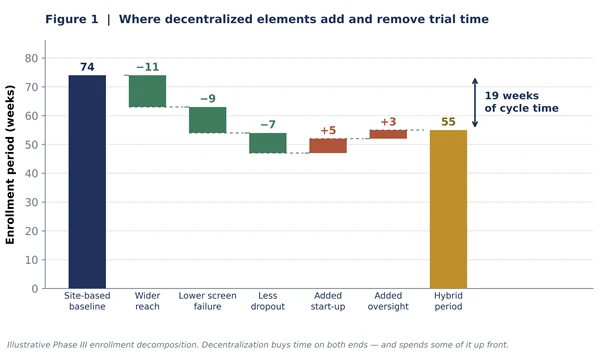
Figure 1 Decentralization buys time at both ends of enrollment and spends some of it on start-up.
The decomposition matters as much as the total. Decentralized designs give back time through wider geographic reach, lower screen-failure rates and reduced dropout, then hand some of it back in study start-up: device validation, vendor integration, additional site training and the oversight architecture the FDA expects. Programs that fail to budget honestly for that front-loaded cost report disappointing results and conclude the model does not work, when what actually happened is that they under-resourced the first four months.
The payoff also varies sharply by asset, and the variance is predictable enough to plan around. Programs in rare disease, where eligible participants are dispersed across a continent, and in chronic conditions with long follow-up and heavy visit schedules, tend to gain the most. Short protocols concentrated around a small number of specialist referral centers gain very little, and sometimes lose. Decentralization is therefore a portfolio selection question rather than a company-wide policy, and sponsors that apply it uniformly across a pipeline will dilute the results in both directions.
Decentralize the Visit, Not the Trial
The second error is treating decentralization as a property of the study rather than of each activity within it. Fully virtual trials remain a small minority of starts, and for defensible reasons: a handful of assessments in most protocols carry the safety and regulatory weight, and those assessments belong at an investigator site.
The productive question is narrower. Take the schedule of assessments, and sort every activity into three routes — deliverable remotely, deliverable by a local healthcare provider, or requiring the investigator site. What emerges is rarely a fifty-fifty split. It is a small number of high-frequency, low-complexity activities that account for most of the participant's travel burden, sitting alongside a small number of complex ones that account for almost none of it.
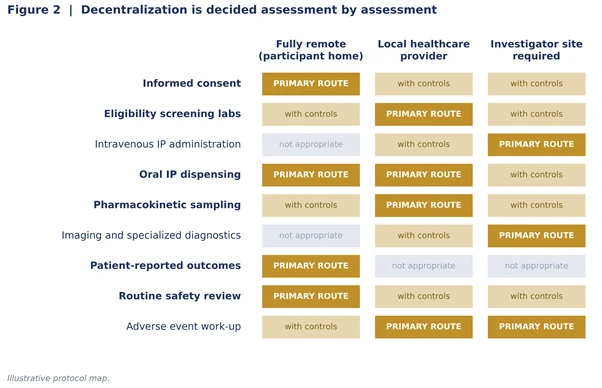
Figure 2 Sorting the schedule of assessments by route is the design decision that actually moves enrollment.
This reframing changes the metric. The right measure of a decentralized design is not the percentage of the trial that has been decentralized, which is a vanity number, but the count of site visits avoided per participant across the study. A protocol that moves four of eighteen visits off-site can outperform one that moves nine, if those four were the ones participants were dropping out over.
What the FDA Asked For, and What Sponsors Keep Getting Wrong
The 2024 final guidance is more permissive than many sponsors assume and more demanding than most have operationalized. Its central message is that decentralized elements do not alter the sponsor's underlying obligations. Investigator oversight still applies when a local provider draws the blood. Delegation must be documented. Electronic systems used to capture trial data are expected to meet existing records requirements. Fully decentralized designs are positioned as appropriate mainly where the investigational product has a well-characterized safety profile.
Two provisions deserve specific board attention because they carry budget consequences. Participants who do not already own the technology a protocol specifies should not be excluded on that basis, and sponsor-provided connectivity is contemplated. That converts access from an aspiration into a line item, and sponsors who treat it as optional will find their enrollment advantage concentrated in exactly the populations they were already reaching.
The recurring failure is data provenance. Sponsors deploy remote capture and treat the resulting data as interchangeable with site-collected data, without establishing where each measurement originated, who performed it under whose delegated authority, and how it moved into the trial record. This is discoverable at inspection and expensive to reconstruct afterward. The discipline required is unglamorous and should be designed in at protocol stage rather than retrofitted during study conduct.
The Constraint Nobody Budgets For: Site Economics
The most underestimated obstacle to decentralized clinical trials in the United States is not regulatory or technical. It is that decentralization moves work and revenue in opposite directions for the investigator site.
When visits move off-site, per-visit site revenue falls. Oversight obligations, however, do not: the investigator remains accountable for remotely captured data, for supervising delegated activities and for reviewing an increased volume of incoming information. Sites that have run a hybrid protocol on a conventional per-visit budget rarely volunteer for a second one, and site attrition eliminates the enrollment advantage the design was built to deliver.
The correction is straightforward and rarely made. Site budgets need to pay for oversight time and remote data review as distinct compensated activities, not as unfunded consequences of a design the sponsor chose. Sponsors should also plan around state-level telehealth licensure, which constrains which investigator can conduct a remote visit with which participant across state lines — a constraint that does not appear in vendor demonstrations and routinely surfaces after the protocol is final.
Local provider networks carry a similar hidden cost. Contracting, training and delegation documentation for a dispersed set of community clinics is administratively heavier than sponsors anticipate, and assessment quality varies more across an ad hoc network than across a qualified site list. The sponsors doing this well maintain a smaller network used repeatedly across studies, treating it as durable infrastructure rather than something assembled for each protocol and dismantled at database lock.
Case Study: Enrolling Faster Without Going Virtual
A mid-cap US biotechnology company running a Phase III program in a chronic cardiometabolic indication — presented here as an anonymized composite of patterns common among sponsors of this size — had missed enrollment projections on two prior studies and was under investor pressure on timeline.
The team resisted the instinct to build a virtual trial. Instead it audited the schedule of assessments and reclassified activities by route. Nine of the protocol's eighteen scheduled contacts were reassigned: symptom diaries and quality-of-life instruments to remote capture, routine safety reviews to telehealth, interim laboratory draws to local providers, oral study drug to direct-to-participant shipment. Imaging, the primary efficacy endpoint assessment and drug titration visits stayed at the site.
Two decisions made the difference. Site budgets were rebuilt to compensate oversight and remote data review directly, which kept high-enrolling sites engaged. And the connectivity provision was funded rather than assumed, so participants without suitable devices or reliable broadband were not screened out — which mattered because those were disproportionately the rural participants the wider catchment was supposed to reach.
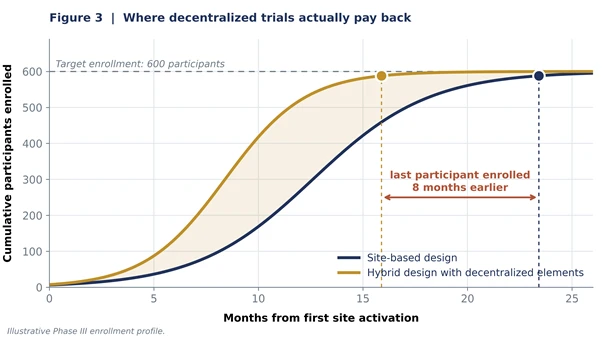
Figure 3 Earlier last-participant-in moves every downstream milestone, not just the enrollment line.
Per-participant cost rose. Enrollment closed materially earlier, dropout fell, and the study reached database lock ahead of the original plan. On the cost metric the program looked worse; on the metric that determined the asset's value it looked considerably better.
Conclusion: Make Decentralization a Capability, Not a Project
The strategic shift is not from site-based trials to virtual ones. It is from treating decentralization as a technology procurement to treating it as a design discipline applied assessment by assessment, funded against timeline value rather than operating cost.
Three commitments follow for US biopharma leadership. Move the decision to where timeline value and operating cost are visible together, because a clinical operations budget will never approve something that pays back in the commercial forecast. Build the assessment-level design capability once and reuse it across the portfolio, rather than reassembling it protocol by protocol. And fix site economics before the first patient is screened, because the enrollment advantage lives inside sites that are willing to run the next study too.
The companies that gave up on decentralized trials generally did not test the model. They tested a business case built on the wrong number. The regulatory framework is now clear, the tooling is mature, and the differentiator has moved from whether a sponsor can decentralize to whether it can decide, protocol by protocol, exactly how much it should.

Lakshmi is a science writer with a foundation in the laboratory. She earned her master's in biotechnology and trained through research internships at ICGEB (JNU) and DIPAS, DRDO, with her work appearing in the Egyptian Journal of Veterinary Sciences. Now APCRM-certified and part of the editorial team at Pharma Focus America and Pharma Focus Europe, she reports on pharmaceutical technology, research, and innovation — giving complex science a clear and confident voice for industry leaders.