Digital Transformation in Pharma: Integrating AI & Automation Technologies
Lakshmi, Editorial Team, Pharma Focus America
Artificial intelligence and automation have moved from the pharmaceutical innovation fringe to the operating core, yet most organisations remain stranded between promising pilots and enterprise returns. This article maps where digital value genuinely concentrates across discovery, development, manufacturing and supply, explains why scaling stalls, and sets out the decisions the pharmaceutical C-suite alone can make on architecture, data governance, workforce design and capital allocation.
Introduction: The Decade the Pharmaceutical Industry Stops Piloting
Every pharmaceutical boardroom now has an artificial intelligence slide. Far fewer have an artificial intelligence balance sheet. The past three years produced a remarkable volume of experimentation across the industry — generative models proposing molecules, feasibility engines redesigning trial protocols, predictive maintenance on filling lines, automated drafting of regulatory documents — and a comparatively modest volume of audited, recurring financial benefit. The distance between those two facts is now the defining strategic problem for senior pharmaceutical leadership.
It is a problem of sequencing, not of science. The underlying technologies work. What fails is usually the operating environment around them: fragmented data estates assembled through decades of acquisition, validation practice designed for deterministic equipment rather than probabilistic models, and funding structures that reward launching a pilot far more generously than retiring a legacy process.
Digital transformation in pharma has therefore become less a technology agenda than a capital-allocation and governance agenda. It belongs jointly to the chief executive, the chief financial officer and the heads of research, quality and operations — not to a digital function reporting three levels down. The organisations now pulling ahead are not those with the most models in production. They are those that decided early, and expensively, to build a shared core before they built anything visible.
The Value Is Real — But Rarely Where the Spend Goes
Aggregate market forecasts for AI in life sciences are largely useless to a board, because they blend fundamentally different classes of return. A more decision-useful view distributes the addressable value pool across the functions that must actually deliver it.
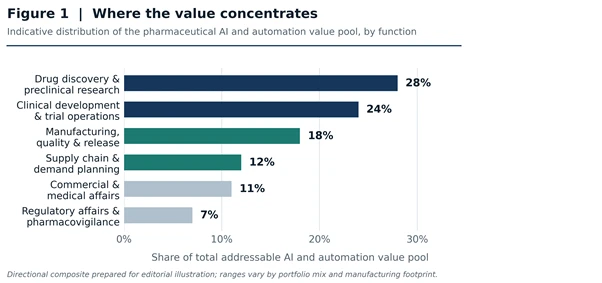
Figure 1. Discovery and clinical development hold the largest theoretical prize; manufacturing, quality and supply chain hold the nearest-term cash.
Figure 1 should be read as two investment classes rather than a ranking. Value in discovery and clinical development is optionality: it changes the shape of the pipeline five to ten years out, it is probabilistic, and it resists attribution — no chief financial officer can cleanly credit a model with a molecule. Value in manufacturing, quality and supply chain is annuity: it appears in cost of goods sold, right-first-time rates, deviation backlogs and working capital within four to eight quarters, and it is auditable.
The practical implication for the C-suite is uncomfortable but clear. A digital portfolio weighted entirely toward optionality will struggle to defend its budget through the first cost-reduction cycle. A portfolio weighted entirely toward annuity will win every budget argument and lose the decade. The discipline is to fund optionality from the research envelope and annuity from the operations envelope, and to prevent a single steering committee from quietly trading one against the other.
From Proof of Concept to Proof of Profit: The Scaling Gap
The industry's adoption statistics flatter it. Ask how many pharmaceutical organisations are using generative AI in medical and regulatory writing and the number is overwhelming. Ask how many have made it the standard, validated, enterprise-wide method — with the previous workflow decommissioned — and the number collapses.
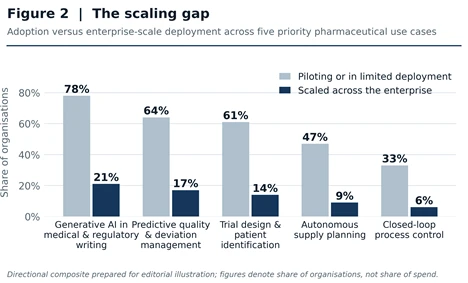
Figure 2. Across every priority use case, adoption outruns enterprise-scale deployment by a factor of three to five.
The ratio in Figure 2 matters more than either individual bar. Where four organisations pilot for every one that scales, most digital spend is being converted into learning rather than earnings. Three causes recur with striking consistency:
- Pilots are designed to prove feasibility, not to survive validation, system integration and audit — so the successful pilot cannot be industrialised without being rebuilt.
- No process owner is accountable for retiring the workflow the technology replaces, leaving the old and new processes running in parallel and the saving unbanked.
- Model estates are built without lifecycle ownership: no registry, no drift monitoring, no revalidation trigger, and therefore no path to a regulated production environment.
A useful board test follows from this: a pilot that cannot name the cycle time, scrap rate, headcount or inventory it will remove is not a pilot. It is a demonstration. Demonstrations belong in an innovation budget with a fixed ceiling and a hard expiry date.
Four Layers Separate a Digital Enterprise from a Digitised One
Most transformation programmes fail at a layer nobody was asked to own. The structure below assigns each layer a single accountable executive and a diagnostic failure signal that a board can test for in a quarterly review.
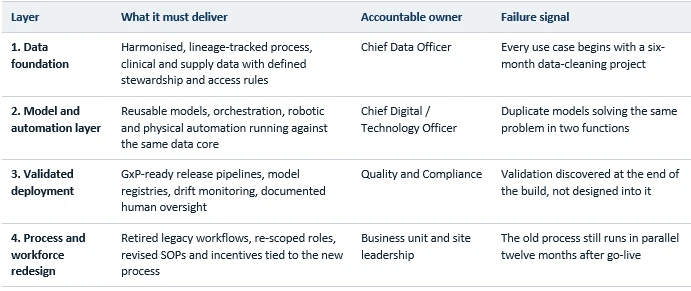
Table 1. The four-layer operating model for AI and automation in a regulated pharmaceutical enterprise.
The sequencing is not negotiable. Layers three and four are where value is realised, but they cannot be built on an absent layer one. Programmes that invert this order produce impressive demonstrations and disappointing margins.
Case Study: Taking Nine Days Out of Batch Release
Consider an anonymised case drawn from a mid-cap sterile injectables manufacturer operating three commercial sites. Batch release averaged fourteen days. Roughly seventy per cent of that elapsed time was not testing but waiting — for paper batch record reconciliation, for deviation investigation, for quality review queues, and for the manual transcription of instrument data into validated systems.
The intervention was deliberately unglamorous. Over eighteen months the company implemented electronic batch records across all three sites, connected in-line process analytical instrumentation directly to a harmonised manufacturing data layer, and deployed two narrow machine-learning models: one classifying and triaging deviations by likely root cause, the other flagging batches at elevated risk of an out-of-specification result while they were still in process.
Crucially, quality leadership co-designed the validation approach from month one, and the executive committee mandated that paper batch records be formally decommissioned site by site rather than maintained in parallel.
The outcome after full deployment: average release time fell from fourteen days to five; deviation investigation cycle time dropped by roughly forty per cent; right-first-time improved from the high eighties into the mid-nineties; and the working capital released by shorter release cycles alone paid back the programme within fourteen months of go-live. No molecule was discovered. The margin was entirely real.
Where AI Meets GMP: Automation on the Regulated Floor
Manufacturing is where automation and artificial intelligence stop being separate agendas. Robotic aseptic filling and automated visual inspection remove human variability from the highest-risk operations. Process analytical technology generates the continuous data stream that makes real-time release testing conceivable rather than aspirational. Closed-loop process control then uses that stream to adjust parameters within a validated design space without waiting for an end-of-batch verdict.
Digital twins sit above this stack, allowing scale-up, tech transfer and changeover scenarios to be rehearsed in silico before a single litre of buffer is consumed. For companies managing complex modalities — cell and gene therapies, sterile biologics, high-potency products — this is rapidly shifting from a differentiator to a licence to compete on cost.
The constraint is rarely the equipment. It is that a facility instrumented for automation but governed by paper-era change control will generate data it is not permitted to act upon.
The Regulator Is Not Your Constraint — Your Governance Is
Executives frequently cite regulatory uncertainty as the reason for slow scaling. The evidence increasingly points elsewhere. Regulators in the United States and Europe have published risk-based credibility frameworks for artificial intelligence used to support regulatory decision-making, and the principle of a predetermined change control plan — agreeing in advance how an adaptive algorithm may be updated without a fresh submission — is now established practice in adjacent regulated domains.
What regulators consistently ask for is what many organisations cannot yet produce: documented data lineage, a defensible account of model development and performance, a defined level of human oversight proportionate to risk, and a monitoring plan that detects degradation before it reaches a patient or a batch.
Those are internal governance artefacts. Building them is a twelve-to-eighteen-month exercise in data stewardship and quality-system design, and it cannot be compressed by procurement. Boards that treat AI governance as a compliance cost consistently pay for it twice — once in the delayed programme, and again in the remediation.
The CFO's Question: What Does This Actually Return?
The most consequential financial decision is not how much to invest but how to structure the investment. Function-by-function builds show earlier, smaller wins and are easier to approve. Platform-led programmes — a shared data core, common model operations, reusable validation patterns — carry a deeper and more uncomfortable initial trough.
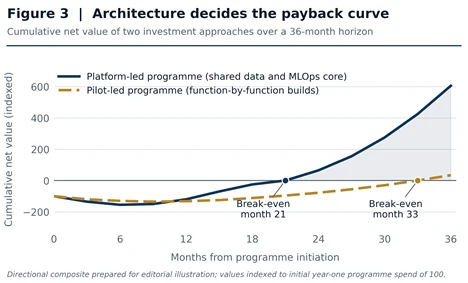
Figure 3. Shared-core investment costs more early and compounds later; sequential pilot builds rarely escape their own integration overhead.
The divergence in Figure 3 is not driven by better algorithms. It is driven by marginal cost. In a platform-led model, the second use case reuses roughly sixty per cent of the first one's infrastructure and the fifth reuses more still, so each successive deployment is cheaper and faster. In a pilot-led model, each use case rebuilds its own pipelines, its own validation package and its own support arrangement, so marginal cost stays flat and integration debt accumulates faster than benefit.
The governance consequence is significant: platform-led programmes must be protected through a trough that will look, at month nine, exactly like failure. That protection is a board decision, and it must be made before the trough, not during it.
Five Decisions Only the C-Suite Can Make
- Fix the core before the use cases. Data harmonisation and model operations are enterprise infrastructure. Funding them from individual business cases guarantees they are never built.
- Put a profit-and-loss owner on every model. If no named executive carries the saving in their budget, the saving will not materialise.
- Fund the retirement, not just the build. Budget explicitly for decommissioning legacy processes and systems, with dates. Parallel running is where returns go to die.
- Make validation a design input. Quality and regulatory leadership belong in the room at the point of design, not at the gate before go-live.
- Buy capability, build differentiation. Document generation, scheduling and demand forecasting are commodities. Proprietary process understanding and molecule-specific insight are not — build only there.
Conclusion: Build the Core, Then Compound
The pharmaceutical industry does not have an artificial intelligence problem. It has an industrialisation problem. The models perform; the pilots succeed; the value stalls at the boundary between a promising demonstration and a validated, owned, enterprise-wide process.
Crossing that boundary is not primarily a technical undertaking. It requires a shared data foundation funded as infrastructure rather than as a project, a quality system that treats probabilistic tools as first-class citizens, executives who are accountable for retiring the processes their technology replaces, and a board with the resolve to hold a platform investment through its trough.
The organisations that make those choices in the current planning cycle will not simply run cheaper factories. They will compound — every subsequent capability arriving faster and costing less than the one before it. Those that continue to fund demonstrations will spend comparable sums over the same period, accumulate an impressive portfolio of proofs of concept, and find their cost base unchanged. In an industry defined by patent cliffs, pricing pressure and shortening exclusivity windows, that is not a neutral outcome. It is a strategic loss taken quietly, one pilot at a time.

Lakshmi is a science writer with a foundation in the laboratory. She earned her master's in biotechnology and trained through research internships at ICGEB (JNU) and DIPAS, DRDO, with her work appearing in the Egyptian Journal of Veterinary Sciences. Now APCRM-certified and part of the editorial team at Pharma Focus America and Pharma Focus Europe, she reports on pharmaceutical technology, research, and innovation — giving complex science a clear and confident voice for industry leaders.