


Digital Transformation in Pharmaceutical Supply Chain Management
Lakshmi, Editorial Team, Pharma Focus America
The US pharmaceutical supply chain is being rebuilt around data. Full serialization under the Drug Supply Chain Security Act, persistent drug shortages and rising expectations for resilience are pushing manufacturers toward connected, predictive operations. This article examines how digital twins, interoperable traceability, advanced analytics and control-tower visibility are reshaping pharma supply chain management, and outlines what American C-suite leaders must prioritize to convert digital investment into measurable resilience and margin.
The Pharma Supply Chain Becomes a Data Business
For decades, the American pharmaceutical supply chain was judged on two measures: cost and compliance. Product moved from manufacturer to wholesaler to dispenser through a chain of largely disconnected systems, and visibility often ended at the loading dock. That model has reached its limits. The pandemic, extended drug shortages, sterile injectable disruptions and new federal traceability mandates have exposed how little many organizations actually know about their own product flows in real time.
Digital transformation is now the response. Yet for the C-suite, the question is no longer whether to digitize but how to do it in a way that delivers resilience, patient availability and financial return together. The leaders pulling ahead are treating supply chain data as a strategic asset, not a by-product of transactions.
Why Pharma Supply Chain Resilience Now Starts on the Balance Sheet
Drug shortages remain the most visible symptom of fragile supply chains. According to data from the American Society of Health-System Pharmacists and the University of Utah, active US drug shortages hit an all-time high of 323 in the first quarter of 2024. The count fell steadily through 2025, and new shortages that year were the lowest since 2006. But the improvement has not held: the active count has risen for three consecutive quarters into 2026.
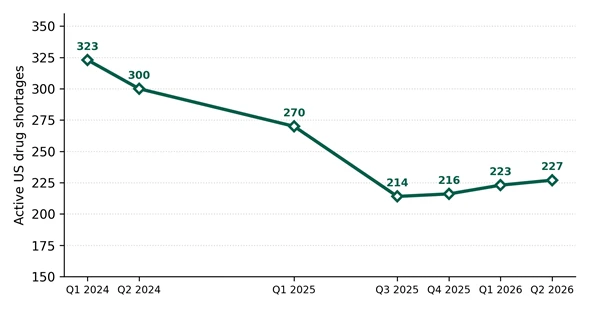
Figure 1: Active US drug shortages, Q1 2024 – Q2 2026
Source: ASHP / University of Utah Drug Information Service quarterly reports (selected quarter-end values)
The lesson for executives is that shortages are rarely sudden events. Most are long-running, rooted in single-source dependencies, thin margins and limited visibility several tiers upstream. Each one carries a hidden cost: lost revenue, expedited freight, regulatory scrutiny and damaged relationships with health systems. Digital supply chain capabilities convert that hidden risk into something leadership can measure, forecast and act on.
DSCSA and the Digital Traceability Mandate Reshaping US Pharma
The Drug Supply Chain Security Act has quietly become the largest digital infrastructure project in US pharmaceutical history. Its enhanced requirements demand electronic, interoperable, package-level tracing of prescription drugs across manufacturers, repackagers, wholesale distributors and dispensers. After a stabilization period and phased exemptions for different trading partners, the final exemption for small dispensers expires in November 2026, bringing the entire chain under full electronic traceability.
Many companies approached DSCSA as a compliance cost. The more strategic view treats serialized data as a foundation. Every scanned unit creates a record of where product is, how long it has been there and where it is going. Combined with sales, inventory and production data, these records can reveal diversion risks, slow-moving stock, expiry exposure and demand shifts weeks earlier than traditional reporting. Organizations that build analytics on top of their traceability data turn a regulatory obligation into a competitive asset.
Predictive Analytics: Turning Digital Pharma Supply Chain Data into Working Capital
Inventory is where digital transformation shows up most clearly in financial results. Pharmaceutical companies have traditionally buffered uncertainty with large safety stocks, tying up capital and increasing write-off risk for products with limited shelf life. Better forecasting changes that equation directly.
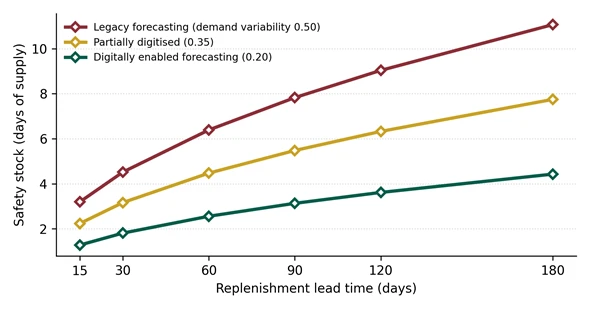
Figure 2: Safety stock required vs lead time at a 95% service level
Illustrative model: safety stock = z × demand variability × √lead time (z = 1.65)
The model in Figure 2 shows why. At a 90-day lead time, an organization with legacy forecasting and high demand variability needs close to eight days of safety stock to maintain a 95% service level. Reducing variability through digitally enabled forecasting cuts that requirement to about three days, without compromising availability. Across a portfolio worth billions of dollars, that difference can release substantial working capital while improving reliability.
Machine learning models that combine historical orders, prescription trends, epidemiological signals, payer changes and point-of-care data are increasingly outperforming traditional statistical forecasts. The goal is not perfect prediction but narrower uncertainty, which the supply chain can then plan around with confidence.
Digital Twins and Control Towers: Seeing the Pharma Supply Chain End to End
A digital twin is a living virtual model of the physical supply network, from active pharmaceutical ingredient suppliers to finished goods distribution. It allows planners to simulate disruptions such as a plant outage, port closure or sudden demand spike and test responses before committing resources. For pharma, where changing a supplier or production site can involve months of regulatory work, the ability to evaluate scenarios in advance is especially valuable.
Control towers provide the operational layer. By integrating data from enterprise systems, contract manufacturers, logistics providers and temperature-monitoring devices, they give leaders a single, near real-time view of product flow and exceptions. For cold-chain biologics and cell and gene therapies, where a temperature excursion can destroy product worth hundreds of thousands of dollars, this visibility is no longer optional.
Inside a Digital Pharma Supply Chain Turnaround
Consider a pattern seen across several large US manufacturers with broad generic injectable and specialty portfolios. Faced with recurring stockouts and high expiry write-offs, these organizations consolidated planning data from multiple enterprise systems into a single cloud platform, layered demand-sensing analytics on top, and linked the platform to serialization records and contract manufacturer production schedules.
The results followed a consistent arc. First came visibility: planners could see inventory by lot and location across the network for the first time. Next came prediction, as forecast error fell and safety stocks were rebalanced toward the products most exposed to disruption. Finally came collaboration, as key suppliers and distributors gained shared access to forecasts and constraints. The most important change was cultural. Decisions that once took weeks of spreadsheet reconciliation moved into daily, data-driven planning meetings.
Conclusion:
The US pharmaceutical supply chain is entering a new phase. Full DSCSA traceability, persistent shortage pressure and growing complexity from biologics and advanced therapies are making digital capabilities essential rather than experimental. The organizations that will lead are those that connect traceability data, predictive analytics, digital twins and control towers into one coherent operating model.
For American C-suite leaders, the opportunity is clear: a digitally enabled supply chain protects patients from shortages, frees working capital, reduces risk and strengthens trust with health systems and regulators. Digital transformation is no longer an IT initiative. It is a core strategy for pharmaceutical resilience and growth.
Frequently Asked Questions
1. What does digital transformation mean for a pharmaceutical supply chain?
It means connecting planning, manufacturing, distribution and traceability data into integrated systems that support real-time visibility, prediction and faster decision-making across the entire network.
2. How does DSCSA support digital supply chain strategy?
DSCSA requires electronic, interoperable, package-level tracing. Beyond compliance, this serialized data can power analytics on inventory, expiry risk, diversion and demand patterns.
3. Can digital tools really reduce drug shortages?
They cannot remove structural causes such as single-source dependency, but earlier warning signals, better forecasting and scenario planning help companies act before disruptions reach patients.
4. What is a pharma supply chain digital twin?
It is a virtual model of the physical supply network that allows leaders to simulate disruptions and test responses, such as alternate sourcing or production shifts, before acting.
5. Where should executives start?
With data quality and governance, a clear executive owner, and a focused use case with measurable financial or availability outcomes, then scale in stages.

Lakshmi is a science writer with a foundation in the laboratory. She earned her master's in biotechnology and trained through research internships at ICGEB (JNU) and DIPAS, DRDO, with her work appearing in the Egyptian Journal of Veterinary Sciences. Now APCRM-certified and part of the editorial team at Pharma Focus America and Pharma Focus Europe, she reports on pharmaceutical technology, research, and innovation — giving complex science a clear and confident voice for industry leaders.