

Digital Twins in Pharma Manufacturing: Optimizing Process Performance
Digital Twins in Pharma Manufacturing: Optimizing Process Performance
Lakshmi, Editorial Team, Pharma Focus America
Digital twins have moved from pharmaceutical R&D curiosity to load-bearing manufacturing infrastructure. This article examines how live, data-fed virtual replicas of bioreactors, granulation trains and fill-finish lines lift yield, compress technology transfer and stabilize quality. It sets out a three-tier maturity model, the validation path available under existing GMP frameworks, the economics executives should interrogate, and the decisions that separate scaled digital twin programs from stalled pilots.
Introduction:
Why the Pharma Digital Twin Has Outgrown the Pilot Plant
For most of the last decade, the digital twin occupied an awkward position in pharmaceutical manufacturing: intellectually attractive, operationally optional. Engineering teams built simulations, quality teams ignored them, and finance teams could not find the return in a variance report. That position has become untenable. Modality complexity has risen faster than process understanding, capacity is expensive and slow to build, and the cost of a single failed campaign in a high-value biologic or cell therapy now exceeds the multi-year cost of the modeling program that might have prevented it.
Two further shifts matter to the American manufacturing base specifically. First, regulators have stopped treating model-based evidence as exotic. The FDA's January 2025 update to its guidance on compliance with 21 CFR 211.110 explicitly accommodates advanced technologies, real-time quality monitoring and process analytical technology — the exact substrate a digital twin runs on. Second, the arithmetic of onshored capacity has changed: new domestic plants are being designed with instrumentation density that older sites never had, which means the data foundation a twin requires is now being poured with the concrete.
The question facing executives is therefore no longer whether digital twins work. It is which twin, on which asset, under whose ownership, and validated how.
A Pharma Digital Twin Is Not a Dashboard — and the Difference Is Expensive
The term has been stretched close to uselessness by vendors, so a working definition is worth insisting on. A digital twin is a dynamic virtual representation of a physical entity that is continuously updated with live operational data and used to predict, simulate and influence the behavior of that entity. Three words carry the weight: continuously, predict, influence.
A three-dimensional model of a cleanroom is not a twin, because it does not update. A business-intelligence dashboard showing batch trends is not a twin, because it describes the past rather than forecasting the next four hours. An offline process simulation used once during facility design is not a twin either, because it has no return path to the plant floor.
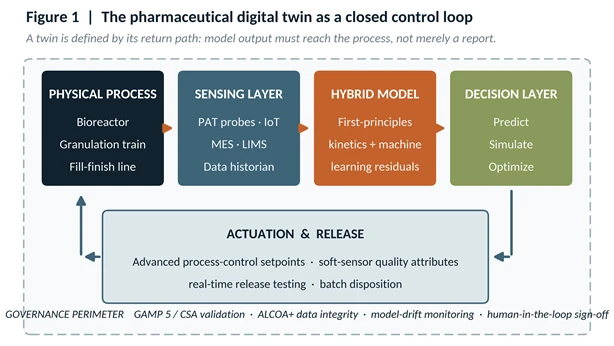
That return path is the defining feature (Figure 1). Data flows from PAT probes, IoT sensors, the manufacturing execution system and the laboratory information management system into a model core; the model core produces predictions; and those predictions reach the process, either as advice to an operator or as a setpoint change under advanced process control. Remove the return path and what remains is an expensive report.
The model core itself is increasingly hybrid. First-principles models — mass and energy balances, reaction kinetics, computational fluid dynamics — carry the physics and remain explainable to an inspector. Machine learning is layered on top to capture the residual behavior the physics misses: raw-material variability, seasonal utility drift, operator-to-operator differences. Neither approach is sufficient alone. Purely mechanistic models are brittle at the edges of the design space; purely data-driven models struggle to justify themselves during an inspection.
Source: author analysis.
The Three Tiers of Digital Twin Maturity — and Why Skipping One Fails
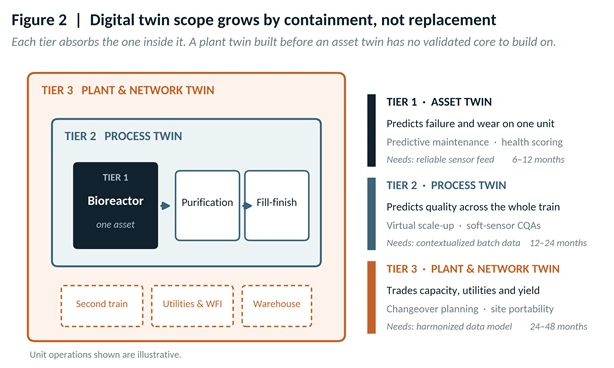
Programs that scale tend to follow the same sequence (Figure 2).
Tier one is the asset twin: a single, well-instrumented unit operation. Predictive maintenance on a lyophiliser, health scoring on a chromatography skid, cleaning-cycle optimization on a CIP loop. The value is real but bounded. The point of tier one is that it proves the data pipeline works and gives the organization its first experience of trusting a model.
Tier two is the process twin: spanning a full train from charge to hold. This is where process performance improves in ways a chief operating officer can see: virtual scale-up, soft sensors that predict critical quality attributes between assay results, and trajectory control that steers a batch toward a golden-batch profile rather than merely comparing it against one afterwards.
Tier three is the plant or network twin: capacity planning, changeover sequencing, utilities-versus-yield trade-offs, and eventually the ability to move a process between sites with model-supported comparability rather than a fresh round of empirical qualification.
The sequencing is not aesthetic. Each tier depends on the data discipline established by the one below it. Sites that begin at tier three, usually because a facility-wide platform was purchased before a single asset was properly instrumented, tend to spend their second year rebuilding tier one.
Source: author analysis.
Where Digital Twins Actually Move Process Performance
Four levers account for most of the measurable benefit.
Virtual scale-up and technology transfer: Moving a process from development to commercial scale traditionally consumes engineering batches, calendar time and product. A validated process twin allows much of that exploration to happen in silico, with physical batches reserved for confirmation. Published analyses of digital twin deployments in pharmaceutical manufacturing report technology transfer timelines shortening by roughly a quarter to a half where process understanding was strong enough to support the model.
Soft sensors and inferential quality: Many critical quality attributes cannot be measured continuously — they are sampled, sent to a laboratory, and returned hours later. A twin infers them in real time from variables that can be measured, converting quality from a retrospective verdict into a live control variable. This is the technical foundation of real-time release testing.
Yield and consistency. By identifying which input variations actually propagate to output, a twin narrows the operating envelope where narrowing matters and widens it where it does not. Reported yield improvements in the same body of analysis cluster in the ten to thirty percent range, with the upper end concentrated in biologics, where inherent variability is highest.
Asset availability and changeover: Predictive maintenance and simulated changeover sequencing recover capacity without capital expenditure — the cheapest capacity a network can add.
“Remove the return path to the plant floor and what remains is an expensive report.”
Case in Point: A Digital Twin on a Sterile Fill-Finish Line
The pattern below is generalized from publicly described deployments at large-molecule sites in North America and Europe. No individual site is identified, and the sequence is presented as an illustrative composite rather than a single project record.
A high-value sterile fill-finish line was losing throughput to two causes: rejects concentrated around start-up and post-intervention restarts, and unplanned stoppages on the stoppering station. The site began with a tier-one asset twin on the stoppering module, fed by existing vibration and torque sensors plus the line historian. Within two quarters, the model was predicting bearing degradation with enough lead time to move interventions into planned maintenance windows.
The second phase extended the model across the filling line, incorporating environmental monitoring, line speed and container-closure inspection data. The twin identified that a substantial share of start-up rejects tracked to a temperature equilibration lag no standard operating procedure had captured, because the effect only appeared when two upstream conditions coincided. The correction was procedural rather than capital: a revised hold step, validated conventionally, but discovered by a model.
Three features of this trajectory recur across successful programs. The team started with an asset that was already instrumented rather than the one that mattered most. The first year produced no closed-loop control at all — the twin was advisory, and operators were free to override it. And the business case was carried by recovered capacity, not by headcount reduction.
Validating a Digital Twin: The Regulatory Path Already Exists
The most common executive objection — that regulators have no framework for this — is out of date. There is no digital-twin-specific regulation, but there does not need to be. The relevant scaffolding is already in place: GAMP 5 and computer software assurance for the computerised system itself; ISO 23247 as a reference architecture for the twin; ALCOA+ for data integrity; and Quality by Design with continued process verification for the process science. Model-based evidence sits comfortably inside a lifecycle validation philosophy regulators have advocated for over a decade.
What is genuinely new is model drift. A validated system that behaves identically forever is a solved problem; a model whose predictive accuracy decays as raw materials, equipment and personnel change is not. Divergence between the twin and the physical process is not a nuisance to be tuned away — it is a signal that should trigger investigation, corrective action or requalification. Firms that scale successfully write drift thresholds, monitoring frequency and requalification triggers into the validation package on day one, rather than discovering the requirement during an inspection.
Two further points deserve board attention. Human-in-the-loop authority should be explicit: who may override the model, and what is recorded when they do. And a twin materially expands the cyberattack surface, because it depends on continuous connectivity between operational technology and enterprise systems. Security architecture belongs in the original project scope, not in a later remediation program.
The Digital Twin Business Case Your CFO Will Stress-Test
Software licenses are rarely the expensive part. The costs that surprise sponsors are instrumentation gaps on legacy assets, the contextualization of historian data into a coherent process model, validation effort, and the ongoing engineering required to keep models current. That last line is the one most often omitted from the appropriation request. A digital twin is not a project with an end date but an asset with a maintenance budget — closer in character to a piece of qualified equipment than to a software rollout.
Against that, the return is unusually legible when the scope is narrow. Single-asset twins on well-instrumented equipment have delivered payback inside a year for small teams, which is why the choice of first asset matters far more than the vendor comparison most steering committees actually conduct. Start where the data already exists and the physics is well understood; defer the facility-wide ambition until the organization has demonstrated it can keep three models honest.
Five Digital Twin Decisions to Make Before Capital Is Committed
- Choose the asset, not the vision: One instrumented unit operation with a clear performance gap beats a facility-wide program with a diffuse one.
- Fund the data layer before the model: Contextualized, harmonized process data is the durable asset; models are replaceable.
- Decide advisory or closed-loop at the outset: The validation burden and the change-management burden differ by an order of magnitude.
- Name a model owner in the plant, not in IT: Twins that report solely to a central digital function rarely survive contact with operations.
- Write the retirement plan: Every model has a shelf life, and the program that specifies drift thresholds and decommissioning criteria in advance is the one auditors trust.
Conclusion: Treat the Digital Twin as a Regulated Asset, Not an IT Project
The organizations extracting value from digital twins in pharmaceutical manufacturing are not the ones with the most sophisticated models. They are the ones that treated the twin as a piece of regulated plant from the first day — instrumented deliberately, validated proportionately, owned by operations, monitored for drift, and retired when it stopped earning its keep.
That reframing carries a strategic consequence. Process understanding, once encoded in a maintained model rather than held in the memory of a handful of experienced engineers, becomes transferable. It moves between sites, survives retirements, and shortens the next scale-up rather than only the current one. For an American manufacturing base being asked simultaneously to build capacity, absorb new modalities and defend margin, that compounding effect is the real argument — not the yield percentage on any single line.
The pilot phase is over. The competitive question now is how quickly an organization can make its second and third digital twins cheaper than its first.

Lakshmi is a science writer with a foundation in the laboratory. She earned her master's in biotechnology and trained through research internships at ICGEB (JNU) and DIPAS, DRDO, with her work appearing in the Egyptian Journal of Veterinary Sciences. Now APCRM-certified and part of the editorial team at Pharma Focus America and Pharma Focus Europe, she reports on pharmaceutical technology, research, and innovation — giving complex science a clear and confident voice for industry leaders.