

From Pipelines to Platforms: How AI Investments Are Transforming Biotech and Pharma’s Operating Model
Kishore Raju Vatsavai, Director, Principal Scientist, Veranova
Artificial intelligence (AI) is becoming a strategic priority across the pharmaceutical industry. Companies are investing heavily in AI to improve research productivity, accelerate drug discovery, and strengthen decision-making. Beyond efficiency gains, AI is reshaping collaboration, innovation models, and competitive dynamics, gradually shifting the industry from traditional pipelines toward more connected, data-driven ecosystems.
Introduction:
A Turning Point for Drug Discovery
Artificial intelligence has rapidly emerged as one of the defining themes in the pharmaceutical industry. Over the last few years, major drugmakers have announced a steady stream of investments, partnerships, and internal initiatives aimed at bringing AI into research and development, manufacturing, quality and commercial operations. Much of the attention has focused on faster drug discovery, which is understandable. It is hard to ignore the potential to shorten development timelines in an industry that is known for long drug development cycles and high failure rates. But the bigger story may be something else entirely. AI is beginning to change how pharmaceutical companies generate insights, make decisions, allocate capital, and work with external partners.
Recent events help explain the rapid increase in interest. In 2024, Insilico Medicine moved an AI-discovered drug candidate into clinical trials in a fraction of the time typically associated with early-stage development. Around the same period, advances such as AlphaFold 3 continued to demonstrate how computational approaches could help researchers understand biological systems at a scale that would have been difficult to imagine a decade ago. These examples do not prove that AI will solve pharma's productivity challenges, but they have undoubtedly changed the discourse.
The shift is still unfolding, and it is too early to declare winners. Yet there is growing evidence that the industry is moving away from a purely pipeline-driven model of innovation toward a more connected and data-intensive platforms approach. Whether that ultimately delivers better outcomes remains uncertain, but the path is becoming more obvious.
Why are investments increasing
Several forces are pushing pharmaceutical companies toward AI adoption at the same time. The most obvious is economics. Drug development remains extraordinarily expensive, and despite remarkable scientific advances, productivity has not always kept pace with investment. Companies continue to spend billions bringing therapies to market while facing significant uncertainty throughout the development process.
A few years ago, many AI applications in pharma were still viewed as experimental. Today, companies have access to larger datasets, more sophisticated models, and substantially greater computing power. The conversation has shifted from whether AI can contribute value to where it can create the most value.
Talent is another factor that doesn't receive enough attention. Across the industry, there is strong demand for individuals who understand both biological science and computational methods. These hybrid skill sets remain relatively scarce, which helps explain why acquisitions are sometimes driven as much by expertise as by technology.
There is also a competitive dimension. Once a handful of companies begin demonstrating measurable improvements in target identification, candidate prioritization, or decision-making speed, others inevitably take notice. In practice, AI is gradually becoming less of a differentiator and more of an expected capability.
From Pipelines to Platforms
For decades, pharmaceutical R&D was organised around a relatively straightforward principle: move promising ideas through a sequence of defined stages and eliminate risk along the way. That model is not disappearing, but it is beginning to evolve.
AI is enabling a more platform-oriented approach in which discovery takes place across networks of data, computational tools, external collaborators, and scientific expertise. Instead of depending exclusively on sequential experimentation, organisations can test and improve hypotheses through a combination of modelling and targeted lab validation.
These changes were bottlenecks that occurred. Historically, laboratory capacity often constrained progress. Increasingly, the limitations are tied to data quality, integration challenges, and the performance of underlying models. That is a significant shift.
The result is not simply faster research. More importantly, it creates tighter feedback loops between computation and experimentation. Predictions can be tested, improved and reloaded into the system much more rapidly than in traditional approaches. While the degree of impact varies from organisation to organisation, the ability to accelerate learning is significant.
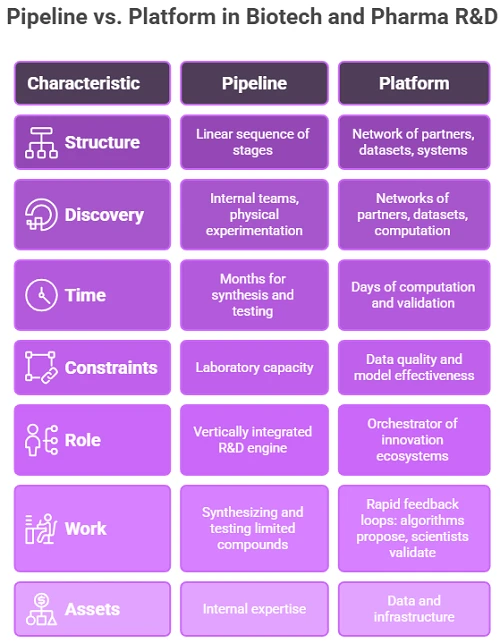
Figure 1: Pipelines to Platforms in Biotech and Pharma R&D
The New Deal Architecture
AI is also changing how pharma companies do partnerships. Instead of attempting to develop every capability internally, many are bringing together their own expertise with specialised capabilities from AI-focused biotech companies and technology providers.
The reasons are straightforward. AI is moving at pace, and few organisations can realistically be a leader in all things. Partnerships provide access to niche capabilities and expertise; internal investment enables you to retain control of your data, processes and long-term strategy. For many, the challenge is in achieving the right balance between the two.
This trend is also apparent in recent industry collaborations in which several pharmaceutical companies are collaborating with specialist companies to achieve faster progress in drug discovery, clinical development, data analytics, and more (Table 1). In a rapidly changing industry, taking the time to build everything in-house can lead to lost opportunities.
Companies that profit the most from AI are unlikely to have all of the capabilities themselves. More likely, they will be the ones that combine strong internal expertise with the innovation and agility of external partners.
Table 1: Recent AI investments and collaborations
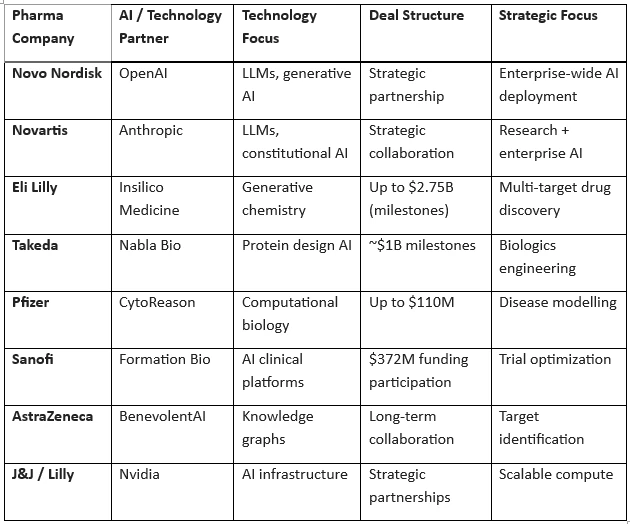
Deal structures increasingly favor milestone-based, risk-sharing models, reflecting both the promise and uncertainty of AI-driven R&D
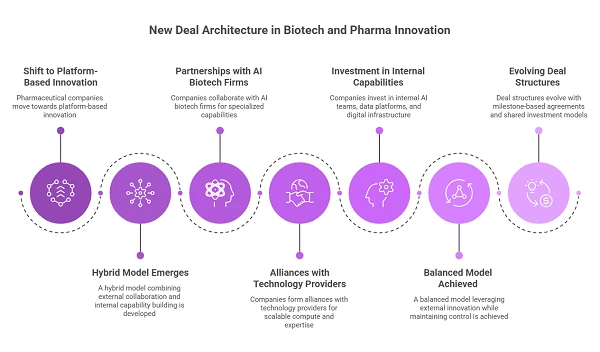
Figure 2: New Deal Architecture in Biotech and Pharma Innovation
Strategic Implications for Leadership
For senior leaders, AI is becoming less of a technology discussion and more of a business discussion.
One challenge is deciding where to build capabilities internally and where to rely on partners. Much of the best AI talent is now outside traditional pharma companies, in specialist biotech companies or large technology providers. Accessing those capabilities may help with speed, but it may also create a dependency if the partnerships are not well structured. Data is another area that deserves attention. Many organisations understand the promise of AI, but fewer have tackled the underlying data challenges in a thorough way. Fragmented systems, lack of standards, and limited interoperability are still common barriers. The reality is that even exceptional models struggle when built on weak foundations.
Many firms have learned that integrating AI at scale is more difficult than expected. Buying software is relatively easy. Building clean, accessible, and trusted data environments across a large organisation is not. Some companies may spend millions on AI initiatives only to discover that their biggest obstacle is not the model itself but the underlying data infrastructure.
Perhaps the most difficult challenge, however, is organisational. Successfully deploying AI requires changes in workflows, decision-making processes, and ways of working. Technology can be purchased. Organisational adaptation is considerably harder.
Risks and Trade-offs
There is lot of excitement about AI, but there are also reasons to be cautious. The pharmaceutical industry has had several waves of technology excitement over the years, and not all of them delivered the value they promised. AI may eventually prove transformational, but sometimes expectations outpace evidence. Execution issues cannot be discounted either. Integrating legacy systems, validating model outputs, handling cultural resistance and avoiding overdependence on outside vendors all require sustained effort. These issues may sound operational, but they often are the difference between a technology initiative’s success or failure. Regulation is also evolving. Expectations for transparency, explainability, validation, and human oversight are growing in significance.
Businesses that put trust and governance first in their AI strategy might be in a better long-term position. In other words, the question isn't whether pharmaceutical businesses should implement AI. The more important question is how they can do it properly while maintaining scientific rigor and operational discipline.
What Comes Next
Over the next few years, AI will likely become a routine part of pharmaceutical operations rather than a separate initiative. In many organisations, that transition has already started.
Most of the measurable impact today is concentrated in early discovery, but companies are increasingly exploring applications in clinical development, manufacturing, quality control, regulatory operations, and commercial decision-making. Whether or not each of those use cases provides significant value is still an open subject. If there is one lesson to be learned from previous technology cycles, it is that adoption typically advances more rapidly than outcomes.
What seems more certain is that AI alone will not create an advantage over competitors. Similar tools are becoming available across the industry. The true differentiator will be execution- the degree to which organizations integrate technology, data, scientific expertise, and decision-making. The companies that benefit most from AI will probably not be those with the most advanced models, but those that embed those capabilities into their day-to-day operations and turn insights into action time and again.
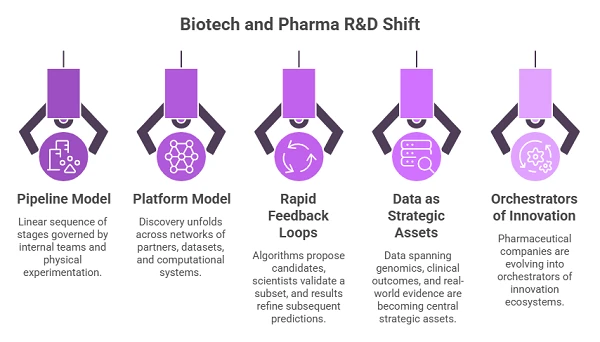
Figure 3: Impact of AI in Biotech and Pharma R&D model
Conclusion
The pharmaceutical industry is still in the early stages of understanding what AI can realistically deliver. Some expectations will certainly prove too optimistic, and other applications will create value in ways that are hard to predict today. What seems increasingly clear, however, is that AI is influencing more than just drug discovery. It is changing how companies organise research, build partnerships, make decisions, and compete. In that regard, the change is operational rather than merely technological.
The organisations that benefit most are unlikely to be those with access to the most sophisticated algorithms. More likely, they will be the ones that combine technology, scientific expertise, high-quality data, and effective execution. It’s not a particularly glamorous conclusion, but it’s probably the most realistic.
Disclaimer:
The views and opinions expressed in this article are those of the author and do not necessarily reflect the official policy or position of the affiliated organisation.
Discloser:
The figures in this article were generated using Napkin AI.
References:
- McKinsey & Company (2025). The State of AI in Pharma and Biotech. https://www.mckinsey.com/capabilities/quantumblack/our-insights/the-state-of-ai
- Nature Reviews Drug Discovery (2025). Artificial Intelligence in Drug Discovery: Recent Advances and Outlook. https://doi.org/10.1080/17460441.2021.1909567
- IQVIA (2025). Global Trends in R&D and AI Adoption in Life Sciences, https://www.iqvia.com/insights/the-iqvia-institute/reports-and-publications/reports/global-trends-in-r-and-d-2025.
- Biotechnology Innovation Organization (2025). Clinical Development Success Rates and Drug Development Trends Update. https://www.bio.org/sites/default/files/2025-06/The%20State%20of%20Emerging%20Biotech%20Companies%20-%20Investment%2C%20Deal%2C%20and%20Pipeline%20Trends.pdf
- U.S. Food and Drug Administration (2026). Guiding Principles for AI/ML in Drug Development and Clinical Submissions, https://www.fda.gov/media/189581/download
- European Commission (2026). EU AI Act – Final implementation guidance for high-risk systems. https://artificialintelligenceact.eu/article/6/
- DeepMind (2025). Advances in Protein Structure Prediction and AI for Biology (AlphaFold updates). https://deepmind.google/science/alphafold/
- Boston Consulting Group (2025). Scaling AI in Biopharma: From Pilots to Platforms. https://www.bcg.com/assets/2025/executive-perspectives-future-of-biopharma-with-e2e-ai-transformation-2dec.pdf

Kishore Raju Vatsavai is a Director and Principal Scientist at Veranova, USA, with over 20 years of experience in the pharmaceutical and biotechnology industries. He is an analytical R&D leader with expertise in analytical method development and validation, regulatory strategy, and Analytical CMC strategy for complex therapeutics. He actively follows and evaluates the adoption of artificial intelligence in the pharmaceutical and biotechnology sectors. Prior to joining Veranova, he held leadership and scientific roles at Appco Pharma, Lupin Pharmaceuticals (USA), Novel Laboratories, and Mylan (now Viatris).