


Future of Pharma IT Infrastructure: Building Agile, Secure, and Data-Driven Enterprises
Lakshmi, Editorial Team, Pharma Focus America
American pharmaceutical companies are discovering that IT infrastructure sets the ceiling on everything else: how fast a product scales, how quickly quality issues surface, how far AI can be trusted. A ransomware shutdown, a rewritten validation doctrine and a tightening security regime have moved infrastructure into the boardroom. This article maps the five layers of a modern pharma IT estate and what US executives should fund first.
The Ceiling Is in the Server Room: Why Pharma IT Infrastructure Now Sets Corporate Speed
For twenty years, pharmaceutical IT was budgeted as overhead. It kept the email running, the ERP patched and the auditors satisfied, and it was measured on uptime and unit cost. That framing is now obsolete in the United States, and the evidence arrived in 2026 from three different directions at once.
A ransomware intrusion took a critical American supplier of injectable components offline worldwide and rippled into the production schedules of the companies that depend on it. Federal regulators finalised a validation doctrine that makes changing a computerised system dramatically cheaper for firms willing to think in terms of risk rather than paperwork. And the federal security regime governing health data began moving from flexible guidance toward prescriptive, mandatory controls.
Each of these is usually filed under a different executive's agenda: the chief information security officer, the head of quality, the general counsel. Read together, they say something simpler. The speed at which a US pharmaceutical company can launch, scale, investigate a deviation, answer a regulator or deploy a model is now determined by the architecture underneath it. Infrastructure has stopped being a cost line and become a constraint on strategy — or, for the companies that get it right, a source of operating leverage that competitors cannot easily copy.
Five Layers, Five Owners: Reading the Modern Pharma IT Estate Like a Balance Sheet
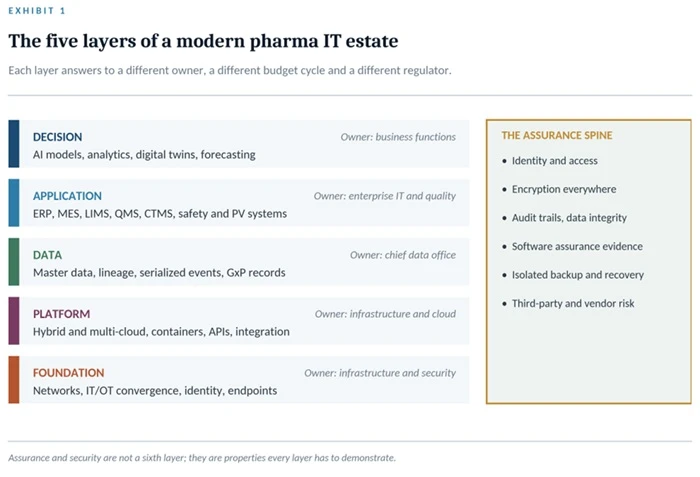
The reason infrastructure decisions stall in large pharmaceutical organisations is rarely technical. It is that the estate has five distinct layers, each with a different owner, a different funding cycle and a different regulatory exposure, and no single executive is accountable for the whole.
At the foundation sit networks, endpoints, identity and the increasingly porous boundary between information technology and the operational technology running plants. Above that is the platform layer: hybrid and multi-cloud environments, containers, integration and APIs. Then the data layer, where master data, lineage, serialized supply chain events and regulated records live. Above that, the application layer familiar to every quality organisation — enterprise resource planning, manufacturing execution, laboratory information management, quality management, clinical trial and safety systems. At the top sits the decision layer, where analytics, forecasting and AI models turn all of it into judgements.
The instructive part is what does not fit into any layer. Identity, encryption, audit trails, assurance evidence, recovery capability and third-party risk are not a sixth tier to be bolted on afterwards; they are properties every layer has to be able to demonstrate on demand. When American executives ask why a modernisation programme is running late, the answer is frequently that the assurance work was scoped as a final phase rather than as a design requirement in each of the five.
The End of Validation Theater: How Risk-Based Assurance Unfreezes Pharma IT
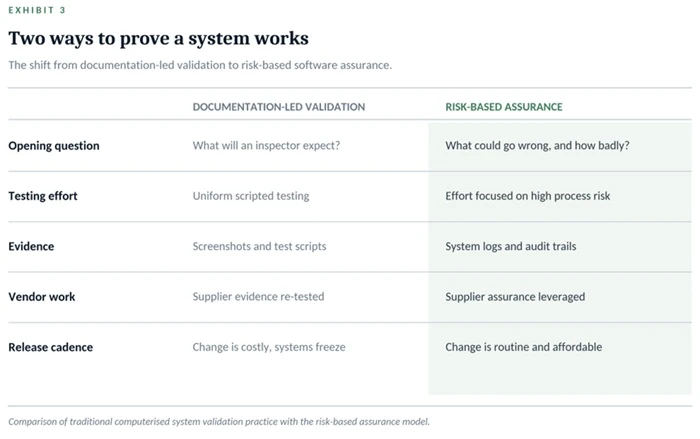
The single most underexploited development in US pharmaceutical IT is the shift from documentation-led computerised system validation to risk-based software assurance. The final federal guidance on computer software assurance for production and quality system software, issued in September 2025, formalises an approach that had been building since 2022: concentrate testing effort where process risk is high, use unscripted and exploratory testing where it is not, and stop duplicating work a supplier has already done.
Three provisions matter commercially. Firms are encouraged to leverage vendor and cloud assurance artefacts — certifications, audit reports, software bills of materials — rather than re-testing mature commercial software in-house. System logs and audit trails are endorsed as evidence in place of screenshots and printed test scripts. And the volume of documentation is expected to scale with risk rather than be applied uniformly. Electronic records rules still apply, and validation of production and quality system software is not among the requirements subject to enforcement discretion, so this is a reallocation of effort rather than a relaxation.
The strategic consequence is a change in the cost of change. Under the old model, the expense of revalidation encouraged organisations to freeze systems, which is precisely how a US pharmaceutical company ends up running production-critical software several major versions behind, with a security posture to match. When assurance becomes proportionate, patching, upgrading and cloud migration become routine operations rather than capital projects. Agility and security stop competing for the same budget.
Case Study: The Fortnight a Ransomware Attack Took a Sterile Supply Chain Offline
On 4 May 2026, a Pennsylvania-based manufacturer of injectable packaging and drug delivery components detected an intrusion in its systems. Attackers exfiltrated data and encrypted parts of the network. The company determined the incident to be material and disclosed it to securities regulators three days later, then took systems offline globally as a containment measure. Manufacturing, shipping and receiving were disrupted across multiple international sites.
What followed is the part American executives should study. Restoration was phased across enterprise systems, then logistics, then production, and the company reported that its manufacturing, supply chain and commercial sites were fully operational globally roughly a fortnight after detection. That is a comparatively strong recovery. It was still a fortnight in which customers depending on those components for the sterile core of injectable production had to manage without them.
Three lessons generalise. The first is that the containment decision is itself the operational damage: taking systems down globally was the responsible response, and it cost production regardless of what the attackers did. Organisations that cannot isolate segments of the estate have only one lever, and it is a blunt one. The second is that the exposure was other people's. The disruption landed on pharmaceutical manufacturers who had no visibility into that supplier's controls and no contractual mechanism to obtain it. The third is the disclosure clock. In the US, a material cybersecurity incident becomes a securities matter within days, which means the chief financial officer and general counsel are now stakeholders in network architecture decisions they have historically never reviewed.
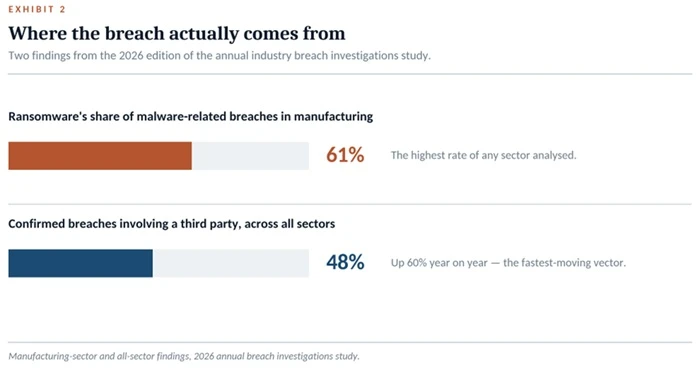
The wider data supports treating this as a pattern rather than an outlier. In the 2026 edition of the annual industry breach investigations study, ransomware featured in 61 percent of malware-related breaches in manufacturing, the highest share of any sector analysed, while third-party involvement in confirmed breaches across all sectors rose sixty percent year on year to reach nearly half of all cases.
Your Data Layer Is a Franchise Asset — Most Pharma Balance Sheets Don't Show It
Ask a US pharmaceutical executive what the company's most valuable intangible is and the answer will be intellectual property. The more accurate answer, increasingly, is the regulated data estate: the batch records, analytical results, clinical datasets, safety cases and serialized distribution events that collectively constitute the evidence base for every product on the market.
Federal supply chain security requirements have already forced part of this transition. Manufacturers, repackagers, wholesale distributors and large dispensers are past their exemption dates for interoperable, package-level electronic tracing, with the remaining category of small dispensers still working through a further extension. For most manufacturers, that means a serialized event stream now exists as a matter of compliance. Very few companies have asked what else it could support — diversion detection, recall precision, channel analytics, demand sensing — because the data was built to satisfy a rule rather than to be used.
The same pattern shows up wherever AI is deployed. Models fail in regulated environments less often because the algorithms are weak than because the data cannot be traced to a defensible origin. Provenance, lineage and integrity are infrastructure properties; if they are absent at the data layer, no amount of investment at the decision layer will recover them. The practical test for a US board is whether the organisation can answer, for any analytical output that influenced a regulatory submission, where every input came from and what happened to it along the way.
Concentration Risk: The Pharma IT Question Every US Board Should Be Asking Its Vendors
Modernisation has quietly concentrated pharmaceutical operational risk into a small number of external platforms. That is largely a good trade — hyperscale providers and specialist software vendors run better security programmes than most in-house teams — but it changes the nature of the exposure from technical failure to counterparty dependence.
Two concrete disciplines follow. The first is contractual: the right to obtain assurance evidence, security certifications, breach notification within defined hours, and support during a regulatory inspection should be negotiated at signature, when leverage exists, not requested during an incident. The second is architectural: knowing which single vendor failure would halt release testing, batch disposition or distribution, and deciding deliberately whether that concentration is acceptable.
Regulatory direction reinforces this. The proposed federal overhaul of health data security rules would eliminate the long-standing distinction between required and addressable safeguards, making controls such as encryption and multi-factor authentication mandatory and adding explicit expectations around vendor oversight. Its final publication has slipped repeatedly, and the current regulatory agenda points well beyond this year. Executives who read that delay as permission to wait are misjudging it: the enforcement pattern in recent settlements already tracks the proposed requirements, and the controls in question are ones a serious organisation would want regardless of what the final rule eventually says.
There is a design principle underneath both disciplines: build for replacement. Encryption standards will change, vendors will be acquired, cloud economics will shift, and a system architected on the assumption that none of that will happen becomes a liability the moment one of them does. Portability of data, modular integration and the ability to swap a cryptographic library or a hosting provider without re-engineering the application are not theoretical virtues. They are what allows an infrastructure estate built in 2026 to still be defensible, and affordable, in 2032.
Conclusion: Agile, Secure and Data-Driven — and Actually Paid For
The three words in the brief pull in different directions if infrastructure is funded the old way. Agility argues for rapid change; security argues for control; data-driven decision-making argues for consolidation and lineage that neither of the others pays for. Treated as a single architecture rather than three competing budgets, they reinforce each other: proportionate assurance makes patching affordable, segmentation makes containment survivable without shutting down the enterprise, and a governed data layer makes both auditable.
For an American pharmaceutical C-suite, the practical agenda is narrower than the technology conversation suggests. Know what is in the estate and who owns each layer. Move validation effort from documentation to risk. Build the ability to isolate rather than only to switch off. Treat the regulated data estate as an asset with a named custodian. And negotiate assurance and exit rights with the vendors on whom production now depends.
None of this is a transformation programme with a ribbon-cutting. It is the unglamorous work of raising the ceiling that infrastructure places over every other ambition in the company — and in a sector where a fortnight of downtime is measured in patients rather than in quarters, that ceiling is now a strategic number, not a technical one.

Lakshmi is a science writer with a foundation in the laboratory. She earned her master's in biotechnology and trained through research internships at ICGEB (JNU) and DIPAS, DRDO, with her work appearing in the Egyptian Journal of Veterinary Sciences. Now APCRM-certified and part of the editorial team at Pharma Focus America and Pharma Focus Europe, she reports on pharmaceutical technology, research, and innovation — giving complex science a clear and confident voice for industry leaders.