


Future-Proofing Biopharma: Integrating AI, Advanced Modalities, and Smart Manufacturing
Lakshmi, Editorial Team, Pharma Focus America
American biopharma is entering a decade in which advantage will belong to companies that connect three forces usually managed apart: artificial intelligence, advanced therapeutic modalities and smart manufacturing. This article shows why new modalities now dominate pipeline value, how AI is moving from the laboratory onto the plant floor, and how new FDA programs reward automated, domestic production, drawing lessons from a robotic cell therapy platform for C-suite leaders.
Introduction: Why AI, Advanced Modalities and Smart Manufacturing Must Converge Now
For decades, the US biopharmaceutical industry organized itself in sequence. Scientists discovered a molecule, developers proved it worked, and manufacturing teams worked out how to make it at scale, often late and under pressure. That relay model was tolerable when most medicines were small molecules produced in familiar ways. It is poorly suited to an era defined by antibody–drug conjugates, bispecifics, cell and gene therapies and RNA medicines, where the process frequently is the product.
Three shifts are forcing a rethink. Advanced modalities have become the main source of pipeline value. Artificial intelligence has matured from experimental pilots into tools that can predict process outcomes, flag quality deviations and orchestrate complex operations. And US policy is now actively rewarding companies that build advanced, domestic production capacity.
Each shift matters on its own. Together, they change what future-proofing means for an American pharma enterprise. Resilience will no longer come from a strong pipeline or an efficient plant in isolation, but from an operating model in which modality science, data and manufacturing are designed as a single system from the outset. This article examines the evidence behind each force, the regulatory momentum in Washington, and a case study showing what integration looks like in practice.
“The companies that win the next decade will not simply discover better medicines; they will be the ones able to make them reliably, affordably and at scale.”
Advanced Modalities Now Carry the Pharma Pipeline's Center of Gravity
The balance of the industry's future revenue has tipped. New modalities accounted for an estimated US$197 billion, or 60%, of total projected pharma pipeline value in 2025, up from US$168 billion and 57% a year earlier. Established formats, including monoclonal antibodies, antibody–drug conjugates, bispecifics and CAR-T therapies, are growing robustly, while some newer platforms such as certain gene, mRNA and non-CAR-T cell therapies have seen momentum slow.
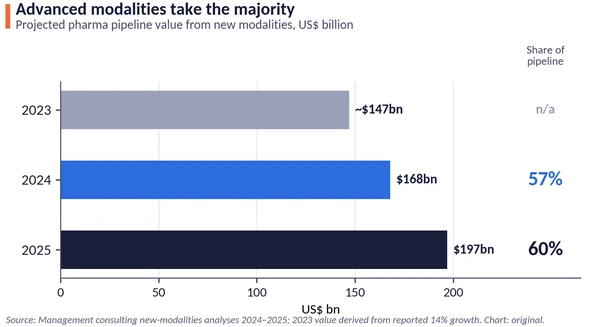
Figure 1: New modalities now represent the majority of projected pharma pipeline value, rising steadily since 2023.
That uneven picture carries a clear message for American boards. Scientific promise alone no longer guarantees commercial success. The modalities that are winning are those with manufacturing processes that can be industrialized, standardized and scaled. Those that are struggling frequently face the opposite problem: complex, manual, patient-specific production that drives costs up, limits capacity and slows access.
The implication is that manufacturing capability has become a strategic filter on portfolio choices. Before committing hundreds of millions of dollars to a novel platform, leadership teams need a credible view of how, where and at what cost the resulting therapy will be produced once demand arrives.
AI Beyond the Lab Bench: The Pharma Value Chain's New Operating System
Public conversation about artificial intelligence in pharma still centers on molecule design. The larger near-term financial opportunity, however, sits downstream in chemistry, manufacturing and controls, quality assurance and supply operations, where decisions repeat thousands of times a year and small gains compound quickly.
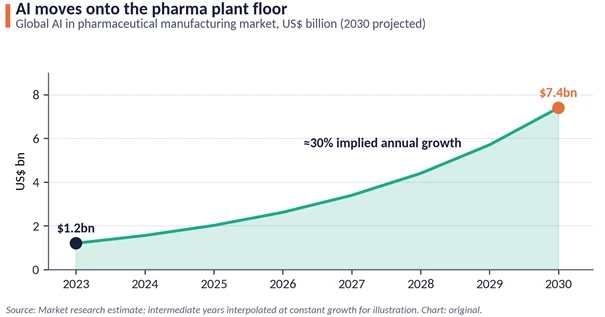
Figure 2: Market estimates point to rapid growth in AI applications for pharmaceutical manufacturing through 2030.
Market researchers value the global AI in pharmaceutical manufacturing segment at about US$1.2 billion in 2023, with projections above US$7.4 billion by 2030, implying growth of roughly 30% a year. The applications driving that growth are practical. Digital twins simulate bioreactor behavior before a single liter is run. Machine learning models forecast batch yield and critical quality attributes in real time, allowing operators to intervene before a deviation becomes a rejected lot. Computer vision inspects vials and syringes with greater consistency than manual review, and demand-sensing algorithms help align production schedules with fluctuating orders.
Regulators are engaging rather than standing aside. In January 2025, FDA issued draft guidance setting out a risk-based framework for establishing the credibility of AI models used to support regulatory decisions on drugs and biologics, and the agency has signaled further guidance on AI quality considerations in manufacturing. For executives, the message is that AI deployed in regulated settings must be treated like any other validated system: with defined context of use, documented training data, lifecycle monitoring and clear human accountability.
Smart Manufacturing Becomes Pharma's Competitive Moat
Smart manufacturing describes production environments in which automation, continuous processing, closed systems and connected data work together. For advanced modalities, the economic case is especially strong. Many cell therapy processes still depend on skilled operators moving materials between open instruments inside high-grade cleanrooms, an approach that is expensive, slow to scale and vulnerable to contamination.
Closing and automating those unit operations changes the cost structure. Engineering analyses indicate that fully closed processes can allow facilities to operate in lower-grade cleanroom environments, reducing air changes, gowning and environmental monitoring, and cutting energy intensity by about three times compared with the highest-grade operations. At the same time, cell expansion steps that once took seven to fourteen days are being compressed to under three days in advanced processes, freeing incubator capacity and accelerating release.
These gains matter beyond the plant. Shorter vein-to-vein times improve outcomes for critically ill patients, lower costs support payer negotiations, and reliable capacity underpins launch confidence. In an environment where pricing scrutiny in the United States continues to intensify, manufacturing efficiency is increasingly a lever for protecting margin and expanding access simultaneously.
The Digital Thread: Integrating AI, Modalities and Manufacturing into One Pharma Strategy
The real prize lies not in any single technology but in connecting them. Leading organizations are building what engineers call a digital thread: a governed data backbone that carries information continuously from modality design through process development, technology transfer, production, release and patient supply.
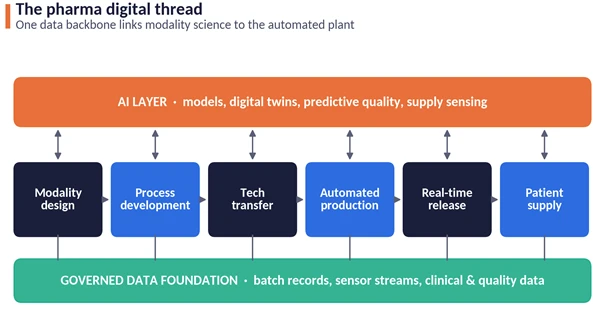
Figure 3: A connected pharma digital thread allows AI to learn across the full lifecycle rather than within isolated functions.
When process data generated in early development flows directly into commercial manufacturing systems, technology transfer becomes faster and less error-prone. When batch and sensor data are standardized, AI models can learn across products and sites instead of being rebuilt for each. And when quality systems are digital from the start, real-time release testing becomes feasible, shortening the gap between production and patient.
Table 1: Three pillars of the future-proof pharma enterprise
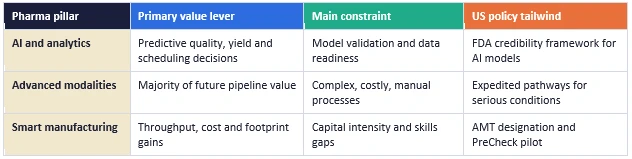
Building this thread is primarily an organizational challenge rather than a technical one. It requires research, manufacturing, quality and IT leaders to agree on shared data standards and joint accountability, a discipline that many US companies have historically left fragmented across functions and acquired sites.
FDA Opens a Faster Lane for Smart Pharma Manufacturing
Washington has moved from encouraging advanced manufacturing to actively rewarding it. FDA finalized guidance for its Advanced Manufacturing Technologies designation program at the end of 2024, offering early engagement and more efficient assessment for applications that rely on qualifying technologies. The first designation, granted in April 2025, went to an automated cell therapy manufacturing platform.
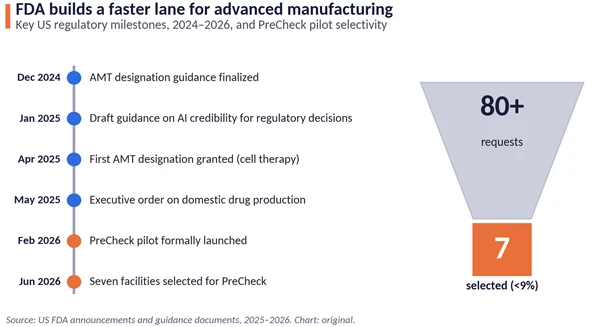
Figure 4: US regulatory programs now provide earlier engagement and faster review for advanced, domestic pharma manufacturing.
Following a May 2025 executive order to strengthen domestic drug production, the agency formally launched its Pre Check pilot in February 2026. The program engages companies during facility design and construction, then supports a streamlined manufacturing section in subsequent marketing applications. In June 2026, FDA selected seven participants from more than 80 requests, a selection rate below 9%, using criteria that included product type, facility readiness, market timeline and manufacturing innovation.
For C-suite leaders weighing where and how to invest in new US capacity, these programs change the calculation. Innovation in manufacturing is now a factor that can shorten regulatory timelines, not merely an engineering preference. Capital plans that pair domestic expansion with genuinely advanced technology are better positioned to secure these advantages.
Case Study: Robotic Cell Therapy Manufacturing Earns a Regulatory Head Start
A California-headquartered cell therapy manufacturing company offers a clear illustration of integration in action. Rather than scaling cell therapy the conventional way, by adding more cleanrooms and more operators, the company built an end-to-end robotic platform in which each manufacturing run takes place inside a sealed, single-use cartridge moved between stations by automation. A companion system automates in-process and release quality testing, producing fully digital batch records.
The reported operating metrics are striking. Each platform unit processes up to 16 batches in parallel. The company states that its facilities can deliver roughly ten times the batch throughput of a conventional contract manufacturer with the same footprint and headcount, while reducing the cleanroom space required by about 90%. Because FDA confirmed that the consumable cartridge constitutes a fully closed system, multiple patients' therapies and multiple products can be produced concurrently without cross-contamination risk.
Figure 5: Reported performance of a robotic, closed cell therapy platform compared with conventional pharma manufacturing approaches.
Regulatory recognition has followed. In April 2025, the platform became the first technology to receive FDA's Advanced Manufacturing Technologies designation, giving developers who reference it in their filings additional agency touchpoints and priority review mechanisms. In June 2026, its New Jersey facility was selected for the inaugural Pre Check cohort, the only cell therapy platform among the seven chosen.
Commercial validation has come through partnerships. A large US pharmaceutical company signed a manufacturing agreement valued at up to US$380 million, and in January 2026 a commercial-stage CAR-T developer began evaluating the platform to support expansion into new indications.
The strategic lesson extends well beyond cell therapy. By treating manufacturing as a technology platform instead of a cost center, the company turned an operational bottleneck into a regulatory and commercial advantage. For established pharma companies, the case suggests that investing in, partnering with or building similar capabilities can materially de-risk advanced modality portfolios.
Leading the Convergence: Pharma Talent, Data and Capital for the AI Manufacturing Era
Technology rarely fails on its own; organizations fail to absorb it. Three leadership priorities stand out for American executives.
The first is talent. The future pharma workforce will need process engineers fluent in data science, quality professionals comfortable validating algorithms, and plant leaders who can manage human-machine teams. Partnerships with universities and community colleges, alongside structured reskilling programs, are becoming as important as capital equipment.
The second is data governance. AI is only as reliable as the information it learns from. Harmonizing data across legacy sites, many of them inherited through acquisitions, and securing it against growing cyber threats should be a board-level priority rather than an IT project.
The third is capital allocation. Manufacturing investment decisions should be evaluated alongside portfolio decisions, not after them. Boards that ask how a new modality will be produced, and whether that process can qualify for faster regulatory pathways, will make better choices about which science to back.
Conclusion: Building the Future-Proof Pharma Enterprise
The convergence of AI, advanced modalities and smart manufacturing is not a distant scenario; it is already reshaping which pharma companies grow, which platforms scale and which therapies reach patients on time. Advanced modalities now define the majority of pipeline value, AI is proving its worth on the plant floor, and FDA has created tangible incentives for companies that modernize production at home.
For American C-suite leaders, the task is to stop managing these forces in separate silos. Companies that connect modality strategy, data infrastructure and manufacturing investment into one coherent plan will launch faster, operate more efficiently and withstand policy and pricing pressure more effectively. Those that continue to treat manufacturing as an afterthought risk owning promising science they cannot deliver. Future-proofing biopharma ultimately means building the capability to turn breakthrough biology into dependable medicine, at scale and on American soil.

Lakshmi is a science writer with a foundation in the laboratory. She earned her master's in biotechnology and trained through research internships at ICGEB (JNU) and DIPAS, DRDO, with her work appearing in the Egyptian Journal of Veterinary Sciences. Now APCRM-certified and part of the editorial team at Pharma Focus America and Pharma Focus Europe, she reports on pharmaceutical technology, research, and innovation — giving complex science a clear and confident voice for industry leaders.