
Future-Proofing Pharmaceutical Manufacturing: AI, Automation, and Digital Transformation
Lakshmi, Editorial Team, Pharma Focus America
American pharmaceutical manufacturing is entering its most consequential modernization since the adoption of good manufacturing practice. Artificial intelligence, advanced automation and connected data platforms are moving from pilot projects to production lines, reshaping how medicines are made, tested and released. This article examines the economic case for AI-enabled pharmaceutical manufacturing, the regulatory programs now rewarding innovation, a real-world predictive maintenance deployment, and the rise of agentic AI in quality operations. It closes with the leadership decisions that will separate resilient manufacturers from those left managing legacy plants.
The Pharmaceutical Manufacturing Reset: Why AI Has Reached the Plant Floor
For decades, pharmaceutical manufacturing innovation moved slowly by design. Validated processes were expensive to change, regulators rewarded consistency, and the safest strategy was to run proven equipment for as long as possible. That conservatism protected patients, but it also left the industry with plants that, in many cases, still rely on paper batch records, calendar-based maintenance and quality reviews conducted weeks after a product is made.
That model is now under pressure from every direction. Drug shortages have become a recurring national concern. Product portfolios are shifting toward biologics, cell and gene therapies, peptides and personalized medicines that demand far tighter process control. Margins are being squeezed by pricing reform, and a generation of experienced operators is approaching retirement. Against this backdrop, AI, automation and digital transformation are no longer innovation-lab experiments. They are becoming the operating foundation for American pharmaceutical manufacturing over the next decade, and a central item on the C-suite agenda.
From Automation Islands to the Intelligent Pharmaceutical Plant
Automation itself is not new to the industry. Distributed control systems, programmable logic controllers and supervisory software have run pharmaceutical equipment for years. The problem has been fragmentation. A typical site operates dozens of systems that do not talk to one another: a historian capturing sensor data, a laboratory information system holding test results, a maintenance platform tracking work orders and an enterprise system managing materials. Each automates a task; none provides a coherent picture of the plant.
Digital transformation in pharmaceutical manufacturing is fundamentally about connecting these islands. When process, quality, equipment and supply data share a common model, AI can do what humans struggle to do at scale: detect subtle patterns across thousands of variables, anticipate failures before they occur and recommend corrective action in real time. The intelligent plant is therefore less a single technology than an architecture, in which data infrastructure, analytics and automation reinforce one another.
This architecture also changes the role of continuous manufacturing, process analytical technology and digital twins. Each delivers value on its own, but together they allow a facility to monitor product quality while it is being made, simulate process changes before they are executed and adjust operations dynamically rather than waiting for end-of-batch testing.
Follow the Capital: The Economics of AI in Pharmaceutical Manufacturing
Investment trends confirm the shift. The global market for AI in pharmaceuticals was valued at roughly USD 1.2 billion in 2024 and is projected to reach about USD 5.8 billion by 2030, a compound annual growth rate of approximately 30 percent. The United States alone accounted for an estimated USD 315 million of that 2024 total.
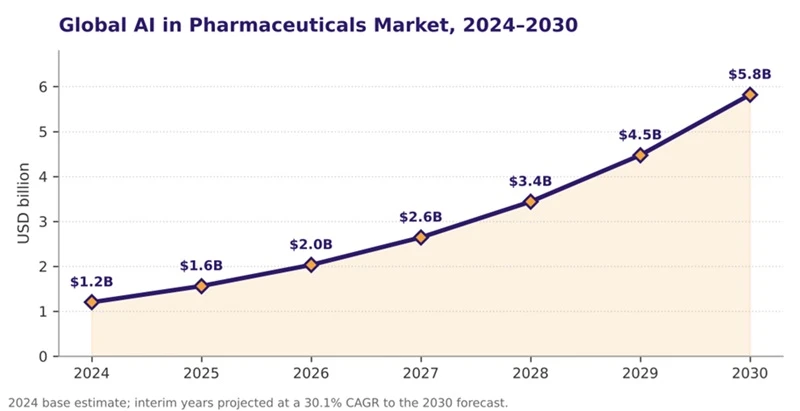
Figure 1: Global AI in pharmaceuticals market outlook, 2024–2030 (USD billion). Interim years projected at a 30.1% CAGR from industry market estimates.
For executives, the more relevant metric is return on operations. Manufacturing and quality functions typically represent a substantial share of a pharmaceutical company's cost of goods, and a large portion of that spend is consumed by deviations, investigations, unplanned downtime, batch failures and manual documentation. These are precisely the areas where AI delivers measurable gains. A single prevented batch loss for a high-value biologic can exceed the full cost of a digital program, which is why boards are increasingly evaluating AI investments on risk-adjusted value rather than as discretionary IT spending.
“The question for American pharmaceutical boards is no longer whether to digitize manufacturing, but how quickly they can scale what already works.”
Washington's New Playbook: Regulation as an Accelerator of Digital Transformation
One of the most important changes for American leaders is that the regulatory environment has moved from cautious tolerance to active encouragement. In January 2025, the US Food and Drug Administration finalized guidance for its Advanced Manufacturing Technologies Designation Program. The program recognizes technologies that can improve the speed, reliability and supply of critical medicines, including continuous manufacturing, modular platforms and advanced process analytics. Applications that rely on a designated technology receive additional early-stage engagement and a dedicated agency point of contact.
In August 2025, the agency announced a voluntary program to expedite reviews of new domestic manufacturing sites. It allows companies to engage with regulators during facility design, construction and pre-production, and to prepare streamlined chemistry, manufacturing and controls submissions. In parallel, the FDA has issued draft guidance on how artificial intelligence used to support regulatory decision-making should be assessed for credibility within its specific context of use.
The strategic implication is significant. Companies that build new or modernized plants around digital and AI-enabled processes from the outset can now align with regulators earlier and reduce the uncertainty that historically discouraged innovation. Regulatory engagement has become a competitive lever rather than a constraint.
Case Study: AI-Driven Predictive Maintenance Across a Biomanufacturing Network
A recent deployment by a major global vaccine and biologics manufacturer illustrates how quickly AI can move from concept to value when the data foundation is addressed first. The company had relied on fixed, time-based maintenance schedules. The result was a familiar set of problems: unnecessary servicing of healthy equipment, longer turnaround times, avoidable product discards and unplanned shutdowns. Equipment data was scattered across separate systems, making reliable failure prediction impossible.
The manufacturer began by unifying more than 400 time-series sensor tags, maintenance work orders, vibration signals and asset information into a single data model across two lighthouse facilities. More than 200 machine learning models were developed and evaluated to flag high-risk equipment behavior, with alerts that explained which sensors drove each prediction and what action engineers should take. For a critical centrifuge, a high-frequency model analyzed second-by-second readings to detect emerging issues within windows as short as 20 seconds.
Initial deployment across both sites took about 12 weeks, and the second facility was brought online in roughly four weeks by reusing the same approach. The system correctly predicted downtime risks for critical assets, including an ultrafiltration feed pump and a water sanitization cycle. The company projects annual economic benefits exceeding EUR 10 million per facility and is now extending the program to additional sites and equipment.
Three lessons stand out for American executives. Data integration determined the pace of success more than algorithm sophistication. Explainable outputs were essential for engineers and quality teams to trust and act on recommendations. And a reusable, templated approach turned a single pilot into a scalable network capability, which is where the real enterprise value lies.
Agentic AI and the Future of Quality and Batch Release
If predictive maintenance represents the first wave of AI in pharmaceutical manufacturing, quality operations represent the next. Batch record review, deviation investigation and release decisions remain among the most labor-intensive and time-consuming steps in the value chain. Finished products can wait days or weeks for documentation review even when every parameter was within specification.
Agentic AI, systems that can plan and execute multistep tasks under human oversight, is beginning to change this. These tools can review electronic batch records against specifications, flag only genuine exceptions, assemble the data needed for an investigation, draft root-cause hypotheses and route findings to qualified reviewers. The human remains accountable for the decision, but the time spent on routine verification falls sharply. Over time, combined with real-time process monitoring, this approach points toward review-by-exception and faster, more confident batch release, with direct implications for inventory, working capital and supply responsiveness.
The governance requirements are equally clear. AI used in quality decisions must be validated for its intended purpose, monitored for drift, protected under data integrity principles and auditable by inspectors. Leaders who treat AI governance as part of the pharmaceutical quality system, rather than as a separate technology policy, will move faster with less regulatory risk.
The Human Factor: Building a Workforce for Digital Pharmaceutical Manufacturing
Automation does not eliminate the need for people; it changes the skills they need. The pharmaceutical manufacturing workforce of the next decade will combine process science, data literacy, automation engineering and regulatory judgment. Operators will increasingly supervise automated systems and interpret AI recommendations rather than perform repetitive manual tasks.
This transition is both a challenge and an opportunity. AI-assisted guidance, augmented-reality training and digital twins can capture the knowledge of retiring experts and accelerate the readiness of new hires. Companies that invest in structured reskilling, cross-functional digital teams and clear career paths for technical talent will be better positioned to compete for a limited pool of specialists.
The Executive Agenda for AI-Enabled Pharmaceutical Manufacturing
For American C-suite leaders, future-proofing begins with treating data as a manufacturing asset. Without integrated, well-governed and contextualized data, even the most advanced AI models will underperform. Investment in data architecture is the foundation on which every other digital capability depends.
It continues with a portfolio approach to value. Rather than funding scattered pilots, leading organizations prioritize a small number of high-impact use cases, such as predictive maintenance, yield optimization, deviation reduction and accelerated release, prove them at lighthouse sites, and scale them deliberately across the network. Success is measured in operational outcomes rather than technology milestones.
Finally, it requires leadership alignment. Digital transformation in pharmaceutical manufacturing cuts across operations, quality, IT, regulatory affairs and finance. Organizations that assign clear executive ownership, embed AI governance in the quality system and engage regulators early will capture value far faster than those that treat digitization as a series of disconnected projects.
Conclusion: Future-Proofing Pharmaceutical Manufacturing Starts in the Boardroom
The convergence of AI, automation and digital transformation is redefining what world-class pharmaceutical manufacturing looks like. Plants that once relied on fixed schedules, paper records and retrospective quality checks are evolving into connected, predictive and adaptive operations. Regulators are signaling support, proven use cases are delivering measurable returns and the technology is maturing rapidly.
What remains is a leadership decision. For American pharmaceutical companies, the next five years will determine which organizations operate resilient, intelligent manufacturing networks and which remain constrained by legacy infrastructure. The future of pharmaceutical manufacturing will not be built on technology alone, but on executives willing to make data, AI and people the core of their manufacturing strategy today.

Lakshmi is a science writer with a foundation in the laboratory. She earned her master's in biotechnology and trained through research internships at ICGEB (JNU) and DIPAS, DRDO, with her work appearing in the Egyptian Journal of Veterinary Sciences. Now APCRM-certified and part of the editorial team at Pharma Focus America and Pharma Focus Europe, she reports on pharmaceutical technology, research, and innovation — giving complex science a clear and confident voice for industry leaders.