Generative AI in Clinical Operations: Optimizing Protocol Development and Site Selection
Lakshmi, Editorial Team, Pharma Focus America
Protocol complexity and underperforming investigator sites remain two of the largest controllable drivers of cost and delay in pharmaceutical development. Generative AI offers a practical route to both: drafting and stress-testing protocols against historical evidence, and ranking sites on predicted enrolment rather than reputation. This article examines where the technology creates measurable value in clinical operations, the governance it demands, and the decisions that belong on the C-suite agenda.
Introduction
The pharmaceutical industry has industrialised almost every part of drug development except the part that consumes the most money. Target identification is computational. Molecule design is computational. Manufacturing is instrumented to the batch record. Yet the clinical protocol — the single document that dictates how many patients are needed, how often they must travel, what data will be collected and, ultimately, whether the asset reaches the market on schedule — is still largely a craft exercise, assembled by a handful of experts working under time pressure from templates and precedent.
The consequences are measurable. Most late-phase protocols are amended after approval, most amendments are avoidable, and roughly half of activated investigator sites never reach the enrolment they were selected to deliver. Each of those failures is paid for twice: once in direct rework and site-activation cost, and again in the far larger currency of delayed launch, where the cost of a lost day is commonly modelled in the hundreds of thousands to several millions of dollars for a significant asset.
Generative AI has moved past pilot theatre in exactly these two areas. Grounded in a sponsor's own historical protocols, study reports, operational databases and real-world evidence, large language models can now draft protocol sections, interrogate eligibility criteria against actual patient populations, and assemble the evidence packs that underpin country and site selection. What follows is a practical read for pharmaceutical leadership: where the value is real, where it is overstated, and what governance the technology demands before it touches a regulated document.
The Amendment Tax: Generative AI's First Target in Pharma R&D
Protocol amendments are the clearest financial signal that design and reality have diverged. Benchmarking work across the industry consistently shows that the majority of Phase III protocols require at least one substantial amendment, that the direct cost of executing one runs into the hundreds of thousands of dollars, and that a substantial amendment typically adds several weeks to months of cycle time once ethics committee re-submissions, re-consenting and site re-training are accounted for.
More striking is the attribution. A significant share of these amendments is classified by sponsors themselves as avoidable — driven not by new safety information or regulatory requests, but by eligibility criteria that proved unworkable at the bedside, assessment schedules that sites could not staff, or endpoints that were never pressure-tested against how the data would actually be collected. Those are design defects, and design defects are precisely the class of problem that responds to better evidence at the drafting stage.
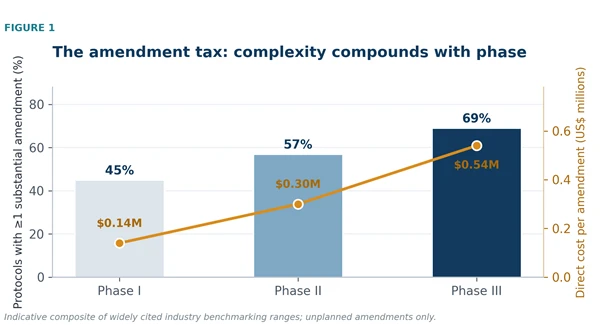
Figure 1: The frequency and unit cost of substantial protocol amendments both rise with phase, concentrating avoidable rework in the most expensive studies a sponsor runs.
Blank Page to Blueprint: How Generative AI Drafts a Protocol
The most productive deployments of generative AI in protocol development are not open-ended chat. They are retrieval-grounded systems: the model is constrained to a curated corpus of the sponsor's prior protocols, clinical study reports, statistical analysis plans, regulatory correspondence, therapeutic-area guidance and published trial registries, and is required to cite the source of every proposition it generates.
Within that architecture, the model produces a first-draft synopsis, background section, objectives-and-endpoints table and schedule of assessments in hours rather than weeks, each element traceable to precedent. Study teams stop authoring boilerplate and start adjudicating choices. The medical writer's role shifts from producing text to interrogating it — a materially better use of scarce clinical and regulatory expertise, and one that tends to surface disagreements about endpoint definitions early, when they are cheap to resolve.
The second capability matters more than the drafting. Because the model can compare a draft against hundreds of comparable studies, it can flag where a design departs from precedent without justification: an unusually long washout, a visit window narrower than the therapeutic-area norm, a biomarker sub-study that historically drove consent refusals. This is protocol review at a scale no human team can replicate, delivered before the document is circulated for approval.
Study teams stop authoring boilerplate and start adjudicating choices — and disagreements about endpoints surface early, when they are still cheap to resolve.
AI-Tested Eligibility: Designing Around Real Patients, Not Templates
Eligibility criteria are where good science quietly becomes bad operations. A laboratory threshold set one decimal place too tight, a prior-therapy exclusion written for a previous standard of care, a washout that no treating physician will accept — each looks defensible in isolation and collectively renders a trial unrecruitable.
Coupling a generative interface to de-identified electronic health record and claims data changes this conversation from opinion to arithmetic. Teams can run a draft inclusion and exclusion set against a real population and see, criterion by criterion, how many otherwise eligible patients each one removes and which subgroups are disproportionately excluded. The same approach exposes representativeness gaps that regulators and payers increasingly expect sponsors to address, allowing diversity plans to be built into the design rather than retrofitted.
Burden modelling follows the same logic. Assessment schedules can be scored for patient time, travel, invasive procedures and site staffing hours, with the model generating a plain-language summary of what participation actually involves — material that can be tested with patient advisory boards and investigators weeks before the protocol is locked. Reducing procedures that serve no primary or key secondary endpoint is one of the few interventions that simultaneously improves retention, lowers data-management cost and shortens the study.
Site Selection: The Costliest Guess AI Can Now Replace
If protocol design sets the difficulty of a trial, site selection determines whether that difficulty is survivable. The industry's long-standing pattern is well documented: a meaningful minority of activated sites enrol no participants at all, a further substantial share enrol below plan, and a small group of high performers quietly carries the study. Every non-performing site still consumes contracting, budgeting, regulatory submission, initiation, training, monitoring and close-out effort — a fixed cost incurred for zero output.
The root cause is the evidence base. Selection has traditionally rested on prior relationships, investigator reputation and self-reported feasibility questionnaires — instruments in which sites are asked to estimate their own performance against a protocol they have skimmed, and which reliably produce optimistic answers. The information that actually predicts enrolment sits elsewhere: historical performance against comparable protocols, verified patient volumes, competing trials recruiting the same population in the same catchment, staffing depth, start-up cycle times and inspection history.
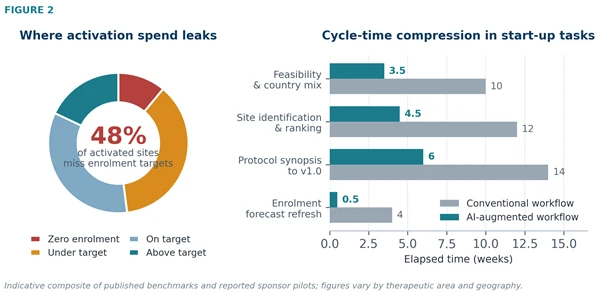
Figure 2: Roughly half of activated sites miss enrolment targets, while AI-augmented workflows compress the start-up tasks that precede activation.
Teaching the AI What a High-Performing Site Looks Like
A credible site-intelligence capability has two layers. The predictive layer — trained on trial management system history, claims and electronic health records, registry data, publication records, regulatory inspection outcomes and competitive trial density — ranks candidate sites and countries by expected enrolment against this specific protocol. The generative layer then does the work that consumed analyst weeks: assembling country feasibility narratives, drafting site profiles, summarising the competitive landscape and preparing investigator outreach tailored to each institution's patient mix.
Two design cautions separate a useful system from an expensive one. First, historical enrolment is partly a function of historical allocation; a model rewarded for volume alone will simply re-select the sites previously given the most patients, entrenching the incumbency it was meant to challenge. Enrolment rate per active month, normalised for protocol complexity and catchment, is the more honest target. Second, the model must be re-scored against the current protocol, because the criteria that make a site strong for one design often make it weak for another.
Used well, the output is not an automated decision. It is a defensible shortlist, delivered early enough to be argued about and with the reasoning attached — precisely what feasibility discussions have historically lacked.
CASE IN POINT
How AI Rescued a Stalled Cardiometabolic Programme
The following is a de-identified composite, drawn from sponsor experiences described publicly at industry forums; figures are illustrative of the pattern rather than a single organisation's results.
A mid-cap sponsor entered the ninth month of a Phase III cardiometabolic outcomes study with enrolment at roughly 40 per cent of plan across more than 500 activated sites in over 20 countries. The default response — add sites, add countries, add cost — had already been costed at eight figures.
Instead, the team ran two diagnostics in parallel. A retrieval-grounded review compared the protocol against comparable outcome trials and flagged two criteria as outliers: a renal function threshold tighter than contemporary practice, and a washout carried forward from an earlier study generation. Population modelling against real-world data indicated the pair was removing close to a quarter of otherwise eligible patients — concentrated in the older, comorbid population the trial was designed to serve. Sites were separately re-ranked on normalised enrolment rate rather than feasibility responses, revealing that many low performers were competing with other studies for an identical patient pool.
The programme proceeded with a single, tightly scoped amendment relaxing both criteria, redirected activation spend from new geographies to the fifty highest-ranked existing sites, and recovered the enrolment curve within two quarters. The instructive detail is not the recovery. It is that both defects were detectable in the protocol at the design stage, months before the first site was contracted.
Validated, Auditable, Unbiased: Where AI Guardrails Belong
Clinical operations is a regulated environment, and enthusiasm has to survive contact with inspection. Any system contributing to a regulated document or a decision affecting participant safety sits inside the sponsor's quality framework: validated for its intended use, covered by controls over electronic records and signatures, and supported by audit trails showing who reviewed what and when. Regulators on both sides of the Atlantic have signalled a risk-based posture, assessing model credibility relative to the specific context of use rather than certifying tools in the abstract.
Three practical exposures deserve board attention. Hallucination is managed by architecture, not by instruction: retrieval grounding with mandatory citation, and a standing rule that no unverified model output enters a protocol, submission or feasibility report. Bias is managed by measurement: if a site-ranking model systematically deprioritises community and safety-net institutions, the sponsor has automated an access problem and should expect to be asked about it. Confidentiality is managed by architecture too — protocol content, investigator data and patient-level records require deployment arrangements in which sponsor data is neither retained nor used for model training.
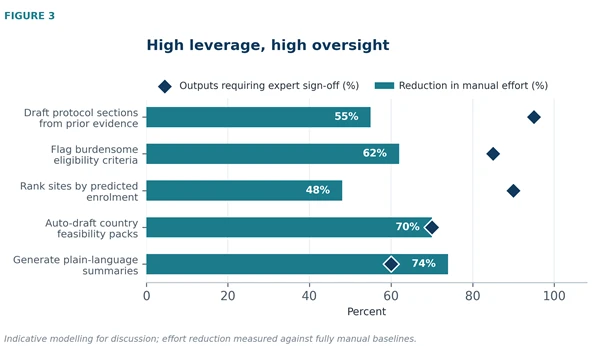
Figure 3: The highest-value applications are also those demanding the most expert sign-off; effort savings accrue to drafting and synthesis, not to judgement.
The Pharma C-Suite AI Agenda: Five Decisions That Determine Value
- Choose two use cases, not twenty. Protocol drafting with grounded review, and site ranking, are the two with the clearest line to cycle time and cost. Breadth of pilots is the most reliable predictor of value never materialising.
- Fund the data layer before the model layer. Historical protocols, study reports and trial management records that are not structured, permissioned and de-duplicated will not support a credible system, however capable the model.
- Change the metric. Documents generated is a vanity measure. Track amendments avoided, protocol-to-first-patient cycle time, share of sites meeting enrolment plan and cost per enrolled patient.
- Rewire the operating model and the contracts. Where a contract research organisation performs feasibility and start-up, oversight responsibilities, model provenance and data rights need to be explicit in the scope of work, not assumed.
- Govern once, deploy repeatedly. A single validation, documentation and monitoring framework applied across use cases is the difference between a scalable capability and a portfolio of unauditable experiments.
Conclusion
Generative AI will not decide which trials a pharmaceutical company should run, and it will not replace the clinical, regulatory and operational judgement that makes a protocol defensible. What it does is remove the excuse for designing in the dark. The evidence needed to write a better protocol and to choose better sites has existed for years inside sponsor archives, health system data and public registries; it has simply been too fragmented and too slow to retrieve within the window in which those decisions must be made.
That constraint has now largely lifted. The competitive question facing clinical development leadership is therefore no longer whether the technology works in narrow, well-governed applications — it demonstrably does — but whether the organisation can restructure its data, its quality framework and its start-up workflow quickly enough to compound the advantage across a portfolio rather than a single study.
The sponsors that move first will not be distinguished by having the most sophisticated models. They will be distinguished by shorter start-up timelines, fewer avoidable amendments, higher-performing site networks and trials that patients can realistically complete. In an environment of pricing pressure and shrinking exclusivity windows, those are not operational refinements. They are the margin.

Lakshmi is a science writer with a foundation in the laboratory. She earned her master's in biotechnology and trained through research internships at ICGEB (JNU) and DIPAS, DRDO, with her work appearing in the Egyptian Journal of Veterinary Sciences. Now APCRM-certified and part of the editorial team at Pharma Focus America and Pharma Focus Europe, she reports on pharmaceutical technology, research, and innovation — giving complex science a clear and confident voice for industry leaders.