

Generative AI in Drug Discovery: From Molecular Design to Translational Impact
Antonio Lavecchia, Full Professor of Medicinal Chemistry, Head of the Drug Discovery Laboratory, Department of Pharmacy, University of Naples Federico II
This article explores how generative AI is reshaping drug discovery, from molecular design and chemical space exploration to ADMET prediction and translational decision-making. It examines the promise of foundation models, diffusion approaches, and integrated workflows, while emphasising that real impact depends on synthesis feasibility, validation, and clinical relevance for patients.
Generative AI is changing the design mindset
Generative AI is changing how scientists think about drug discovery. Rather than searching existing compound libraries or modifying known scaffolds, these models can propose chemical ideas under defined constraints, explore less accessible chemical space, and support testable hypotheses.
This shift matters because drug discovery is not a problem of molecular novelty alone. Each candidate must be evaluated in relation to potency, selectivity, synthetic feasibility, absorption, distribution, metabolism, excretion and toxicity (ADMET), safety, intellectual property, and clinical relevance. The value of generative AI is not measured by how many molecules it can create, but by how many useful decisions it can improve. In this sense, it should be viewed as a decision-support technology for modern drug discovery, not simply as a molecule generator.1
What generative AI adds to molecular design
Generative AI adds a new dimension to molecular design because it helps design what could exist, not only search what is already available. It can explore broad chemical space and propose scaffolds, analogs, or molecular series that satisfy objectives such as potency, selectivity, novelty, synthetic accessibility, ADMET profile, and target compatibility.
This capability is particularly useful when drug discovery requires the simultaneous optimisation of several properties. A molecule may be potent but poorly soluble, selective but difficult to synthesise, novel but metabolically unstable, or promising in silico but unsuitable for progression. Generative AI can support the balancing of these competing requirements by integrating chemical, structural, pharmacophoric, and biological constraints into the design process. In this way, it can assist both ligand-based design, where information comes mainly from known active compounds, and structure-based design, where the three-dimensional context of the target guides molecular generation. Generative AI shifts drug discovery from searching existing chemical libraries to designing candidate chemical matter under defined biological and developability constraints.2
Different computational approaches can support this process, including transformer-based models, graph neural networks, diffusion models, and emerging foundation models.
Importantly, the most useful systems are those that allow control over the design objective. Controllable generative approaches, such as SMARTS-guided transformer models, illustrate how AI can generate molecules while respecting medicinal chemistry rules, structural requirements, or predefined design constraints.3
Foundation models, diffusion approaches and the new molecular imagination
A major reason why generative AI is advancing so rapidly is the emergence of more general and adaptable models. Foundation models are trained on large datasets and can learn broad representations that are later adapted to specific tasks, such as molecular property prediction, target discovery, lead optimisation, or preclinical decision support.4
Large language models and molecular language models extend this logic by treating molecules, protein sequences, assay descriptions, and biomedical text as structured languages. They can learn patterns across chemical, biological, and textual information that may support hypothesis generation and molecular design.
Diffusion models add another important capability. They are particularly promising for three-dimensional molecule generation and structure-based design because they can generate candidate ligands in relation to the shape and chemical environment of a target pocket.5 This is especially relevant when the aim is not only to design a molecule, but to design a molecule that fits a biologically meaningful context.
AlphaFold 3 further reinforced the idea that AI can model complex biomolecular interactions, including proteins, nucleic acids, small molecules, ions, and modified residues.6 The next phase of generative AI will be increasingly multimodal, combining molecular structure, protein context, omics information, phenotypic data, and clinical signals.
The translational gap: generated molecules are not medicines
The ability to generate new molecules is impressive, but generated molecules are not medicines. This distinction is essential for understanding the real impact of generative AI in drug discovery. A computationally novel structure may look attractive on screen, yet fail because it cannot be synthesized efficiently, does not engage the intended target, lacks selectivity, shows poor ADMET properties, raises toxicity concerns, or is incompatible with available biological assays.
Novelty is useful only when it is connected to a meaningful therapeutic hypothesis. A molecule that differs from known compounds is not automatically valuable. It must also be chemically feasible, biologically relevant, experimentally testable, and developable. In pharmaceutical R&D, a generated compound should be judged not only by predicted affinity or structural originality, but by its potential to survive the practical filters that determine whether a project can progress.
The same applies to intellectual property. AI may generate structures that appear patentable, but patentability alone is not enough if the molecule lacks a plausible route to synthesis, acceptable physicochemical properties, manageable liabilities, or a clear connection to disease biology. A molecule generated by AI becomes valuable only when it can be synthesised, tested, optimised, and connected to a patient-relevant biological question. Recent work combining generative AI, physics-based active learning, molecular modelling, synthesis, and in vitro testing illustrates this direction, showing that the future of generative AI depends less on producing many virtual molecules than on connecting design with experimental evidence.7
From isolated models to integrated discovery workflows
The greatest impact of generative AI will come when it is embedded into integrated discovery workflows rather than used as an isolated model. In practice, the most useful approach follows an iterative logic: design, filter, synthesise, test, learn, and redesign. Each cycle should improve both the molecules and the quality of project decisions.
In this workflow, generative AI can propose candidate structures, while computational filters assess synthetic feasibility, physicochemical properties, novelty, and potential liabilities. Retrosynthesis tools can help evaluate whether a molecule can realistically be made. Docking and molecular dynamics can provide structural hypotheses about target engagement. ADMET models can identify early developability concerns. Experimental assays provide feedback that no in silico model can replace.
Active learning is especially important because it allows models to improve as new experimental data become available. Instead of separating computation from laboratory work, active learning creates a feedback loop in which each experiment informs the next design cycle. Human medicinal chemistry review remains central, because experts can recognise chemical liabilities, synthetic risks, assay artifacts, or biological assumptions that may not be captured by the model.
Generative AI should not be treated as a molecule factory, but as part of an iterative decision system. Its value increases when it connects molecular design with synthesis planning, biological testing, ADMET evaluation, experimental feedback, and continuous model monitoring.7 This integrated workflow illustrates how generative AI can move from molecular design to translational decision-making when each generated idea is evaluated through feasibility, developability, experimental evidence, and clinical relevance.
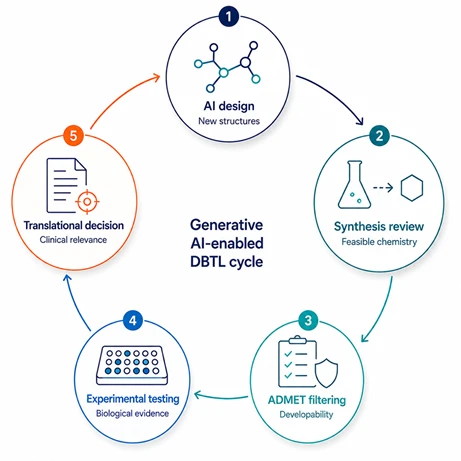
Figure 1. From generative molecular design to translational impact. Generative AI creates value when molecular ideas move through a design-build-test-learn workflow, connecting synthesis feasibility, ADMET and safety assessment, experimental validation, and clinical relevance.
What this means for pharmaceutical companies
For pharmaceutical companies, the key lesson is that generative AI should be measured by industrial impact, not by superficial output metrics. The number of molecules generated is not, by itself, a meaningful indicator of value. What matters is whether generated compounds are project-relevant, feasible to synthesise, compatible with medicinal chemistry strategy, and supported by evidence that can inform real decisions. This requires evaluation criteria that go beyond novelty or predicted affinity: synthesis feasibility, ADMET profile, selectivity, toxicity risk, intellectual property potential, assay compatibility, and experimental validation.
Generative AI also needs to be integrated with the functions that determine whether a program can progress. Medicinal chemistry, biology, DMPK, toxicology, CMC, clinical strategy, data science, and regulatory expertise should not operate in separate silos. They should contribute to a shared view of what counts as a valuable AI-supported recommendation.
This is particularly important as regulatory expectations evolve. For applications in which AI produces information or data intended to support regulatory decision-making, the FDA has clarified the importance of assessing whether the AI model is credible for its intended context of use.8 The companies that benefit most from generative AI will not be those that generate the largest number of molecules, but those that connect molecular generation with evidence, feasibility, and translational judgment.
Conclusion:
From molecular novelty to patient relevance
Generative AI is one of the most promising technologies in modern drug discovery, but its value depends on how it is used. If treated only as a source of novel structures, it may increase virtual output without improving pharmaceutical decisions. Its real potential emerges when molecular generation is guided by chemistry, biology, developability, experimental validation, and clinical relevance.
For drug discovery teams, the goal should not be to replace scientific judgment, but to strengthen it. Generative AI can help scientists explore more possibilities, test better hypotheses, and focus resources on candidates with a stronger rationale for progression. The future of generative AI in drug discovery will not be defined by molecular novelty alone, but by its ability to help scientists select better hypotheses, better candidates, and ultimately better therapies for patients.
References
- Lavecchia A, ed. Applied Artificial Intelligence for Drug Discovery: From Data-Driven Insights to Therapeutic Innovation. Springer Nature Switzerland; 2026.
- Gangwal A, Lavecchia A. Unleashing the power of generative AI in drug discovery. Drug Discovery Today. 2024;29(6):103992.
- Delre P, Bellofatto G, Lavecchia A. VeGA-RX and VeGA-SCX: Controllable SMARTS-Guided Generative Transformers for Precision-Driven De Novo Drug Design. J Chem Inf Model. 2026;66(9):5189-5205.
- Delile J, Mukherjee S, Mueller J, Khalil I, Zhukov L, Meier C. Foundation models in drug discovery: Phenomenal growth today, transformative potential tomorrow? Drug Discovery Today. 2025;30(12):104518.
- Huang L, Xu T, Yu Y, et al. A dual diffusion model enables 3D molecule generation and lead optimization based on target pockets. Nature Communications. 2024;15(1):2657.
- Abramson J, Adler J, Dunger J, et al. Accurate structure prediction of biomolecular interactions with AlphaFold 3. Nature. 2024;630(8016):493-500.
- Filella-Merce I, Molina A, Díaz L, et al. Optimizing drug design by merging generative AI with a physics-based active learning framework. Communications Chemistry. 2025;8(1):238.
- U.S. Food and Drug Administration. Considerations for the Use of Artificial Intelligence to Support Regulatory Decision-Making for Drug and Biological Products. Draft Guidance. 2025.

Antonio Lavecchia is Full Professor of Medicinal Chemistry at the University of Naples Federico II, where he leads the Drug Discovery Laboratory. His work spans AI-driven drug discovery, molecular modeling, medicinal chemistry, and pharmaceutical innovation. He has published over 200 papers, edited Applied Artificial Intelligence for Drug Discovery, and serves as expert evaluator for industrial R&D projects.