


Global Clinical Trial Strategies: Navigating Regulatory Complexity and Operational Excellence
Lakshmi, Editorial Team, Pharma Focus America
Global clinical development has entered a period of simultaneous convergence and divergence: shared quality principles, incompatible effective dates, and national rules dictating where trial data may reside. For American sponsors, country selection now carries data-residency, inspection and market-access consequences. This article examines the regulatory landscape facing multinational studies and the portfolio-level operational disciplines that separate predictable programs from expensive ones.
The Global Trial Map Is Being Redrawn Under American Sponsors' Feet
US biopharmaceutical companies have spent two decades treating global trial expansion as an arithmetic problem: more countries, more sites, more patients, faster enrollment, lower cost per subject. That arithmetic no longer holds. Between the start of 2025 and the start of 2027, essentially every regulatory jurisdiction that matters to an American sponsor has rewritten or is rewriting the rules governing how a clinical trial is designed, monitored, documented and — critically — where its data is permitted to live.
The result is neither the fragmentation of the past nor the harmonized world sponsors were promised, but something more demanding than both: authorities converging on identical principles while diverging on dates, annexes and enforcement posture. For a chief executive or chief medical officer this is a commercial issue, not a procedural one. Country selection now determines not only enrollment velocity but data-transfer obligations, inspection exposure and the credibility of a submission in markets the company intends to enter years later. A protocol designed for one agency and retrofitted for everyone else is an expensive habit, and this regulatory cycle punishes it harder than the last.
"Between 2025 and 2027, every jurisdiction that matters to a US sponsor rewrote the rules for running a trial — and quietly changed what country selection costs."
One Trial, Many Rulebooks: The Convergence That Isn't Quite Convergence
The clearest illustration is the global rollout of the revised Good Clinical Practice standard. Its core principles and first annex reached final international adoption in January 2025, but the effective dates scattered. The European Union applied them in mid-2025. The FDA issued its final guidance in September 2025. Canada and the United Kingdom implemented in April 2026. China required conformity for new trials from the spring of 2026 and brings its own comprehensively revised national GCP — issued jointly by four national authorities — into force in September 2026. A second annex, extending the same principles to decentralized elements, real-world data sources and pragmatic designs, was adopted internationally in June 2026 and takes effect in Europe in January 2027.
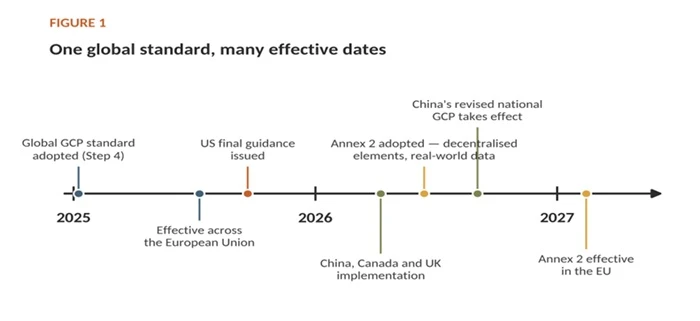
Figure 1: A single harmonized standard, staggered across jurisdictions. Multi-region studies running through 2026 may have operated under different quality standards in different countries simultaneously.
Read as a compliance exercise, this is a scheduling nuisance. Read strategically, it is something else. A multi-region study enrolling today may have run under one quality standard in one country and a different one in another, with the boundary falling mid-enrollment. Trial master files that do not record which standard governed which period will be reconstructing that history under inspection pressure.
The deeper shift is philosophical. The revised standard replaces procedural compliance with quality by design: sponsors identify what genuinely matters to participant safety and data reliability, then concentrate oversight there rather than distributing it evenly across everything. That is a governance change, not a documentation change, and it lands squarely on the sponsor. Activity may be delegated to a contract research organization; accountability may not.
“Delegation of activity is permitted. Delegation of accountability is not — and every vendor handoff is now an oversight obligation the sponsor personally owns.”
Where the Weeks Actually Go: Country Selection as a Financial Decision
Ask most American development teams why they added a country and the answer involves enrollment rate or cost per patient. Neither is the variable that most often determines whether a study finishes on schedule. Study start-up is. The interval between protocol finalization and first patient enrolled varies by a factor of two across regions, and the variance sits mostly in components that no amount of enrollment enthusiasm can offset: competent-authority review, ethics committee sequencing, site contracting, and import licensing for investigational product. A territory with excellent accrual and a nine-month contracting cycle can be a worse choice than a slower-recruiting one that activates in three.
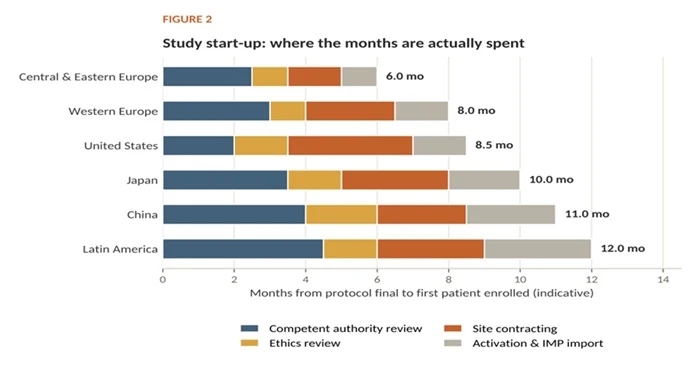
Figure 2: Indicative start-up intervals by region, decomposed. Contracting and activation — not regulatory review — dominate the variance in several markets.
The second variable is concentration. Sponsors chronically over-distribute. Adding a tenth country for a marginal share of enrollment multiplies regulatory submissions, translations, monitoring travel and — under the revised quality standard — oversight obligations that scale with footprint rather than patient numbers. A tighter country set with deeper site penetration usually reads out sooner.
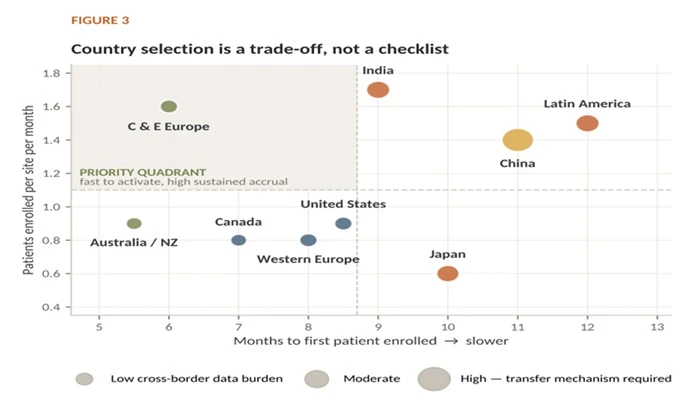
Figure 3: Candidate territories plotted on speed to first patient against sustained accrual per site, sized by cross-border data burden.
Plotting candidate territories against two axes — speed to activate and sustained enrollment per site — separates genuine contributors from portfolio decoration. Countries in the upper-left quadrant deserve investment. Those in the lower-right are frequently retained out of habit, legacy relationships, or a vague conviction that geographic breadth strengthens a submission. It rarely does. Regulators assess data quality and population relevance, not the number of flags on a slide.
Data Sovereignty: The Constraint That Now Picks Your Countries for You
The constraint that has moved fastest, and that most US boards still underestimate, is where trial data is permitted to travel. Health and genetic information is treated as sensitive personal data in a widening set of jurisdictions, and cross-border transfer is no longer a matter of contractual assurance. In China, moving trial data to a sponsor, central laboratory or data-capture environment outside the country requires one of a defined set of legal mechanisms — a regulatory security assessment, a filed standard contract, or a certification route that became fully usable at the start of 2026 — with volume thresholds calculated cumulatively across a calendar year rather than per transfer. A study that begins below the threshold can cross it mid-year and change compliance category without anyone in clinical operations noticing.
Separately, national rules on human genetic resources govern who may collect biological samples, under what approvals and on what intellectual property terms. Recent Chinese consultation drafts point toward a more pragmatic posture with faster confirmations for straightforward trial filings, but the underlying architecture holds: a foreign sponsor, CRO or central laboratory can each independently trigger an approval requirement.
The practical consequence is that data architecture must be designed alongside country strategy rather than after it. Where the database sits, which vendor holds which fields, whether samples are analyzed locally or shipped — these are regulatory decisions with timeline consequences, and they are too often made by people with no line of sight to the development plan.
The Diversity Requirement That Exists in Statute but Not Yet in Guidance
A distinctly American complication sits alongside all of this. Federal law has required diversity action plans for certain late-phase studies since the 2022 omnibus reform, obliging sponsors to set enrollment goals across demographic groups and describe how they will meet them. The implementing guidance, however, has not been finalized. A draft published in mid-2024 was withdrawn from public view in early 2025 and restored shortly afterward under court order; the final document remains outstanding.
Sponsors are therefore operating against a statutory obligation whose operational contours are undefined. The temptation is to wait. That is the wrong read. The infrastructure a diversity plan requires — demographic capture at screening, enrollment forecasting by subgroup, site selection weighted toward representative catchment areas, retention tracking — takes eighteen to twenty-four months to build and cannot be retrofitted to a study already enrolling. Companies treating this as paperwork to be completed once the rules land will find that the rules describe capabilities they do not have. There is also a commercial argument that survives any regulatory weather: enrollment that does not resemble the treated population produces effect estimates payers and prescribers discount.
Operational Excellence Is a Portfolio Discipline, Not a Study-Level One
Where does global cycle time actually get won and lost? Protocol amendments remain the single largest self-inflicted delay. A substantial share are avoidable, and each one in a multi-country study triggers a cascade: resubmission to every competent authority, ethics re-review on unsynchronized clocks, re-consent, site retraining and system reconfiguration. Amendment discipline is the reason a well-designed study in eight countries routinely beats a poorly designed one in four.
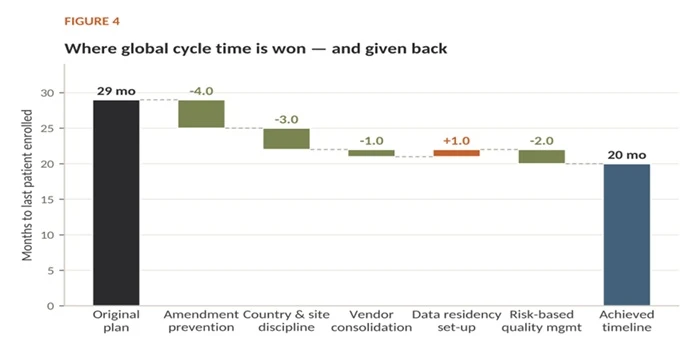
Figure 4: A composite view of the levers that move a global timeline — including the months that data-residency architecture legitimately costs.
Country and site selection is the second lever. The third is vendor architecture: sponsors that route each functional area to a different provider create handoff seams, and under the revised quality standard every seam is an oversight obligation the sponsor personally owns. Consolidating data flow, even at higher unit cost, frequently pays for itself in avoided reconciliation. The fourth is risk-based quality management, which the new standard effectively mandates rather than merely permits. Identifying critical-to-quality factors upfront and monitoring against defined tolerance limits replaces exhaustive source data verification with targeted attention. Organizations that made this transition years ago are watching compliance costs fall; those that deferred are now absorbing it as an unplanned program.
None of these is a study-level decision. All four are set by portfolio-level standards — protocol templates, vendor contracts, quality systems, country playbooks — which is why they belong on an executive agenda rather than in a study team's risk log.
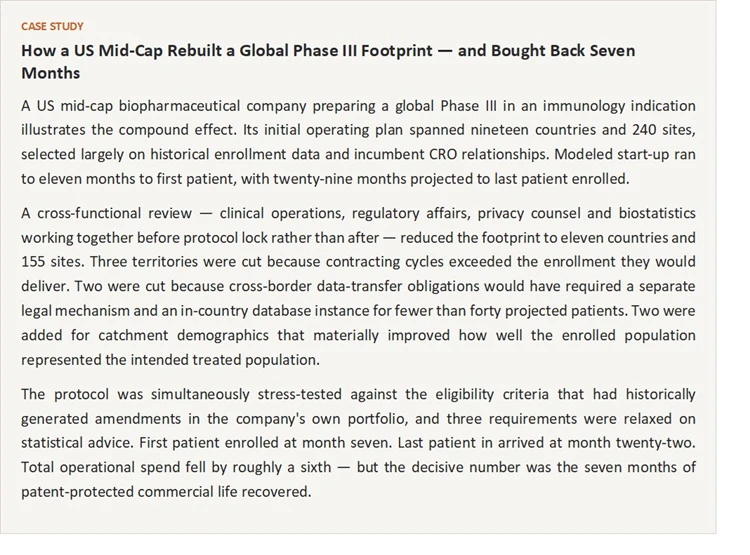
The Questions Boards Should Be Putting to Global Development
Three things follow for the executive committee. The first is where global strategy is actually decided. In most organizations, country selection is delegated to clinical operations and reviewed by nobody senior until a timeline slips. Given that the same decision now carries data-residency, inspection and market-access consequences, it warrants a defined forum with regulatory, legal and commercial representation — convened before protocol lock, not after the first enrollment miss.
The second is measurement. Companies that track enrollment rate but not start-up interval, amendment frequency or screen-failure ratio are watching the symptom rather than the cause; the indicators that predict a late readout are visible roughly eighteen months before the ones most executive dashboards display. The third is the build-versus-buy posture on regulatory intelligence. Requirements now shift on quarterly cycles across a dozen relevant markets, and sponsors relying solely on a CRO's interpretation are outsourcing a judgment regulators will hold them personally accountable for.
Conclusion: Complexity Is Permanent — Readiness Is a Choice
Regulatory complexity in global clinical development is not a phase to be waited out. The direction of travel — principles-based quality standards, national control over health data, explicit expectations about who the enrolled population represents — reflects durable changes in how societies govern research, not a cycle that reverses with an administration.
What remains genuinely optional is readiness. Two companies running the same protocol in the same indication will produce materially different timelines, costs and inspection outcomes depending on decisions taken before the first site is ever contacted: how many countries, chosen on what evidence, with what data architecture, under what quality system, with which capabilities built in advance rather than assembled under deadline. Global trial strategy has quietly become one of the highest-leverage decisions on the American biopharmaceutical executive agenda. It deserves to be treated as such — designed deliberately at portfolio level, governed from the top, and measured against the operational indicators that predict outcomes rather than the ones that merely report them.

Lakshmi is a science writer with a foundation in the laboratory. She earned her master's in biotechnology and trained through research internships at ICGEB (JNU) and DIPAS, DRDO, with her work appearing in the Egyptian Journal of Veterinary Sciences. Now APCRM-certified and part of the editorial team at Pharma Focus America and Pharma Focus Europe, she reports on pharmaceutical technology, research, and innovation — giving complex science a clear and confident voice for industry leaders.