

How AI Is Changing Drug Discovery and Pharmaceutical R&D in the U.S.
Lakshmi, Editorial Team, Pharma Focus America
Artificial intelligence has become permanent infrastructure in U.S. pharmaceutical R&D, yet the first clinical evidence reveals a sharp asymmetry: AI-discovered molecules clear Phase 1 far more often than conventional ones, then fail Phase 2 at historical rates. This article examines what that gap means for American pharmaceutical boards — where AI genuinely pays, why data governance now sits inside FDA submissions, and how capital allocation should change.
Introduction: U.S. Pharmaceutical R&D Finally Has Real Data on What AI Does
For most of the past decade, the AI story in American drug discovery was told in forward-looking statements. In 2026 it can be told in outcomes. An analysis presented at a major oncology congress this year counted 117 AI-enabled therapeutic assets across 63 companies that had entered interventional human trials. Of those, 60 had completed Phase 1 — and only eight had completed Phase 2. None has yet been approved by the FDA.
That is not a verdict of failure. It is a young field meeting the clock. But it is a far more useful picture than the adoption statistics that dominate board decks, and it points toward a conclusion most U.S. pharmaceutical strategies have not absorbed: artificial intelligence has proved extraordinarily good at the part of R&D that was never the expensive part.
Meanwhile the underlying economics have barely moved. Average R&D cost per launched asset has climbed from roughly $1.19 billion in 2010 to about $2.67 billion in 2025. Forecast internal rate of return across the top twenty biopharma companies reached 7.0% in 2025 — but strip out the GLP-1 franchises and that figure falls to 2.9%. Whatever AI has delivered so far, it has not yet surfaced in industry-level returns.
Why AI Clears Phase 1 in Pharmaceutical Trials and Then Stalls at Phase 2
The clinical record now shows a clean pattern. Published analyses put Phase 1 success for AI-discovered molecules at roughly 80–90%, against a historical industry baseline of 40–65%. At Phase 2, the advantage evaporates: success sits near 40%, statistically indistinguishable from the long-run average.
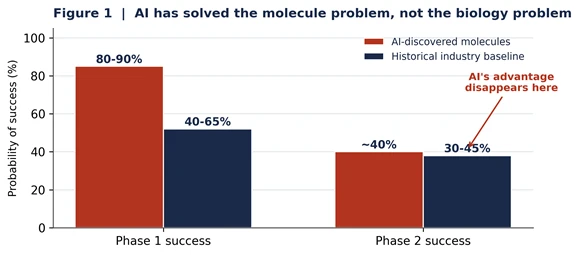
Figure 1: AI-discovered molecules outperform sharply in Phase 1 and converge to the historical baseline in Phase 2.
The explanation is uncomfortable but simple. Phase 1 largely asks a chemistry and pharmacokinetics question — is the molecule tolerable, and does it behave in the human body the way it was designed to? That is precisely what generative chemistry, structure prediction and ADMET models are trained to answer, and they answer it well. Phase 2 asks a biology question: is this target genuinely causal in this disease, in these patients? No amount of molecular optimization rescues a wrong target.
For American R&D leadership, that reframes the entire investment case. AI today is a machine for producing better molecules against hypotheses that humans still choose. The industry's dominant failure mode — target validation — remains largely untouched. Companies pouring capital into generative chemistry while leaving target biology unchanged are buying speed on the leg of the race that was never the bottleneck.
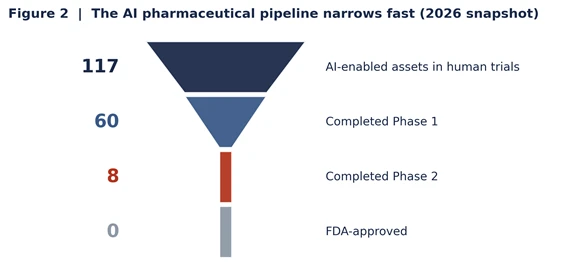
Figure 2: The AI-enabled clinical pipeline in 2026 — a large front end, a very thin late stage, and no approvals yet.
“Artificial intelligence is currently a machine for producing better molecules against hypotheses that humans still choose.”
Where AI Actually Pays Inside U.S. Pharmaceutical R&D Budgets
Follow the money rather than the headlines. Discovery and preclinical work together account for roughly a third of pharmaceutical R&D spending; clinical development consumes the majority of it. AI capability is inverted relative to that distribution — most mature where the least money is spent, least mature where the most is.
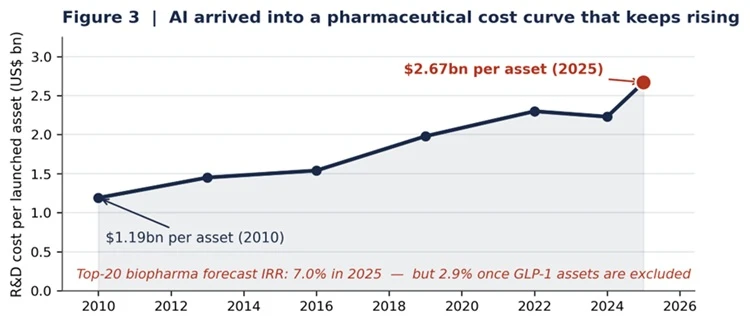
Figure 3: U.S. and global pharmaceutical R&D cost per launched asset has more than doubled since 2010, and recent returns are concentrated in a narrow set of assets.
That mismatch is where the near-term American opportunity sits, and it is not in molecule generation. It is in clinical operations: protocol design informed by historical trial performance, site and investigator selection, eligibility screening against electronic health records, adaptive enrollment forecasting, and automated safety signal detection across pharmacovigilance data. These are unglamorous applications with measurable P&L consequences. A trial that enrolls four months faster is worth considerably more than a preclinical program that finishes four months faster, because it sits closer to the revenue.
The second underexploited area is failing earlier and more cheaply. The commercial value of AI is not only in finding winners; it is in killing losers before Phase 2 money is committed. A model that improves go/no-go accuracy at candidate selection reshapes portfolio economics far more than one that generates ten thousand additional structures.
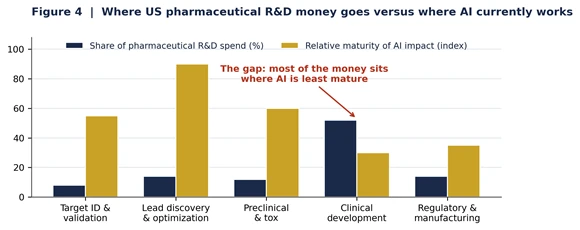
Figure 4: The structural mismatch in U.S. pharmaceutical R&D — AI is most capable where the least capital is deployed. Spend shares are indicative.
Data, Not Algorithms, Is the Real AI Asset in American Pharma
Frontier models are broadly available to anyone with a budget. Proprietary, well-curated biological data is not. The durable advantage in U.S. pharmaceutical AI belongs to organizations that can connect decades of internal assay results, failed-compound records, toxicology findings and clinical datasets into something a model can actually learn from.
Most cannot. Legacy data sits in incompatible systems, negative results were rarely captured systematically, and program failures — the most information-rich records a pharmaceutical company owns — are the worst preserved. Executives routinely approve eight-figure AI budgets while the underlying data remediation stays unfunded, which is the single most common reason promising pilots never scale.
Treating data as a capital asset has concrete consequences. It changes diligence in M&A, where data estate quality becomes a valuation input rather than a footnote. It changes partnership terms, because ownership of models trained on joint data is now a material negotiation point. And it changes what “R&D infrastructure” means when capital is allocated.
The FDA Has Made AI a Pharmaceutical Submissions Problem, Not an IT Problem
In January 2025 the FDA issued its first guidance on using AI to support regulatory decisions about a drug or biological product's safety, effectiveness or quality, built around a seven-step, risk-based credibility assessment framework organized by context of use. In January 2026 the FDA and EMA jointly published ten guiding principles for good AI practice in drug development, and a final version of the U.S. guidance has been expected during 2026. The agency has reported receiving more than 500 drug and biologics submissions with AI components since 2016.
The strategic content of that framework is easy to overlook. The FDA does not regulate the model; it regulates the credibility of the model's output for one specific use. Regulatory risk scales with how much an AI result influences a decision and how serious the consequence of being wrong. A model used for internal triage carries little burden. The same model used to justify a dose selection or a safety conclusion carries a great deal.
The practical consequence is that model documentation, version control, training-data provenance and ongoing performance monitoring become submission artifacts. U.S. companies that built AI capability inside IT or digital innovation functions, outside GxP-grade quality systems, are discovering that their most commercially valuable models are also their least defensible ones.
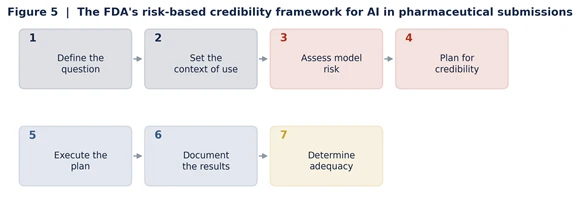
Figure 5: The FDA's seven-step credibility assessment, where regulatory burden scales with model risk and context of use.
Case Study: How One U.S. Biopharma Rebuilt Its AI Strategy Around Attrition
Composite case. Assembled from patterns observed across several U.S. organizations between 2023 and 2026; figures are illustrative rather than reported.
A U.S.-headquartered mid-cap biopharmaceutical company with approximately $4 billion in revenue and $900 million in annual R&D spend built a generative chemistry platform between 2023 and 2025. It worked as designed: candidate nomination accelerated substantially. Then two consecutive Phase 2 programs failed on efficacy, both against targets selected before the platform existed.
The 2025 board review concluded that the company had automated the wrong step. Roughly 40% of the AI budget was redirected from molecule generation into target validation and clinical operations. Three changes followed: a curated internal data layer that deliberately included negative results and terminated programs; a causal-evidence scoring model combining human genetics, proteomics and real-world data, used as a formal gate before candidate nomination; and AI-assisted protocol design and site selection across the clinical portfolio.
Eighteen months later, candidate nominations had fallen by 31% — deliberately — while the share of programs advancing past proof of concept rose. Median time to first patient enrolled shortened by four and a half months. Two programs were terminated at the nomination gate that would previously have entered IND-enabling work, avoiding an estimated $70 million in committed spend. Model documentation was rebuilt inside the quality system ahead of guidance finalization.
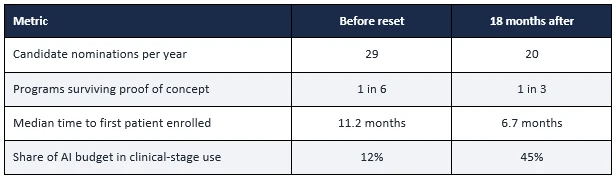
Table 1: Composite case study — fewer candidates, better justified. Figures illustrative.
The transferable lesson is not technological. The company's return improved when it stopped using AI to make more candidates and started using it to make fewer, better-justified ones.
What U.S. Pharmaceutical Boards Should Change About AI Right Now
Four shifts separate companies compounding value from companies compounding activity. The first is measurement: AI should be judged against attrition, not throughput. The operative metric is change in probability of technical success at Phase 2, not molecules generated, papers published or hours saved.
The second is sequencing — fund the data estate before the model estate, because the curation work nobody wants to sponsor is what determines whether anything downstream generalizes. The third is ownership: AI governance belongs under quality and regulatory functions now, not after the first FDA information request arrives about a model that supported a submission.
The fourth is expectation management with investors. The first genuine test of AI-discovered medicine arrives with pivotal readouts over the next two to three years, and a meaningful share of them will fail. Boards that have narrated AI as a certainty rather than a portfolio bet will find those failures repriced against them.
Conclusion: AI Will Reshape U.S. Pharmaceutical R&D, But Not on the Timeline Being Sold
The honest summary of 2026 is that artificial intelligence has industrialized one step of pharmaceutical R&D and left the rest of the value chain intact. Molecules are cheaper, faster and better than they were. Human biology is exactly as difficult as it was. The Phase 1 numbers are real, the Phase 2 numbers are sobering, and both are true at once.
That is not an argument for slowing investment. It is an argument for pointing it somewhere else. The American companies most likely to convert AI into shareholder return are not those with the largest compute budgets or the most impressive molecule counts. They are the ones rebuilding target validation as a data problem, moving AI into the clinical operations where most R&D dollars are actually spent, curating the failures their competitors discarded, and putting model governance inside the quality system before a regulator asks.
The first AI-discovered medicine will be approved in the United States, probably within a few years. It will matter less than the quieter change already underway — a generation of pharmaceutical R&D organizations learning to be wrong faster, cheaper and earlier than they have ever been able to be.
Frequently Asked Questions: AI in U.S. Drug Discovery and Pharmaceutical R&D
Has the FDA approved any AI-discovered drug yet?
No. As of mid-2026 no AI-discovered medicine has received FDA approval. The most advanced end-to-end AI-discovered candidate entered Phase III during 2026, and the FDA does not classify approvals by whether AI was used in discovery, so field-wide “firsts” depend heavily on the tracker making the claim.
Does AI actually improve clinical success rates in pharmaceutical development?
So far, only in Phase 1. AI-discovered molecules report roughly 80–90% Phase 1 success against a 40–65% historical baseline, but Phase 2 success sits near 40%, matching the long-run industry average. Efficacy still depends on target biology and trial design, not discovery method.
Where should a U.S. pharmaceutical company deploy AI first for measurable return?
Clinical development and candidate-selection gating, because that is where the majority of R&D spend sits. Protocol design, site selection, eligibility screening and enrollment forecasting deliver faster, more auditable financial impact than additional molecule generation.
What does the FDA's AI guidance require of pharmaceutical sponsors?
It asks sponsors to establish the credibility of an AI model's output for a defined context of use through a seven-step, risk-based assessment. Documentation, data provenance, version control and performance monitoring effectively become part of the submission record.
Is proprietary data really more valuable than the AI model itself?
For most pharmaceutical companies, yes. Models and compute are purchasable; decades of internal assay, toxicology, failed-compound and clinical data are not. Companies that never captured negative results are missing the most informative training data they could own.
How should a board measure return on AI investment in R&D?
By attrition economics rather than activity. Track change in probability of technical success at Phase 2, cost avoided through earlier termination, and cycle-time reduction in clinical operations. Counts of generated molecules or completed pilots are not evidence of value.

Lakshmi is a science writer with a foundation in the laboratory. She earned her master's in biotechnology and trained through research internships at ICGEB (JNU) and DIPAS, DRDO, with her work appearing in the Egyptian Journal of Veterinary Sciences. Now APCRM-certified and part of the editorial team at Pharma Focus America and Pharma Focus Europe, she reports on pharmaceutical technology, research, and innovation — giving complex science a clear and confident voice for industry leaders.