

How Biosimilars Are Changing Competition in the U.S. Drug Market
Lakshmi, Editorial Team, Pharma Focus America
Biosimilars have saved the U.S. healthcare system $81.6 billion since 2015, yet their real impact is strategic rather than purely financial. This article examines how biosimilars are reshaping competition in the U.S. drug market: shifting power to pharmacy benefit managers, compressing originator lifecycles, and redrawing regulatory economics. Drawing on the adalimumab market as a case study, it outlines what pharma executives must rethink as the next wave of biologic exclusivity losses approaches.
The $81.6 Billion Wake-Up Call for U.S. Pharma Leaders
For most of the past decade, biosimilars were treated in American boardrooms as a slow-burning nuisance: a regulatory pathway that existed on paper, produced a trickle of approvals, and rarely threatened a flagship biologic in a meaningful way. That view is now dangerously out of date.
According to the latest annual savings analysis from the U.S. generic and biosimilar industry, biosimilars have generated $81.6 billion in savings for patients and the healthcare system since the first product entered the market in 2015. They have been used in almost 3.8 billion days of patient therapy with no unique clinical challenges. By the end of 2025, the FDA had approved around 90 biosimilars referencing 20 different molecules, and 63 of them had reached the market.
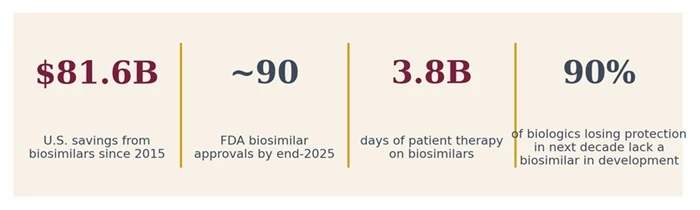
Figure 1. The U.S. biosimilar market by the numbers
The numbers matter, but the more important story is structural. Biosimilars are changing who holds power in the U.S. drug market, how quickly originator revenues erode, what regulators demand from developers, and which molecules will face competition at all. For C-suite leaders on either side of the originator–challenger divide, understanding these shifts is now a core strategic competence rather than a market-access footnote.
From Legal Loophole to Market Force: A Decade of U.S. Biosimilar Momentum
The U.S. biosimilar story began with legislation enacted in 2010 that created an abbreviated approval pathway for products highly similar to an already licensed biologic. The first approval did not arrive until 2015, and the first interchangeable designation, which allows pharmacy-level substitution subject to state law, followed in 2021. For years, uptake was uneven. Hospital-administered oncology biosimilars gained ground relatively quickly, while pharmacy-benefit products struggled against entrenched rebate contracts.
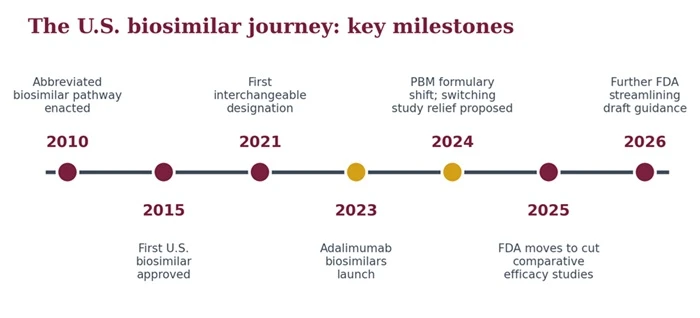
Figure 2. Milestones in the evolution of the U.S. biosimilar market
What changed was not the science, which has been sound from the start, but the commercial environment around it. A growing number of approvals created genuine multi-source competition in several categories. Payers became more confident. Regulators gathered enough real-world experience to start removing requirements that had added cost without adding meaningful safety assurance. The result is a market that now behaves less like a niche and more like the generic revolution that transformed small-molecule economics a generation ago, albeit with its own distinct rules.
The competitive effect extends well beyond the biosimilars themselves. According to the U.S. Department of Health and Human Services, biosimilar prices at launch are on average 50% lower than the reference product’s price at the time of biosimilar entry. That pressure forces originators to respond with deeper rebates, lower net prices or new product strategies, which is why much of the value created by biosimilars shows up in the pricing of the reference biologic rather than in biosimilar sales alone. Lower prices have also widened access: industry analysis estimates that biosimilar competition has enabled nearly 571 million additional days of patient therapy that would not otherwise have been delivered. For payers and employers facing rising specialty drug costs, that combination of lower spending and broader access has turned biosimilars from an interesting option into a central lever of pharmacy benefit strategy.
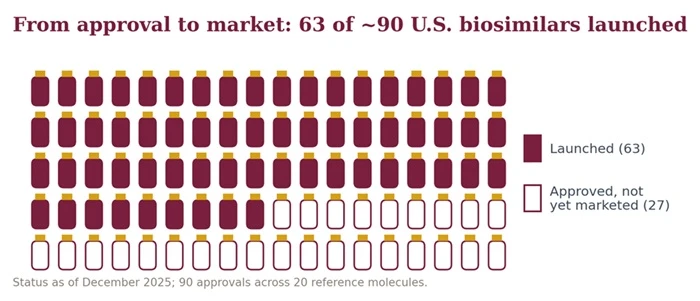
Figure 3. Pictograph: approvals do not guarantee launches, as roughly 30% of approved U.S. biosimilars were not yet marketed at end-2025
That gap between approval and launch is itself a competitive signal. Patent settlements, litigation, manufacturing readiness and, above all, access to formularies determine whether an approved biosimilar ever reaches patients. Regulatory success is necessary but no longer sufficient.
The New Biosimilar Gatekeepers: How PBMs Are Rewriting Pharma Competition
In the U.S. pharmacy-benefit market, the decisive competitive battle is fought not in the clinic or even in the prescriber’s office, but in formulary design. The three largest pharmacy benefit managers control about 80% of prescriptions dispensed in the United States. Their coverage decisions can move market share faster than any sales force.
The most consequential development of recent years has been the rise of private-label biosimilars. Rather than simply choosing between an originator and a competitor, major PBMs have established affiliated entities that co-produce or commercialize their own versions of biosimilar products, then prefer those versions on their formularies. The model has delivered rapid uptake where years of conventional competition failed, but it has also raised concerns about transparency and conflicts of interest, and it has left manufacturers without such partnerships struggling for access.
In the U.S. biosimilar market, a single formulary decision can achieve what a year of conventional commercial effort could not.
For originators, the implication is stark. Rebate walls, historically the most effective defence against biosimilar entry, are weakening as PBMs discover that owning part of the biosimilar margin is more attractive than collecting rebates on the reference product. For biosimilar developers, the lesson is equally sobering: a strong product and a low list price are no guarantee of access. Channel strategy, partnership architecture and contracting capability now matter as much as manufacturing quality.
Washington Tilts the Field: FDA Reforms That Speed the Biosimilar Clock
Regulation is also shifting in ways that will intensify competition. In June 2024, the FDA issued draft guidance proposing that switching studies are generally no longer needed to demonstrate interchangeability, citing evidence that switching between reference products and biosimilars raises no additional safety or efficacy concerns. In October 2025, the agency moved to reduce reliance on comparative clinical efficacy studies in favour of advanced analytical characterization, and in 2026 it released further draft guidance to streamline biosimilar development.
These changes matter commercially because comparative efficacy trials have been among the most expensive and time-consuming elements of biosimilar development. Lowering that barrier improves the business case for developing biosimilars of smaller-revenue biologics, broadens the pool of potential competitors, and shortens the interval between exclusivity loss and competitive entry. For originators, the historical assumption that complex development costs would limit the number of challengers is becoming less reliable.
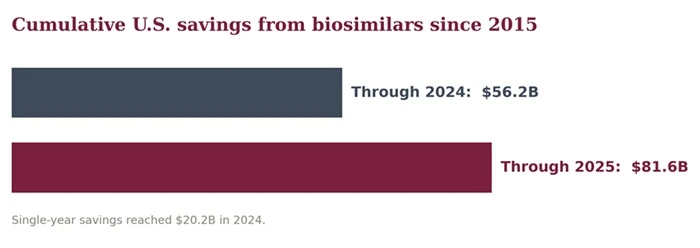
Figure 4. Cumulative savings from biosimilars in the U.S. continue to accelerate
The Biosimilar Void: The Next Frontier of U.S. Pharma Competition
Paradoxically, the most important competitive story of the coming decade may be where biosimilars are absent. The industry’s 2025 savings analysis found that 90% of brand-name biologics expected to lose patent protection over the next ten years have no biosimilar competitor in current development. Most of these are smaller-revenue products, including many used in rare diseases, where the investment case for a biosimilar has historically been weak.
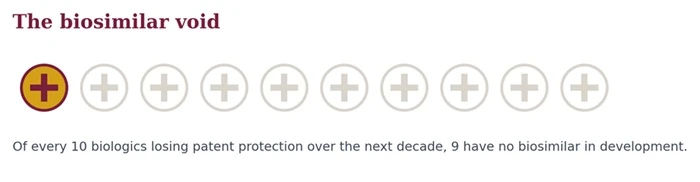
Figure 5. Pictograph of the biosimilar void facing the U.S. market over the next decade
This void cuts both ways. For originators of mid-sized biologics, it suggests that the traditional revenue cliff may be gentler than feared, at least in the near term. But the regulatory streamlining described above is designed precisely to change that calculation, and as development costs fall, previously unattractive molecules become viable targets. For biosimilar developers, the void represents the largest untapped opportunity in the U.S. market, rewarding those who build efficient, analytics-led development platforms capable of serving smaller markets profitably.
Rethinking the Biologic Franchise: Biosimilar Strategy in the Boardroom
For originator companies, the era of treating loss of exclusivity as a single cliff event is over. Biosimilar competition now unfolds as a series of channel-specific negotiations, and leaders need earlier, more granular scenario planning that models PBM behaviour, private-label dynamics and regulatory timelines, rather than relying on historical erosion curves from earlier launches. Lifecycle investment, such as improved formulations, new indications and next-generation molecules, must be timed so that patients and payers have a reason to stay before biosimilars arrive, not after.
For biosimilar developers, differentiation has moved beyond price. Reliable supply, device design, patient support and above all the ability to structure partnerships with powerful intermediaries will separate winners from also-rans. The adalimumab experience shows that being early and cheap is not enough if a product is locked out of the formularies that control the majority of prescriptions.
For both sides, policy engagement is no longer optional. Federal scrutiny of PBM practices, ongoing debate over interchangeability, and evolving FDA development standards will shape competitive outcomes as decisively as any commercial strategy. Executives who understand the policy trajectory will anticipate market shifts rather than react to them.
Conclusion: Beyond the Discount – Biosimilars Now Set the Rules of U.S. Pharma Competition
Biosimilars have moved from the margins of the U.S. drug market to its centre. They have delivered $81.6 billion in savings, proven their clinical reliability across billions of days of therapy, and demonstrated, through the adalimumab experience, that they can rapidly displace even the most entrenched biologic once the commercial conditions align.
Yet the defining feature of this market is not the discount biosimilars offer. It is the way they have redistributed competitive power toward formulary gatekeepers, accelerated the regulatory clock, and exposed a vast pipeline of biologics that still face no competition at all. The companies that thrive will be those that treat biosimilars not as a pricing problem to be managed at the end of a product’s life, but as a permanent force shaping strategy from the first day of a biologic’s development.

Lakshmi is a science writer with a foundation in the laboratory. She earned her master's in biotechnology and trained through research internships at ICGEB (JNU) and DIPAS, DRDO, with her work appearing in the Egyptian Journal of Veterinary Sciences. Now APCRM-certified and part of the editorial team at Pharma Focus America and Pharma Focus Europe, she reports on pharmaceutical technology, research, and innovation — giving complex science a clear and confident voice for industry leaders.