
How Decentralized Clinical Trials Are Changing U.S. Research
Lakshmi, Editorial Team, Pharma Focus America
Decentralized clinical trials (DCTs) are moving U.S. pharmaceutical research out of the hospital and into patients' homes. Supported by telehealth, electronic consent, direct-to-patient drug delivery and wearable sensors, and now backed by formal FDA guidance, decentralized models promise faster enrollment, broader participation and richer real-world data. This article examines the regulatory foundations, two landmark U.S. case studies, the operational trade-offs and the strategic decisions facing pharma leaders.
For most of its history, the American clinical trial has been built around a single location: the research site. Participants were expected to travel, often repeatedly, to an academic medical center or specialist clinic for screening, dosing, blood draws and questionnaires. That model produced rigorous science, but it also produced familiar frustrations for pharmaceutical sponsors, including slow recruitment, costly site networks, high dropout rates and study populations that rarely reflected the full diversity of American patients.
Decentralized clinical trials challenge that design at its root. Instead of asking patients to come to the research, they bring research activities to the patient through telehealth visits, electronic informed consent, home nursing, local laboratories, investigational products shipped directly to the home and digital health technologies that capture data continuously. The pandemic forced the industry to test these tools at scale, and Washington has since moved to codify them. For U.S. C-suite leaders, decentralization is no longer an experiment at the margins of clinical development. It is becoming a core design choice with direct consequences for speed, cost and market competitiveness.
Beyond the Research Site: Defining the Decentralized Clinical Trial
A decentralized clinical trial is not a single format but a spectrum. At one end sits the traditional site-based study. At the other is the fully remote trial, in which no participant ever visits a research facility. Between them lies the hybrid model, which most U.S. sponsors now favor: critical assessments such as imaging or complex infusions remain at sites, while routine follow-up, symptom reporting and medication supply move into the home or the local community.
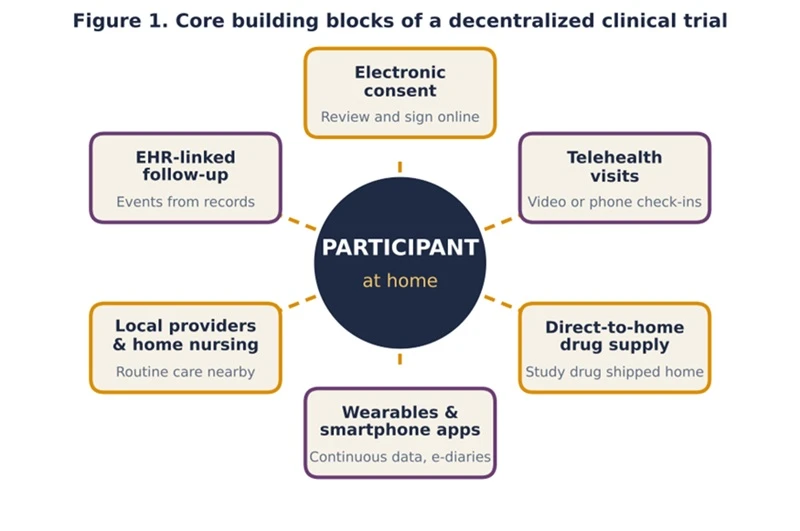
The building blocks are now well established. Electronic consent platforms allow participants to review study information at their own pace and discuss it with investigators by video or phone. Telehealth replaces many in-person check-ins. Mobile nurses and local healthcare providers handle routine procedures closer to where patients live. Smartphones and wearable sensors collect patient-reported outcomes and physiological signals between visits, generating longitudinal data that a clinic snapshot can never capture.
Washington Weighs In: The Regulatory Engine Behind Decentralized Clinical Trials
Regulatory clarity has been the decisive accelerant. The Food and Drug Omnibus Reform Act, enacted on December 29, 2022, directed the FDA to issue guidance on decentralized clinical studies covering topics such as digital health technologies, remote data collection, participant burden, recruitment and diversity. The same law requires sponsors of phase 3 drug trials to submit diversity action plans setting out enrollment goals and how they intend to meet them.
The FDA responded with draft guidance in May 2023 and finalized its recommendations for conducting clinical trials with decentralized elements on September 17, 2024. The final guidance confirms that telehealth visits, in-home procedures, local healthcare providers and digital tools can all form part of an FDA-regulated trial. It also draws firm lines. Investigators remain responsible for participant safety and for tasks they delegate, local providers may perform only routine activities within their usual scope of practice, and research-specific tasks stay with trained study staff. For sponsors, the message is clear: decentralization is welcome, but accountability cannot be decentralized with it.
Case Study 1: ADAPTABLE and the Power of Patient-Driven Decentralized Research
The ADAPTABLE trial offers one of the clearest demonstrations of decentralized principles at national scale. Designed to answer a question that had persisted for decades, namely whether 81 mg or 325 mg of daily aspirin better protects patients with established cardiovascular disease, the pragmatic study enrolled 15,076 patients through 40 U.S. centers between April 2016 and June 2019.
What made ADAPTABLE distinctive was its operating model. Participants enrolled and were randomized themselves, follow-up relied heavily on patient-reported outcomes collected directly from participants, and clinical events were identified through electronic health record data rather than repeated clinic visits. Direct-to-participant emails and mailers encouraged people to stay on their assigned dose. Over a median follow-up of 26.2 months, the trial found no significant difference between the two doses in the combined rate of death or hospitalization for heart attack or stroke (hazard ratio 1.02), nor in hospitalization for major bleeding.
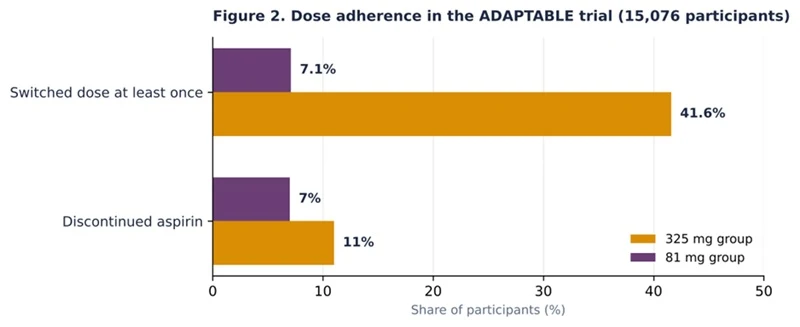
The adherence data proved just as instructive. In the 325 mg group, 41.6% of participants switched dose at least once, compared with 7.1% in the 81 mg group, and discontinuation rates were 11% and 7% respectively. For research leaders, this highlights both the strength and the risk of decentralized pragmatism: it captures how patients actually behave in daily life, but it demands careful design to protect the interpretability of results.
Case Study 2: CHIEF-HF and the Fully Remote Decentralized Clinical Trial
If ADAPTABLE proved that decentralized methods could work at scale, CHIEF-HF tested how far they could go. This double-blind, placebo-controlled trial evaluated canagliflozin in patients with heart failure and was conducted entirely remotely across 18 U.S. health systems, with no in-person study visits at all. Participants were identified through health-system channels, gave electronic consent through a study app after a phone discussion with the site investigator, received study medication at home and wore a consumer activity tracker. Symptoms were measured through a validated heart failure questionnaire completed on a smartphone at 2, 4, 6 and 12 weeks.
The trial randomized 476 participants and met its primary endpoint. At 12 weeks, canagliflozin improved the symptom score by 4.3 points more than placebo, a statistically significant result, with benefit appearing as early as two weeks. Yet CHIEF-HF also carries a sobering lesson. Enrollment was planned for 1,900 participants but was closed early when the sponsor's priorities changed. The decentralized design delivered a valid answer, but strategic commitment, not technology, ultimately determined the study's scale.
The Business Case for Decentralized Clinical Trials: Speed, Reach and Representation
For pharmaceutical executives, the attraction of decentralization rests on three interlocking advantages. The first is reach. By removing the need to live near an academic center, decentralized designs open trials to rural communities, working adults, caregivers and patients with mobility limitations who were previously excluded by geography and logistics. The second is representation. With diversity action plans now written into federal law, sponsors need practical tools to enroll populations that mirror the patients who will ultimately use their medicines, and lowering the burden of participation is among the most direct of those tools.
The third advantage is data quality and depth. Continuous digital measurement can reveal treatment effects between visits, capture real-world functioning and generate evidence that resonates with payers and health systems as much as with regulators. In a competitive U.S. market where differentiation increasingly depends on demonstrating value beyond the primary endpoint, that evidence can carry strategic weight long after approval.
Hidden Fault Lines in Decentralized Clinical Trials: Data, Equity and Oversight
Decentralization does not remove complexity; it redistributes it. Sponsors must manage a wider network of vendors spanning telehealth platforms, home-health providers, courier logistics and device manufacturers, each introducing new points of failure. Data from multiple digital streams must be validated, integrated and protected under privacy and cybersecurity obligations. State-by-state differences in telehealth licensing and pharmacy rules add further operational friction for national programs.
There is also an equity paradox. Digital tools can widen access, yet they can exclude patients without reliable broadband, smartphones or digital literacy. The FDA's guidance explicitly expects sponsors to make technologies usable and available to all participants. Leaders who provide devices, connectivity support and in-person alternatives will avoid replacing one form of exclusion with another.
Building the Decentralized Clinical Trial Enterprise: A Leadership Perspective
The organizations gaining the most from decentralized clinical trials treat them as an enterprise capability rather than a protocol add-on. That begins at the design stage, where clinical, regulatory, data science and patient engagement teams decide together which assessments truly require a site and which can safely move closer to home. It extends to procurement strategy, where integrated technology platforms can reduce the fragmentation that comes from assembling vendors study by study.
Equally important is investment in people and relationships. Investigators and site staff remain the backbone of trial integrity, and decentralized models succeed when they support rather than sideline them. Partnerships with health systems, community clinics and pharmacies can extend reach into underserved regions while keeping clinical oversight close to the patient. Finally, sponsors that measure outcomes rigorously, including enrollment speed, retention, diversity and data completeness, will build the internal evidence needed to scale what works.
Early regulatory dialogue completes the picture. Discussing decentralized elements with the FDA before a pivotal program begins, particularly novel digital endpoints, remote safety monitoring plans and the location of trial records for inspection, reduces the risk of late surprises that can erase any time saved in enrollment. Boards should expect clinical leaders to present decentralization not as a technology purchase but as a portfolio-wide strategy, with clear criteria for when hybrid, fully remote or traditional designs best serve the science.
Conclusion
Decentralized clinical trials are reshaping how the United States generates medical evidence. Federal legislation and final FDA guidance have given sponsors a clear framework, while studies such as ADAPTABLE and CHIEF-HF have shown that rigorous, regulatory-grade answers can come from patients' homes and smartphones. The model is not a universal solution, and it brings new demands in vendor oversight, data governance and digital equity. But the direction of travel is unmistakable. For American pharma leaders, the competitive question is no longer whether to decentralize, but how deliberately and intelligently to do it, building hybrid trial strategies that place the patient, rather than the site, at the center of research.

Lakshmi is a science writer with a foundation in the laboratory. She earned her master's in biotechnology and trained through research internships at ICGEB (JNU) and DIPAS, DRDO, with her work appearing in the Egyptian Journal of Veterinary Sciences. Now APCRM-certified and part of the editorial team at Pharma Focus America and Pharma Focus Europe, she reports on pharmaceutical technology, research, and innovation — giving complex science a clear and confident voice for industry leaders.