

How Pharma Companies Are Building Commercial Strategies for High-Cost Therapies
Lakshmi, Editorial Team, Pharma Focus America
Gene therapies, cell therapies and advanced rare-disease treatments now carry price tags that can reach several million dollars per patient, straining conventional pharmaceutical launch models in the United States. This article examines how pharma companies are redesigning commercial strategy for high-cost therapies through value-based pricing, outcomes-linked payment models, purpose-built access infrastructure and policy engagement, and draws lessons from a federal outcomes-based model that opened Medicaid access to sickle cell gene therapies.
The Multimillion-Dollar Question Facing High-Cost Therapies
American medicine has entered an era in which a single treatment can deliver decades of benefit, and in some cases a potential cure, after one administration. Gene therapies for inherited blood disorders, engineered cell therapies for cancer and advanced treatments for rare neuromuscular and metabolic diseases are no longer experimental curiosities. They are approved, reimbursed and reaching patients. They are also priced accordingly, with several one-time therapies carrying list prices of two to four million dollars per patient.
That combination of transformative clinical value and extraordinary upfront cost has exposed the limits of the traditional pharmaceutical commercial model. A launch built for daily pills or monthly injections, with broad sales forces, predictable refills and annual formulary negotiations, is poorly suited to a therapy administered once, at a handful of specialist centers, to a small population whose insurers may change long before the benefit is fully realized.
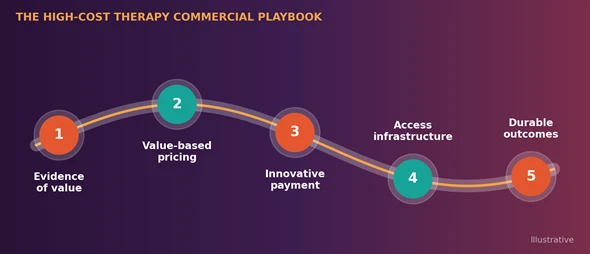
For American C-suite leaders, getting commercial strategy right for high-cost therapies is now a board-level priority. Commercial underperformance can erode the return on years of research investment, while missteps on pricing or access invite political and reputational scrutiny. This article explores how pharma companies are rebuilding their commercial playbooks around evidence, payment innovation, access infrastructure and policy engagement, and what a landmark federal outcomes-based model reveals about the road ahead.
Why the Classic Pharma Launch Playbook Breaks Down for High-Cost Therapies
The economics of high-cost therapies differ from conventional medicines in three fundamental ways. First, the cost is concentrated at the start, while the benefit accrues over many years. A payer that funds a gene therapy today absorbs the full expense immediately, yet the savings from avoided hospitalizations, transfusions or chronic treatments may appear only gradually.
Second, the US insurance market is fragmented and fluid. Patients regularly move between employer plans, individual coverage, Medicaid and Medicare. A commercial insurer that pays for a durable therapy may never capture the downstream savings if the patient changes coverage a few years later. This mismatch between who pays and who benefits is one of the most persistent barriers to access.
Third, the patient populations are small and geographically dispersed, while treatment is concentrated in a limited number of qualified centers. Many therapies require complex cell collection, manufacturing turnaround times measured in weeks, conditioning regimens and extended hospital stays. Commercial success therefore depends as much on operational execution as on promotional reach. Leaders who apply a primary-care launch mindset to these products often find that awareness is high, yet treated patient numbers remain stubbornly low.
Pricing on Proof: How Value Narratives Anchor High-Cost Therapy Launches
In the United States, price-setting for high-cost therapies has shifted from a largely internal exercise to a public argument that must withstand scrutiny from payers, independent value assessors, clinicians, patient advocates and policymakers. The companies that launch most successfully build their value narrative years before approval.
That narrative typically rests on quantifying the full burden of the disease: lifetime medical costs, lost productivity, caregiver impact and the quality-of-life consequences of current standard care. Health economics and outcomes research teams are now involved from early clinical development, shaping endpoints that payers find meaningful rather than relying on endpoints designed solely for regulatory approval.
Durability is the central question. Payers want confidence that a one-time therapy will keep working, yet pivotal trials rarely follow patients for more than a few years. Leading sponsors address this gap through long-term follow-up studies, patient registries and real-world evidence commitments, often presented to payers before launch. Increasingly, price itself is framed as conditional: a figure justified by expected long-term outcomes, backed by a willingness to share risk if those outcomes do not materialize.
Pay Over Time, Pay for Results: Innovative Payment Models for High-Cost Therapies
The most visible change in commercial strategy for high-cost therapies is the rise of innovative payment arrangements. These models range from simple rebates to sophisticated contracts in which payment depends directly on patient outcomes.
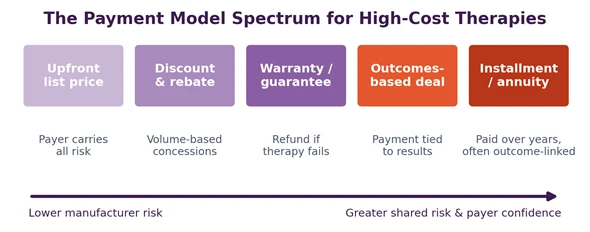
Figure 1: Payment options for high-cost therapies range from traditional upfront pricing to models in which manufacturers share significant financial risk.
Warranty-style agreements offer refunds if a therapy fails within a defined period. Outcomes-based agreements link payment to measurable results, such as freedom from disease events or sustained biomarker response. Installment and annuity models spread the cost across several years, easing budget pressure for payers and aligning payment more closely with the timing of benefit. In practice, the most sophisticated arrangements combine these elements, with payments made over time and continued only if agreed outcomes are met.
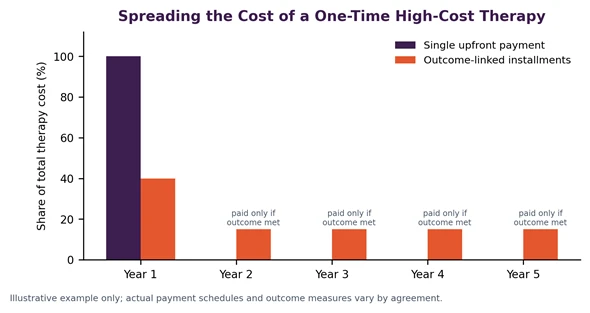
Figure 2: An illustrative comparison of a single upfront payment with an outcome-linked installment structure.
These arrangements are not simple to execute. They require agreement on measurable outcomes, reliable data collection, clear rules for patients who change insurers and administrative systems capable of tracking payments over many years. Federal price-reporting rules have also shaped what is feasible; regulatory changes that allow manufacturers to report multiple best prices for value-based arrangements in Medicaid have removed one long-standing obstacle. Even so, many payers still prefer straightforward discounts, and pharma companies must be prepared to offer a menu of options tailored to different customer segments rather than a single, one-size-fits-all contract.
Beyond the Price Tag: Building the Access Infrastructure High-Cost Therapies Demand
A favorable coverage decision does not guarantee that patients are treated. For high-cost therapies, the path from diagnosis to infusion can take many months and involve referrals, eligibility testing, prior authorization, cell collection, manufacturing and hospital admission. Each step is a potential point of attrition.
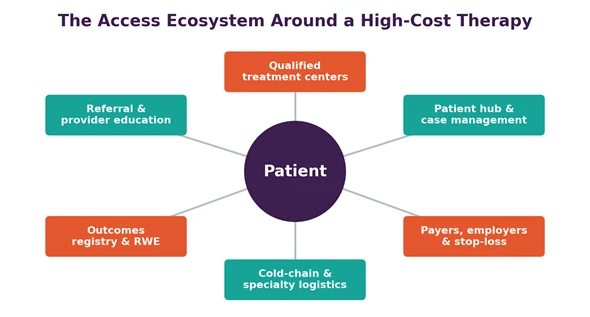
Figure 3: Commercial success for high-cost therapies depends on a coordinated ecosystem around each patient.
Leading companies are therefore investing in access infrastructure rather than traditional field force scale. They build networks of qualified treatment centers and support them with training, reimbursement guidance and scheduling capacity. Dedicated patient hubs provide case management, travel and lodging support, and help families navigate insurance requirements. Specialty logistics teams manage chain-of-identity and cold-chain requirements with the precision of a clinical operation.
Self-insured employers represent a distinctive American challenge. A single multimillion-dollar claim can disrupt a mid-sized employer's health budget, prompting some plans to exclude high-cost therapies or rely on stop-loss insurance. Pharma companies are responding by engaging directly with benefits consultants, stop-loss carriers and specialty carve-out programs to create financing mechanisms that make coverage more predictable for employers.
Washington's Influence on High-Cost Therapy Commercial Strategy
Federal policy is now a core input into commercial planning for high-cost therapies. The Inflation Reduction Act's Medicare negotiation provisions, including how orphan-drug exclusions apply and the differing timelines for small molecules and biologics, influence indication sequencing, lifecycle planning and launch pricing decisions. Medicaid, which covers a large share of patients with certain rare and inherited diseases, has become a critical and increasingly sophisticated customer.
State Medicaid programs, operating under fixed annual budgets, feel the pressure most acutely. A handful of patients receiving multimillion-dollar therapies in a single year can create a visible budget shock, even when the long-term economics are favorable. Some states have explored supplemental rebate agreements, carve-outs from managed care capitation and dedicated funding pools for high-cost therapies. For manufacturers, understanding state budget cycles and legislative calendars has become as important as understanding formulary review timelines.
Policymakers are also experimenting directly with new payment approaches. The most significant example to date is a federal model that negotiates outcomes-based agreements for gene therapies on behalf of state Medicaid programs, which offers valuable lessons for every company preparing to launch a high-cost therapy.
Case Study: One Federal Deal, 84% Coverage – Outcomes-Based Pricing Opens Medicaid to Sickle Cell Gene Therapies
Sickle cell disease affects a predominantly Medicaid-covered population in the United States, and the arrival of two approved gene therapies created a difficult financial problem for state budgets. The therapies offered the possibility of a durable transformation in patients' lives, but their multimillion-dollar prices were a formidable barrier for individual state programs.
To address this, the Centers for Medicare & Medicaid Services (CMS) launched the Cell and Gene Therapy Access Model, a voluntary program in which the federal government negotiates outcomes-based agreements with manufacturers on behalf of participating state Medicaid agencies. The model initially focuses on gene therapies for sickle cell disease, and both manufacturers of the approved therapies agreed to participate. States could begin participating on a rolling basis between January 2025 and January 2026.
Under the agreements, participating states receive negotiated discounts and are entitled to rebates if the therapies do not deliver the expected clinical benefits. Access conditions are standardized: treatment is delivered at qualified centers, outcomes are tracked through a designated patient registry, and continuity of care is protected after treatment. By mid-2025, 33 states, the District of Columbia and Puerto Rico had signed on, representing approximately 84% of Medicaid beneficiaries living with sickle cell disease.
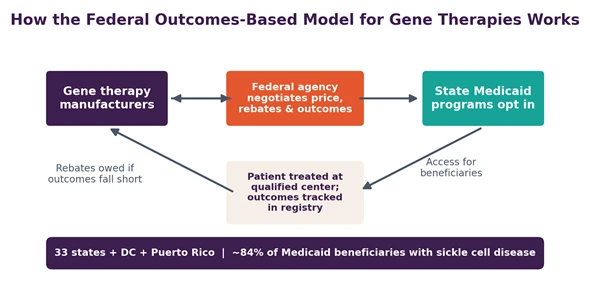
Figure 4: The structure of the federal outcomes-based model for sickle cell gene therapies.
The strategic lessons for pharma leaders are significant. First, centralized negotiation dramatically reduced the transaction burden of contracting with dozens of individual states, turning a fragmented market into a single, scalable agreement. Second, outcomes-based terms gave states the financial confidence to cover a high-cost therapy that many might otherwise have restricted. Third, the registry requirement builds a long-term evidence base that can support future pricing, label and payer discussions. For companies preparing their own high-cost therapy launches, the model demonstrates that accepting accountability for outcomes can unlock access at a scale that list-price negotiation alone rarely achieves.
The C-Suite Agenda for Turning High-Cost Therapies into Sustainable Pharma Franchises
The companies that succeed with high-cost therapies treat commercial strategy as an enterprise capability rather than a launch-year project. Pricing, market access, medical affairs, manufacturing and data teams must operate as a single integrated unit, with decisions about outcomes measures and evidence generation made alongside clinical development rather than after it.
Portfolio strategy matters as well. A company with a single high-cost therapy faces concentrated commercial risk, while those building platforms across related indications can spread investments in treatment center networks, patient hubs and outcomes infrastructure across multiple products. Boards should therefore evaluate high-cost therapy opportunities not only on the merits of an individual asset, but on how well each launch strengthens capabilities that the next one can reuse.
Financial planning also needs to evolve. Outcome-linked and installment arrangements shift revenue across multiple years and introduce contingent liabilities, requiring close collaboration between commercial leaders, finance teams and auditors. Capacity at treatment centers and in manufacturing must be scaled ahead of demand, because unmet treatment slots translate directly into lost patients and reputational risk. Finally, engagement with policymakers and patient communities should be sustained rather than reactive, positioning the company as a constructive partner in making transformative therapies affordable.
Conclusion:
High-Cost Therapies Demand a New Commercial DNA
High-cost therapies are rewriting the rules of pharmaceutical commercialization in the United States. The traditional model of broad promotion, upfront pricing and annual formulary negotiation cannot carry therapies that deliver lifelong benefit from a single dose. In its place, a new playbook is emerging, built on rigorous evidence of value, flexible and outcome-linked payment models, purpose-built access infrastructure and constructive engagement with policymakers.
The federal sickle cell gene therapy model shows that when manufacturers are willing to share risk, payers are willing to expand access. For American pharma executives, the message is clear: the winners in this market will not simply be the companies with the most innovative science, but those that can prove, finance and deliver its value at scale.

Lakshmi is a science writer with a foundation in the laboratory. She earned her master's in biotechnology and trained through research internships at ICGEB (JNU) and DIPAS, DRDO, with her work appearing in the Egyptian Journal of Veterinary Sciences. Now APCRM-certified and part of the editorial team at Pharma Focus America and Pharma Focus Europe, she reports on pharmaceutical technology, research, and innovation — giving complex science a clear and confident voice for industry leaders.