

How Single Use Technologies Are Changing Biopharmaceutical Production
Lakshmi, Editorial Team, Pharma Focus America
Single-use technologies have moved from niche clinical tools to the backbone of modern biopharmaceutical production. This article examines how disposable bioreactors, bags and fluid paths are reshaping plant economics, speed to market, sustainability and supply security for US manufacturers. Drawing on federal pandemic-era investments, a published life cycle assessment and the new USP <665> standard, it explains what the shift means for capital planning, compliance and the C-suite agenda over the next decade.
For most of the biopharmaceutical industry’s history, a manufacturing plant was defined by its steel. Gleaming tanks, fixed piping and miles of welded lines were built to last for decades, cleaned and sterilized between every batch, and validated at great expense before a single dose left the building. That model delivered the first generation of biologics, but it was designed for a world of few products, long runs and predictable demand.
That world has changed. Today’s portfolios span monoclonal antibodies, bispecifics, vaccines, cell therapies and gene therapies, many produced in smaller volumes for narrower patient populations. Speed to clinic and speed to market have become competitive weapons, and multiproduct flexibility now matters as much as raw capacity. In response, single-use technologies (pre-sterilized, disposable bioreactor bags, mixers, tubing, filters and connectors) have moved from the development laboratory to the commercial production floor.
For American C-suite leaders, the shift raises questions that go well beyond engineering. It changes how capital is deployed, how supply chains are secured, how sustainability is measured and how regulators assess product quality. This article examines each of those dimensions and what they mean for strategic decision-making.
From Steel to Polymer: The Single-Use Shift Redefining Biopharmaceutical Plants
The most visible change single-use systems bring is the disappearance of cleaning. In a stainless-steel suite, each batch is bracketed by clean-in-place and steam-in-place cycles, followed by verification that residues from the previous product have been removed. These steps consume purified water, steam, chemicals, energy and, above all, time. Single-use assemblies arrive pre-sterilized, are installed and integrity-checked, run once and are then discarded.
The operational consequences are significant. Changeover between products can shrink from days to hours, reducing the risk of cross-contamination and making genuinely multiproduct facilities practical. Because fewer fixed utilities are needed, buildings can be smaller and simpler, and modular suites can be built, expanded or repurposed far faster than traditional plants. Single-use bioreactors are most commonly deployed at scales up to 2,000 liters, which aligns well with the high-titer processes and smaller patient populations that characterize many modern pipelines.
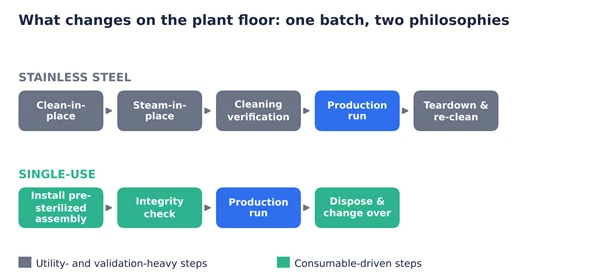
Figure 1. How a batch cycle differs between stainless-steel and single-use operations.
The Single-Use Economics Every Biopharmaceutical CFO Should Understand
Single-use technology rewrites the financial profile of a plant rather than simply lowering its cost. Capital expenditure falls because there is less fixed equipment, less utility infrastructure and less cleaning validation to fund upfront. Operating expenditure, however, shifts toward consumables, which must be purchased for every batch. The result is a cost structure that scales more closely with output, a welcome feature when demand is uncertain or a product may fail in late-stage trials.
The trade-off is volume. For a high-demand product with stable, long-term output, the cumulative cost of disposables can eventually outweigh the depreciation of a stainless-steel line. That is why most leading manufacturers now operate hybrid networks, using single-use systems for clinical supply, launches and multiproduct suites, while retaining stainless steel for the highest-volume products. The strategic question for finance leaders is not which technology wins, but where each one earns its place in the portfolio.
Speed carries its own financial value. A facility that can be designed, built and qualified faster brings revenue forward and shortens the period in which capital sits idle. For a newly approved therapy, earlier commercial supply can mean earlier market share and a longer effective period of exclusivity. Finance teams that evaluate single-use investments solely on cost per gram therefore risk underestimating their true return, which often lies in time saved and risk avoided rather than in unit economics alone.
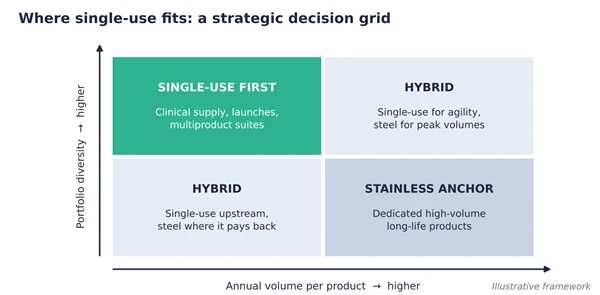
Figure 2. An illustrative decision grid for matching manufacturing technology to portfolio strategy.
Greener Than It Looks? The Sustainability Paradox of Single-Use Technologies
Plastic waste makes single-use technology an easy target for sustainability critics, yet full life cycle analysis often tells a more nuanced story. Stainless-steel operations carry a heavy hidden footprint in water-for-injection, clean steam, cleaning chemicals and the energy needed to heat and circulate them. A life cycle assessment carried out during the design of a 2,000-liter monoclonal antibody clinical supply facility in California reported that the single-use approach cut carbon emissions by 17%, energy consumption by 25% and water use by 28% compared with a stainless-steel equivalent.
The waste challenge remains real. Most used assemblies are still incinerated or landfilled because multilayer films and mixed polymers are hard to recycle, and contaminated materials require careful handling. Forward-looking manufacturers are working with suppliers on take-back schemes, waste-to-energy recovery and designs that use fewer material types. For boards facing investor scrutiny on environmental performance, the credible position is transparency: report the full life cycle picture, not just the visible plastic.
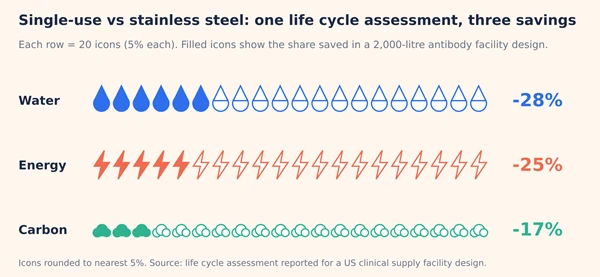
Figure 3. Reported resource savings for single-use versus stainless steel in one 2,000-liter facility design.
Case Study: The Pandemic Stress Test That Made Single-Use Supply a National Priority
The COVID-19 pandemic offered the clearest demonstration of how central single-use technology had become to American biopharmaceutical production. As vaccine and therapeutic programs scaled at unprecedented speed, demand for bags, filters, tubing and bioreactor liners surged. By May 2021, industry reports indicated that some manufacturers were waiting 10 to 12 months for certain single-use equipment, a serious constraint for programs measured in weeks.
The federal response treated these components as strategic infrastructure. Under a Memorandum of Understanding signed in May 2021 by the Department of Defense and the Department of Health and Human Services, a dedicated capacity-expansion team built a $2.3 billion portfolio that explicitly included bioprocessing consumables alongside vials, mRNA raw materials and fill-finish capacity. The program awarded 20 cooperative and technology investment agreements to US-based companies. Each recipient was required to complete its expansion within 36 months and to provide the government with at least 10 years of priority access and preferential pricing. Separate federal agreements also funded engineering design for new domestic lines producing cell culture media and single-use media bags.
Three lessons stand out for executives. First, single-use components are no longer interchangeable commodities; a missing bag can halt a batch as surely as a failed bioreactor. Second, qualifying alternative suppliers takes time, so dual-sourcing must be built before a crisis, not during one. Third, domestic capacity has become a matter of public policy, and companies that align manufacturing investments with national resilience goals may find partners and incentives that others miss.
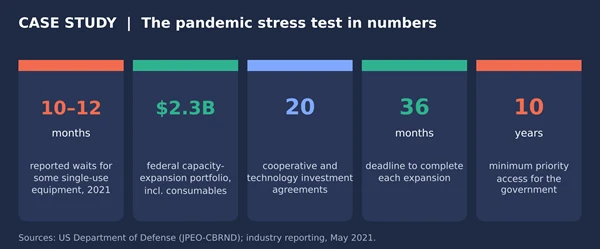
Figure 4. Key figures from the pandemic-era single-use supply crunch and the federal response.
USP <665> and the New Compliance Era for Single-Use Systems
Because single-use systems place plastic in direct contact with process fluids, regulators have long expected manufacturers to understand what might leach into the product. United States Pharmacopeia General Chapter <665>, which covers plastic components and systems used to manufacture pharmaceutical drug products, became official on 1 May 2026 after USP extended its original date of 1 May 2022 to allow further stakeholder engagement. Together with its companion chapter <1665>, it sets out a risk-based approach for assessing extractables from manufacturing components, scaled to factors such as contact time, temperature, solvent type and proximity to the final product.
For manufacturers, the practical effect is a heavier reliance on supplier data and a sharper need for structured risk assessments across every fluid path. Companies with fragmented supplier documentation or legacy components lacking modern characterization data face the steepest climb. Those that standardize component libraries and demand consistent extractables data from vendors will find compliance faster and cheaper.
The chapter also has implications beyond the quality department. Procurement teams must now weigh a supplier’s documentation and change-notification practices as heavily as price, because an unannounced change to a film, resin or sterilization method can trigger fresh risk assessment. Legal and commercial teams should ensure supply agreements require timely disclosure of such changes. In this sense, USP <665> turns extractables management into a cross-functional discipline that reaches deep into the supply chain.
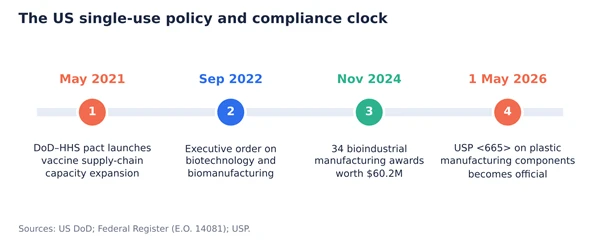
Figure 5. Milestones shaping US single-use manufacturing policy and compliance.
Beyond the Bag: Where Single-Use Technologies Go Next
The next phase of single-use adoption will be shaped by integration rather than substitution. Continuous and intensified processing pairs naturally with disposable flow paths, enabling smaller footprints and steadier output. Cell and gene therapies, which depend on closed, sterile handling of small batches, are among the fastest-growing users of single-use assemblies. Embedded single-use sensors for pH, dissolved oxygen and biomass are bringing real-time process data into disposable systems, supporting automation and data-driven batch release.
Federal policy continues to reinforce domestic biomanufacturing. An executive order on biotechnology and biomanufacturing was signed in September 2022, and in November 2024 the Department of Defense announced 34 bioindustrial manufacturing awards worth a combined $60.2 million under its distributed bioindustrial manufacturing program. These signals suggest that onshore production capacity, including the components that single-use systems rely on, will remain a policy priority.
The C-Suite Lens: Building Resilient Single-Use Biopharmaceutical Operations
For executive teams, single-use strategy is ultimately about resilience and optionality. Leaders should treat critical consumables with the same rigor as active ingredients, mapping single points of failure and qualifying second sources early. Capital plans should model the full cost of ownership across realistic demand scenarios rather than headline equipment prices. Sustainability reporting should reflect full life cycle data. Quality functions should be resourced to meet USP <665> expectations across every fluid path. Above all, technology choices should follow portfolio strategy, not habit.
Talent deserves equal attention. Operating single-use suites well demands staff who understand assembly design, integrity testing, supplier quality and data integrity, skills that differ from those of traditional stainless-steel operators. Organizations that invest in cross-training and in close technical partnerships with their suppliers will extract more value from the same equipment. Finally, executives should insist that single-use decisions are revisited as portfolios evolve; the right balance for a company with two products will not be the right balance when it has ten.
Conclusion
Single-use technologies have quietly redefined what a biopharmaceutical plant looks like and how quickly it can respond. They lower capital barriers, accelerate changeovers, enable multiproduct agility and, in many cases, reduce water and energy use. They also introduce new dependencies on suppliers, new waste challenges and new compliance expectations under USP <665>.
The pandemic proved that these components are strategic assets, not routine supplies. American manufacturers that build hybrid networks, secure diverse and domestic supply, invest in recycling partnerships and embed rigorous extractables management will be best positioned for the next decade of biologics growth. For the C-suite, the message is clear: single-use is no longer a technical choice made on the plant floor. It is a strategic decision that shapes speed, cost, sustainability and resilience across the entire enterprise.

Lakshmi is a science writer with a foundation in the laboratory. She earned her master's in biotechnology and trained through research internships at ICGEB (JNU) and DIPAS, DRDO, with her work appearing in the Egyptian Journal of Veterinary Sciences. Now APCRM-certified and part of the editorial team at Pharma Focus America and Pharma Focus Europe, she reports on pharmaceutical technology, research, and innovation — giving complex science a clear and confident voice for industry leaders.