


How Smart Factories Are Transforming the Future of Pharmaceutical Manufacturing
Lakshmi, Editorial Team, Pharma Focus America
Smart factories, which connect equipment, data and people through sensors, automation, analytics and artificial intelligence, are moving from pilot projects to the core of US pharmaceutical operations. This article explains what distinguishes a genuine smart factory, how continuous manufacturing and real-time quality control are changing plant economics, how FDA programs are encouraging adoption, and where leaders meet resistance. A composite case study and practical conclusions help C-suite executives shape their manufacturing strategy.
The Pharmaceutical Plant Is Becoming a Data Business
For decades, the American pharmaceutical plant ran on a familiar rhythm: produce a batch, hold it, test it in a laboratory, review the paperwork and release it days or weeks later. The model was dependable, but it was slow, labor-intensive and blind to much of what happened inside the process between samples. Problems were usually discovered after the fact, when a batch had already failed.
That model is now giving way to something fundamentally different. In a smart factory, equipment, sensors, control systems and enterprise software share data continuously, so that quality is monitored as the product is made rather than inspected afterwards. Analytics flag drift before it becomes a deviation, digital records replace paper, and decisions that once took weeks can be made in hours.
For US pharmaceutical leaders, the shift arrives at a pivotal moment. Federal policy is actively encouraging new domestic production, the FDA has built dedicated pathways for advanced manufacturing, and pipelines are filling with products that demand tighter process control. The question for the C-suite is no longer whether to digitize manufacturing, but how quickly and how well.
Beyond Automation: What Makes a Pharmaceutical Smart Factory Truly Smart
Automation alone does not make a factory smart. Many US plants have run automated equipment for years, yet still operate as collections of isolated machines, each producing data that no one connects. The distinguishing feature of a smart factory is integration: information flows from the sensor on a tablet press or bioreactor through control systems and manufacturing execution systems up to quality, supply chain and business planning.
Three layers define a mature pharmaceutical smart factory. The first is connected sensing, where process analytical technology measures critical quality attributes in real time instead of relying solely on offline laboratory tests. The second is contextualized data, in which batch records, equipment status, environmental conditions and material genealogy sit in a single, trustworthy data platform. The third is decision intelligence, where models, including digital twins that simulate a process virtually, turn that data into recommendations or automated adjustments.
Executives should be wary of vendor claims that skip the second layer. Without clean, contextualized data, advanced analytics and artificial intelligence cannot deliver reliable results, and in a regulated environment, unreliable results are worse than none.
Continuous Flow, Continuous Insight: Smart Factories Rewrite Pharmaceutical Production Economics
The most visible expression of the smart factory is continuous manufacturing, in which materials move through an integrated process without stopping between steps. Because continuous lines depend on constant monitoring and automated control, they are inseparable from smart factory principles.
Adoption has been steady rather than explosive. According to the FDA, 17 approved drugs now use continuous manufacturing, the first of them approved in July 2015. The international standard that underpins the approach, ICH Q13 on continuous manufacturing of drug substances and drug products, was published by the FDA as final guidance in March 2023, giving companies a harmonized regulatory reference.
The economic case extends beyond continuous lines. Smart factory capabilities can shorten release times through real-time release testing, reduce scrap by catching drift early, improve equipment utilization through predictive maintenance and make technology transfer faster by capturing process knowledge digitally. Smaller, more flexible footprints also matter as companies weigh new US facilities, because they lower the capital required to bring capacity online and allow plants to switch products more easily.
Leaders should also recognize that not every product suits a fully continuous process. For many established products, the greater return comes from applying smart factory tools to existing batch operations, connecting equipment, digitizing records and using analytics to reduce variability, rather than rebuilding lines from scratch.
Washington Opens the Door: How FDA Programs Are Accelerating Smart Factory Adoption
Regulatory uncertainty has historically been one of the strongest brakes on manufacturing innovation. Few companies want to be the first to file a novel process with a regulator unfamiliar with it. The FDA has spent more than a decade reducing that risk.
Its Emerging Technology Program, established in 2014, allows companies to engage with agency experts before filing applications that use novel manufacturing approaches. The program has accepted 191 applications, with continuous manufacturing the largest category of accepted technologies, followed by novel unit operations, novel analytical technologies and aseptic technologies.
Building on that foundation, the FDA finalized guidance for its Advanced Manufacturing Technologies Designation Program in December 2024. Designated technologies qualify for early and frequent interaction with the agency, an important advantage for companies investing in platforms they plan to use across multiple products.
Most recently, in response to an executive order signed in May 2025 on domestic production of critical medicines, the FDA launched its PreCheck pilot on February 1, 2026, to support companies building new US manufacturing facilities. The agency received more than 80 requests to participate in the first month and announced seven selected participants on June 29, 2026. For leaders planning greenfield plants, these programs make it realistic to design smart factory capabilities in from the start.
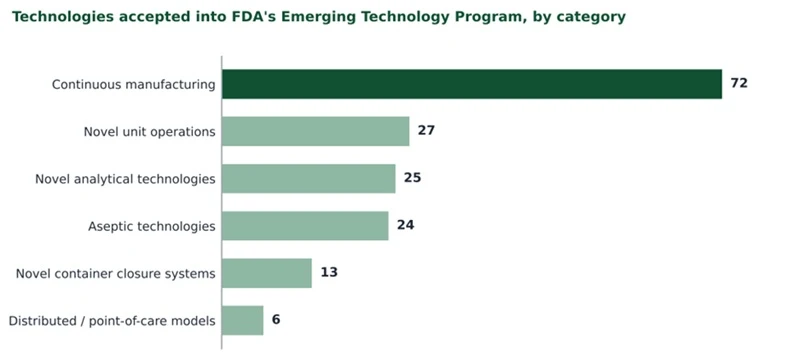
Figure 1: Manufacturing technologies accepted into the FDA’s Emerging Technology Program, by category. Source: FDA, as reported in May 2026.
AI on the Plant Floor: Smart Factory Intelligence Meets Pharmaceutical Quality Rules
Artificial intelligence promises the next leap: models that predict batch outcomes, optimize process parameters, detect anomalies in equipment behavior and support visual inspection. In March 2023, the FDA published a discussion paper on artificial intelligence in drug manufacturing, signaling interest in how such tools can be used and regulated.
The challenge for pharmaceutical manufacturers is that good manufacturing practice demands validated, explainable and controlled systems. A model that continues to learn after deployment raises difficult questions about change control and data integrity. As a result, most US companies are applying AI first in advisory roles, such as predictive maintenance, scheduling and deviation trend analysis, where a human remains the decision-maker, before moving towards closed-loop control.
Data integrity is the thread that ties these efforts together. Every model depends on records that are complete, consistent and attributable, the same principles inspectors already apply to paper and electronic systems. Plants that have struggled with data integrity findings in the past should resolve those weaknesses before layering AI on top, because automation tends to amplify existing problems rather than correct them.
For the C-suite, the sensible approach is to treat AI governance as part of the quality system from day one, defining who owns each model, how it is validated, how performance is monitored and when it must be retrained.
The Hidden Costs: Cybersecurity, Legacy Systems and the Smart Factory Skills Gap
Smart factories create new exposures alongside new capabilities. Connecting operational technology to enterprise networks expands the attack surface, and a cyber incident at a pharmaceutical plant can halt supply of essential medicines. Network segmentation, secure remote access and incident response plans must be built into the design, not added later.
Legacy infrastructure is a second obstacle. Many US sites run equipment and control systems installed decades ago, often from multiple vendors using incompatible data formats. Integrating them is frequently more expensive than the visible technology itself, which is why many digital programs stall after an impressive pilot.
The third constraint is people. Smart factories need operators comfortable with data, engineers who understand both automation and pharmaceutical science, and quality professionals able to validate software-driven processes. Companies that invest in reskilling their existing workforce typically move faster than those relying on external hiring alone.
Case Study: A US Sterile Injectables Plant Builds Its Smart Factory One Line at a Time
This case is an illustrative composite based on patterns common across US pharmaceutical operations. It does not describe a single named organization and deliberately avoids specific financial or performance figures.
A mid-sized US manufacturer of sterile injectables operated a site with several filling lines, a largely paper-based batch record system and frequent delays while laboratory results and documentation were reviewed before release. Leadership wanted faster release and better visibility, but could not afford to shut down production for a full transformation.
The company chose to build its smart factory incrementally. It began by connecting a single filling line, installing environmental and equipment sensors and feeding the data into a central historian. Next, it introduced electronic batch records on that line, which removed manual transcription and allowed quality reviewers to focus on exceptions rather than every entry. Only after the data foundation proved reliable did it add predictive maintenance models and dashboards that gave supervisors real-time views of line performance.
Several lessons emerged. Starting small allowed the team to validate each element and build confidence with quality and regulatory staff. Involving operators early turned potential resistance into ownership, as the people closest to the process helped design the dashboards. Finally, the company treated the first line as a template, documenting its architecture so that later lines could be connected faster and at lower cost. The site gradually moved from reactive troubleshooting to proactive control.
Conclusion: Leading the Smart Factory Era in American Pharmaceutical Manufacturing
Smart factories are transforming pharmaceutical manufacturing by changing where quality comes from. Instead of being tested into products at the end, it is increasingly built in and verified continuously through connected data, advanced controls and analytics. The FDA has created practical pathways for companies willing to innovate, and federal attention on domestic production has raised the strategic value of modern US capacity.
For American C-suite leaders, the priorities are clear. Treat manufacturing data as a strategic asset, invest in the integration layer before the headline technology, embed cybersecurity and AI governance in the quality system, and develop the workforce that will run these plants. Companies that act decisively will gain faster, more resilient and more flexible operations. Those that delay risk finding that the plants they rely on were built for a manufacturing era that is rapidly coming to an end.

Lakshmi is a science writer with a foundation in the laboratory. She earned her master's in biotechnology and trained through research internships at ICGEB (JNU) and DIPAS, DRDO, with her work appearing in the Egyptian Journal of Veterinary Sciences. Now APCRM-certified and part of the editorial team at Pharma Focus America and Pharma Focus Europe, she reports on pharmaceutical technology, research, and innovation — giving complex science a clear and confident voice for industry leaders.