

Inside the Approval Timeline: Where Programs Really Lose Months
Lakshmi, Editorial Team, Pharma Focus America
Most programs don't lose their timeline to a single dramatic failure—they lose it quietly, in the seams between functions. This article reframes the approval timeline as an operational system rather than a scientific one, exposing where months truly vanish: document queues, cross-functional reviews, and query cycles no one owns. Understand the anatomy of a slip, and reclaim the calendar time your science already earned.
Introduction:
Ask a development team why their program slipped two quarters, and you’ll usually hear about the obvious culprits: a clinical hold, an unexpected safety signal, a manufacturing deviation. These are the losses that get postmortems and steering-committee attention. But they are not, in aggregate, where most programs surrender their timeline.
The real erosion happens quietly. It lives in the gaps between functions, in documents waiting for a signature, in a query that sits unanswered for eleven days because the person who can answer it is traveling. Individually, none of these delays looks like a crisis. Collectively, they are the difference between a first-cycle approval and a program that arrives to market a year late—often behind a competitor who ran the same gauntlet more cleanly.
This is an argument for treating the approval timeline as an operational system rather than a sequence of scientific milestones. The science is hard, but it is usually not what costs you the months.
‘’The critical path to approval is rarely lost in a single dramatic failure. It bleeds away in weeks—here and there—across handoffs no one owns.’’
The Anatomy of a Slip
To understand where time disappears, disaggregate a program’s journey into its functional handoffs rather than its phases. Phases are how we plan; handoffs are where we bleed.
There is a persistent gap between where teams believe their delay accumulates and where independent timeline audits repeatedly find it. Teams anchor on the scientific and regulatory events they can name. Auditors find the losses in the connective tissue: documents in queue, cross-functional reviews, and query cycles.
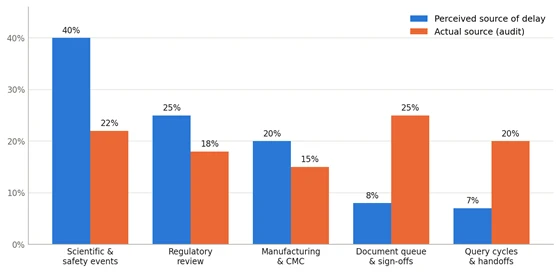
Figure 1. Where teams think time goes versus where timeline audits find it.
The two categories teams most reliably underestimate—document queues and cross-functional query cycles—are precisely the ones that don’t belong to any single owner. A safety signal has a home: pharmacovigilance. A CMC deviation has a home: manufacturing sciences. But a document sitting in a review queue for nine days, or a data query bouncing between biostatistics and clinical operations, belongs to the seams between departments. And seams have no defenders.
The Handoff Problem
Every transfer of work between functions carries a hidden cost that rarely appears on a Gantt chart: latency. Not the time to do the work, but the time before the work starts.
A statistician can turn around an analysis in three days. But if the request lands in her queue behind four others, and she needs a clarification that takes the requester two days to answer, the three-day task consumes two weeks of calendar time. Multiply that pattern across the dozens of handoffs in a submission-stage program, and the arithmetic becomes sobering.
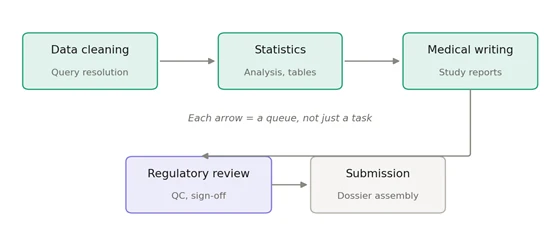
Figure 2. A simplified submission-stage critical path. Each arrow is a handoff—and a place where queue time accumulates before work begins.
Notice that the path has five active work stages but four handoffs. In a well-run program, the work inside each stage is fast and predictable. The variability—the part that makes one program finish two quarters ahead of an identical one—lives almost entirely in the arrows.
Three Silent Killers
Across programs that slip, the same three patterns recur. None of them is glamorous. All of them are fixable.
The first is the unowned query. When a data discrepancy surfaces, someone has to notice it, route it to the right person, wait for an answer, and confirm the resolution. If any link in that chain lacks a clear owner and a clock, the query drifts. A single unresolved query can hold up a database lock, and a delayed lock cascades through every downstream function.
The second is the review that expands to fill available time. A document sent out for a “two-day review” with no hard deadline routinely comes back in nine. Reviewers are busy, the request has no forcing function, and the requester feels awkward chasing senior colleagues. The fix is unglamorous but reliable: time-boxed reviews with explicit start and end dates, and an escalation path when the box is missed.
The third is the sequential dependency that could have run in parallel. Teams often serialize work out of habit—waiting for a final clinical study report before starting a regulatory section that could have been drafted from a near-final version. The calendar cost of unnecessary serialization is enormous, and it hides in plain sight because each step looks reasonable on its own.
Case Study: The Program That Bought Back a Quarter
A mid-sized developer running a late-stage program in an immunology indication noticed a troubling pattern: three consecutive programs had each slipped between ten and fourteen weeks against plan, and no single failure explained any of them. Leadership commissioned a timeline audit rather than another scientific review.
The audit reconstructed the actual calendar of the most recent program, marking every point where work sat idle. The findings were unremarkable in isolation and damning in aggregate. Data queries took an average of nine calendar days to resolve, though the median actual work involved was under an hour. Cross-functional document reviews averaged eleven days against a nominal three-day target. And the regulatory writing team had, by convention, waited for fully finalized statistical outputs before beginning to draft—adding roughly three weeks of pure serialization that the data did not require.
None of these was a scandal. Each was simply the path of least resistance in an organization where no one owned the seams. The team implemented three changes for the next program. Every open query was assigned a named owner and a 48-hour resolution clock, with automatic escalation. Every document review was time-boxed to a hard deadline with a designated backup reviewer to cover absences. And writing teams were authorized to begin drafting from near-final outputs, with a lightweight process to reconcile changes when finals arrived.
The result was not dramatic in any single moment—which is exactly the point. The next program finished eleven weeks ahead of where the old pattern would have predicted, reclaiming close to a full quarter without adding headcount, without cutting corners on quality, and without a single heroic intervention. The gains came entirely from the arrows.
Why This Is a Leadership Problem, Not a Process Problem
It is tempting to read the case study as an argument for better project management software or a new tracking dashboard. That reading misses the point. Tools help, but the underlying issue is one of ownership and incentive, and those are set at the top.
The seams between functions are unowned precisely because organizational charts are built around functions, not flows. Every leader owns a box; no one owns an arrow. Statisticians are measured on the quality of their analyses, writers on the quality of their documents, regulatory staff on the compliance of their submissions—and none of them is measured on how quickly work moves between them. The queue time that accumulates in the handoffs is, in a real sense, nobody’s key performance indicator.
Changing this requires senior sponsorship. Someone with authority across functions has to declare that timeline latency in the handoffs is a shared responsibility, name owners for the seams, and give those owners the standing to escalate when a review runs long or a query stalls. This is not a project-management tweak—it is a decision about what the organization measures and rewards.
The competitive stakes make the case. When two developers pursue the same indication with comparable science, the one that reaches the market first captures a durable advantage that the slower entrant rarely recovers. That advantage is frequently won not in the laboratory but in the unglamorous discipline of moving work cleanly between desks.
Own the Arrows
The next time a program slips, resist the reflex to look only at the dramatic scientific event. Ask instead where the work waited. Ask how long queries sat unowned, how long reviews ran past their nominal deadlines, how much work was serialized that could have run in parallel. The answers are rarely flattering, but they are almost always actionable.
The months are not lost in the science. They are lost in the seams—and the seams can be closed by any organization willing to decide that someone, finally, owns the arrows.

Lakshmi is a science writer with a foundation in the laboratory. She earned her master's in biotechnology and trained through research internships at ICGEB (JNU) and DIPAS, DRDO, with her work appearing in the Egyptian Journal of Veterinary Sciences. Now APCRM-certified and part of the editorial team at Pharma Focus America and Pharma Focus Europe, she reports on pharmaceutical technology, research, and innovation — giving complex science a clear and confident voice for industry leaders.