

Leveraging AI for Intelligent Quality Ecosystem
Future of Data Integrity & Compliance
Ranjit Barshikar, CEO-QbD International (cGMP / QbD Consulting), United Nations MPP Advisor
The transition from traditional, isolated systems to an interconnected Quality Management System (QMS) with a modern "Intelligent Quality Ecosystem" is a paradigm shift in the pharmaceutical industry. It is a prerequisite for ensuring drug and patient safety, sustaining regulatory compliance, and future-proofing data. With increasing US FDA scrutiny of data integrity and related concerns, the pharmaceutical industry is moving toward risk-based frameworks.
For several decades, QMS in the pharmaceutical industry was designed to document what went wrong after complaints, non-compliance, or deviations were reported, i.e., in a reactive mode, resulting in manual paperwork, isolated data, and a usual state of inspection anxiety. However, as manufacturing complexities rise, this traditional, reactive approach is no longer sustainable. Global regulatory agencies have placed significant emphasis on data integrity, underlined by strict ALCOA+ principles, demanding a fundamental paradigm shift.
Intelligent Quality Ecosystem:
Transitioning to an intelligent quality ecosystem is no longer a luxury. By incorporating Artificial Intelligence (AI) and Machine Learning (ML) directly into quality operations, forward-thinking pharmaceutical companies are moving away from isolated software systems toward dynamic, interconnected networks. This transition aligns with modern regulatory developments, such as the FDA’s guidance on Computer Software Assurance (CSA), which promotes risk-based, automated testing over traditional documentation. Leveraging AI within this ecosystem transforms quality operations into proactive operational excellence for patient safety. According to the US FDA, implementing risk-based processes for computer software used in manufacturing operations or Quality Systems can help the pharmaceutical industry maintain quality compliance, ensure product quality, and support validation requirements.
Pharma manufacturing requires precision, consistency, and strict adherence to quality standards. To comply and remain in business, it is imperative for vendors to acquire systems that can withstand unexpected failures or cyberattacks.
Robotic systems offer a way to address these limitations by:
- Reducing human error in repetitive, high-precision tasks.
- Enabling continuous operation which significantly increases output and reduces downtime.
- Improving traceability and data integrity, which are essential for process optimization, regulatory compliance, and audit readiness.
- Relieving workforce stress in cleanroom settings, where contamination control is critical to maintaining product safety.
Regulatory initiatives:
The US FDA issued a draft guideline in January 2025, “Considerations for the use of Artificial Intelligence to support regulatory decision-making for Drugs & Biological Products”. Similarly, the EU issued, in September 2025, “AI Act Guide – Version 1.1”. This AI Act is not just about regulation; it is about trust, safety, and sustainable innovation.
Pharma manufacturers are now using AI and Robotic Process Automation (RPA) technologies to maximise quality and compliance. Several pharma Organizations are using AI to analyse large volumes of scientific data and accelerate drug discovery. AI is an enabler of Pharma 4.0*. The Pharma 4.0* paradigm has the potential to create a well-controlled, connected, digitized ecosystem and supply chain. AI enhances rapidly changing supply chains and reduces dependence on human intervention. Today, the pharma industry is aware of the benefits of AI implementation, and hence the industry will not go back to traditional ways. The next 5 years will see almost 50%–55% of pharma manufacturers adopting AI by 2030. AI has tremendous potential to shift the paradigm in product/process design and real-time monitoring in the interest of patient-centric product development, as required by regulatory agencies.
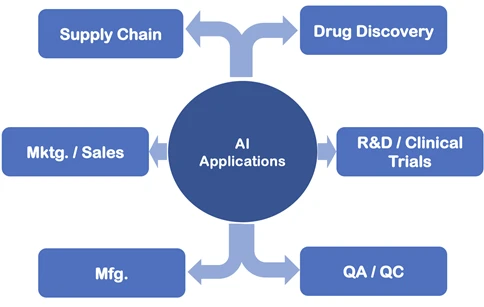
AI applications in Pharmaceutical Industry: Figure: 1
Intelligent Quality Ecosystem key metrics:
- Automated data entry to avoid transcription mistakes.
- Proactive Risk Management: moving from a reactive to a predictive approach to identify anomalies before they occur.
- Predictive Audit Trail Review: scanning e-records in real time to flag unauthorized data deletions, modifications, or anomalies.
- Prioritizing Deviations & CAPA (Corrective and Preventive Actions): When a deviation occurs, AI/NLP (Natural Language Processing) analyzes historical quality data to identify likely root causes and suggest the most effective CAPAs.
- Smart Documentation / SOP: AI cross-references SOPs against global regulatory updates and automatically flags non-compliances.
- Real-time Batch Release.
- Continuously monitor Critical Process Parameters (CPPs) and Critical Quality Attributes (CQAs) during production, predicting process failures early and streamlining the review process for quick monitoring.
- Automating ALCOA+ Principles: deploying biometric sign-offs and reviewing audit trails. Utilizing IoT sensors to record “CPPs & Continuous Process Verification” (CPV) in real time for Attributable and Legible data. Contemporaneous data entry is the key. Building a culture where data is inherently Enduring, Available, and Traceable across the entire drug lifecycle.
Data Integrity:
AI data quality is the degree to which data is accurate, complete, reliable, and fit for use across the AI lifecycle, including training, validation, and deployment. AI offers advanced solutions for improving data quality and integrity through automation, pattern recognition, and anomaly detection. It enhances data quality by identifying and correcting inconsistencies, detecting anomalies, and filling missing values using predictive modeling. By leveraging Deep Learning (DL) models for automated data cleaning, validation, and security, organizations can achieve higher accuracy, reliability, and trust in data integrity compliance.
Robotic process automation (RPA):
As is now well known, RPA automation benefits repetitive manual jobs by providing high-speed, almost real-time monitoring, along with audit trails. RPA helps ensure regulatory agency compliance requirements, as bots do not change set procedures by themselves, thereby enhancing audit trail compliance. Leveraging RPA to automate processes minimizes human and data errors, avoids unauthorized access to critical data processing, and generates audit trail data for QA review and monitoring purposes to ensure compliance. RPA can monitor and check process logs against regulations and policy documents to flag non-compliant processes. RPA can access regulatory requirements, policies, SOPs, etc., from internal data documents and can send emails or flags to relevant employees about changes or updates in regulations. Such RPA tools help tremendously in ensuring data integrity compliance. AI can also be programmed to monitor outsourced contract companies for compliance risks. AI can even schedule, monitor, and send reminders for internal inspections based on a risk-based approach.
AI can also be programmed to monitor outsourced contract companies for compliance risks. Even AI can schedule, monitor, reminders, internal inspections based on risk based approach.
SAP ERP systems can also benefit from RPA by:
- Saving time on repetitive jobs.
- Minimizing human errors due to manual data entry.
- Monitoring compliance, quality, and accuracy.
The future of AI in pharma includes using it for AI-assisted drug design, creating simulated clinical data, personalizing medicine through genomic data analysis, and enhancing supply chain management with technologies like blockchain.
Environment Monitoring:
Online Contamination Monitoring Solutions to ensure real-time monitoring and viable and non-viable particle detection for environmental control/monitoring. Data Integrity compliance: compliant with 21 CFR Part 11, guaranteeing secure, tamper-proof records. Compliance: count, report, and manage data confidently for inspections.
Decades ago, the scenario was “Quality by Testing” (QbT) at the end of batch manufacturing. Then came “Quality by Design” (QbD), to build quality into the design of products and ensure robust processes. Now the pharma industry is moving into Smart Quality – Quality by Control (QbC), with effective online process monitoring to release batches in real time.
Pfizer’s Michigan “Modular Aseptic Processing” facility is now operational, highly robotic, and highly digital. Sanofi’s USA Biopharma manufacturing facility embeds advanced AI, digitalization, and automation throughout the site. Sanofi produces small-molecule drugs, complex biologics, vaccines, and medical devices using AI-powered systems, continuous biologics production technologies, modular facilities, and sustainable practices. This approach supports robust GMP compliance and Quality Assurance, so every medicine meets high Quality standards while reaching patients faster and more reliably. China’s “Hepalink Pharmaceutical Group” 5G-enabled pre-filled syringe manufacturing plant won the ISPE** FOYA award for Novel Technology/Innovation in 2026. The vertically integrated plant has digital infrastructure powered by 5G connectivity, AI, digital twin technology, and automated material-transfer systems. India’s Dr. Reddy’s facility at Bachupally, Hyderabad, is part of the Global Lighthouse Network, implementing Advanced Analytics, Digital Twins, Robotic Process Automation, Augmented / Virtual / Mixed Reality, Digital Performance Management, and the Industrial Internet of Things (IIoT).
Such innovations create an Intelligent Quality Ecosystem in manufacturing, enhancing efficiency, sterility assurance, production capacity, and supply chain resilience.
Trends shaping 2026 and beyond:
- Better quality predictions, faster actions, and positive outcomes.
- Consistency in batch manufacturing and testing.
- Patient-centric development, manufacturing, and testing of medicines.
- Empowered Patients. Patient-focused drug development with AI helps to understand patient expectations. In the future, patients will be better equipped with their own data, such as genetic history or biomarker data from wearable devices.
Validation 4.0 encompasses a proactive, predictive approach to validation, where data analytics and real-time monitoring play crucial roles. This approach allows for continuous validation and assurance that processes and systems consistently produce the intended results. It is imperative to understand that AI is an enabler, helping to arrive at the right output based on the right input. AI-generated content requires human review and approval. AI decision support has to be verified/validated by humans for accuracy. Recently, the US FDA issued its first warning letter related to AI to a company for not using AI properly.
Sustaining growth strategy for AI for Intelligent Quality Ecosystem: (Figure 2)
- Digitalization of processes with AI/ML in product development, quality, and manufacturing.
- Use of Augmented Reality, Virtual Reality, and Mixed Reality with HoloLens/Holograms on a large scale for operational efficiency, supporting predictive analytics.
- Robots in operational tasks, for faster, more consistent, and cost-effective outputs.
- Fully automated plants with minimum human intervention.
- Fully automated labs for inline testing and monitoring. RPA to monitor all equipment for real-time data review/audit trail.
- Ensure Quality by “Control” of all CPPs. Monitoring all CPPs is vital to ensure compliance.
- Steps toward “Quality Maturity” Upskilling through continuous training activities to support the Quality Ecosystem is important.
- Documentation writing and validation report generation
- AI-based decision-making models to support qualification and deviation management
- Image processing pilots for equipment validation and visual inspections
- Emerging technologies like Quality by Design (QbD), Continuous Manufacturing/PAT.
- Proper and responsible use of AI and validation.
Figure 2: Technologies/Future Tools: Intelligent Quality Ecosystem
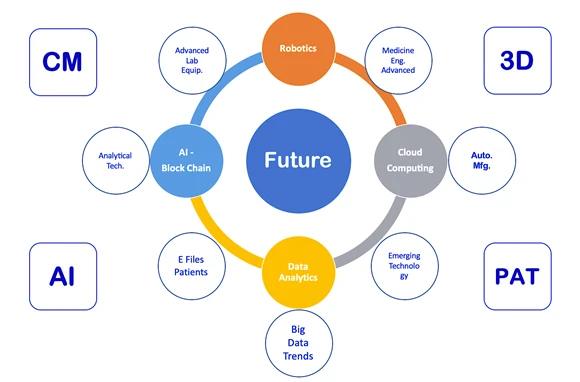
CM: Continuous Mfg., PAT: Process Analytical Technology. 3D Printing,
Practical benefits of AI:
- Forecasting supply chain issues before they occur
- Predicting production bottlenecks and enabling real-time compliance monitoring.
- Automated audit trail reviews, data integrity compliance, and fewer errors.
- Smart Proactive Risk Analysis – early detection of compliance gaps.
- Automated inspections with consistent, traceable audit outcomes.
- Anytime audit readiness.
- Predictive compliance in process monitoring and maintenance.
- Effective monitoring, supply chain management, and traceability.
- Faster drug discovery, smarter clinical trials, and more personalized treatments.
- Ensuring data accuracy in labeling/cartoning and detecting anomalies in packaging operations.
- Enhanced data security.
Conclusion:
AI functions as a decision-support tool rather than an autonomous decision-maker. The “human” in the loop remains the decision-maker. Do not depend on AI for decisions; humans should review AI process data and ensure verification/validation of AI-generated data.
The need of the hour is a newer-technology-first approach, shifting priorities to preventive and predictive models to create smart, paperless factories for Intelligent Quality Ecosystems.
“AI is paving the way for Safe, Efficacious, Patient-centric Medicines by Patient-centric Manufacturing Excellence.”
References:
- US FDA draft guideline in January 2025, “Considerations for the use of Artificial Intelligence to support regulatory decision-making for Drugs & Biological Products”.
- EU Act in September 2025, “AI Act Guide – Version 1.1”.
- *ISPE: International Society for Pharmaceutical Engineering
- **ISPE https://ispe.org/facility-year-awards

Ranjit Barshikar has 56 years of pharma industry experience, specializing in Quality, Manufacturing, Regulatory, and R&D. He has worked with Pfizer Ltd., Lyka Labs, and Ranbaxy (Sun Pharma). He is now CEO – QbD International INDIA, cGMP/QbD consulting, United Nations MPP Advisor, and Editorial Board Member of the Journal of Generic Medicines – UK.
Authored the book “Quality Trailblazer- cGMP to Quality Maturity”. 550+ global presentations at conferences in 70 countries and 170+ webinars.