Molecular Handedness: The Pharma Impact of the 2026 Chemistry Nobel
Chandramouli Ramnarayanan, Global Technical Enablement Engineer, JMP Statistical Discovery LLC, SAS Institute, Cary, NC, USA
Valliappan Kannappan, Founder, Chiralpedia, Coimbatore, India
The 2026 Nobel Prize in Chemistry honours Henri B. Kagan and Kenso Soai for showing how a small imbalance between mirror-image molecules can be amplified, in Soai’s case to near purity. The work explains a long-standing puzzle about the origin of biological handedness and gives process chemists a practical lens for developing single-enantiomer medicines.
Introduction
On 7 October 2026, the Royal Swedish Academy of Sciences awarded the Nobel Prize in Chemistry to Henri B. Kagan of Université Paris-Sud and Kenso Soai of Tokyo University of Science “for the discovery of non-linear effects and autocatalysis in asymmetric organic synthesis” [1].
The citation sounds remote from the plant floor. It is not. A large share of small-molecule drugs are chiral, and most new ones are developed as single enantiomers. Every one of those products depends on a reaction or a separation that favours one mirror image over the other. The laureates changed how chemists understand and exploit that preference.
Why handedness matters
A chiral molecule exists as two non-superimposable mirror images called enantiomers. They share the same formula, melting point, and solubility, yet a biological target can tell them apart because proteins are built only from left-handed amino acids. One enantiomer of a drug may carry the therapeutic effect while the other is inactive, differently active or harmful.
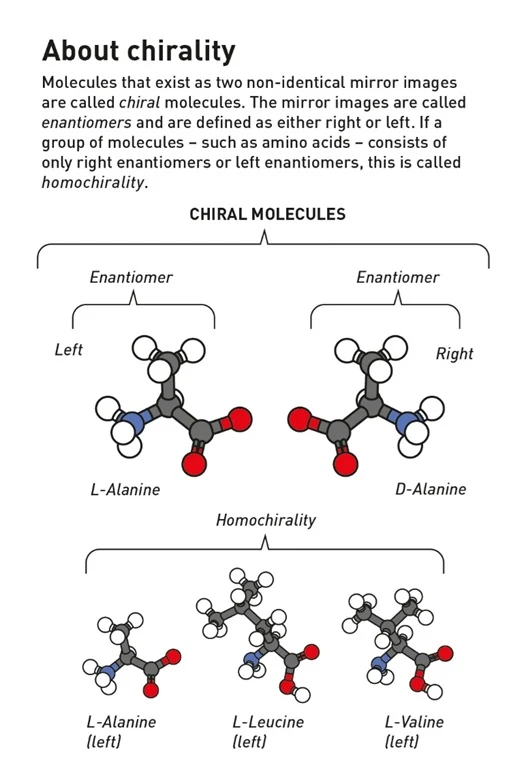
Figure 1. Enantiomers and homochirality. Living systems use only one mirror image of each amino acid. © Johan Jarnestad / The Royal Swedish Academy of Sciences [2].
Regulators have expected sponsors to characterise each enantiomer since the early 1990s [4], and enantiomeric purity is now a routine critical quality attribute. The scientific question behind the prize is older and more basic. Ordinary synthesis from non-chiral materials gives a 50:50 mixture. How, then, did nature end up with one hand only, and how can a chemist reproduce the trick?
In 1953, the physicist Charles Frank answered on paper [3]. A reaction can drive itself to a single hand if it is asymmetric, if one mirror image is enhanced while the other is suppressed, and if the product catalyses its own formation. Asymmetric catalysis, recognised by the Nobel Prizes of 2001 and 2021, met the first condition. Kagan and Soai supplied the other two [2].
Kagan: when purity in is not purity out
An asymmetric catalyst usually pairs a metal with a chiral ligand. Until the mid-1980s, chemists assumed a simple proportionality: a ligand of 50 per cent enantiomeric excess (ee) would give a product of half the ee obtained with pure ligand. In 1986, Kagan’s group showed that the relationship is often curved [5].
The reason is that more than one ligand can sit on each metal. Mix right- and left-handed ligands and three catalysts form: right-right, left-left and a mixed pair. If the mixed catalyst is sluggish, it locks away equal amounts of both hands and leaves the remaining active catalyst far purer than the ligand that went in.
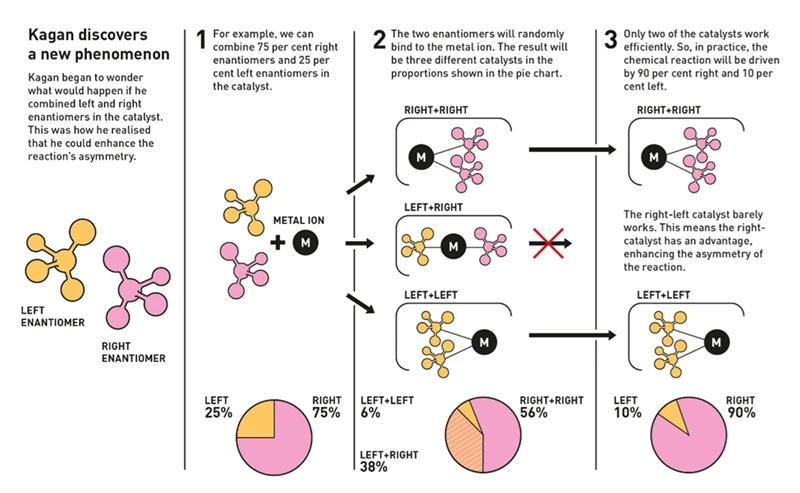
Figure 2. How a non-linear effect arises. A 75:25 ligand mixture behaves like a 90:10 catalyst when the mixed species is inactive. © Johan Jarnestad / The Royal Swedish Academy of Sciences [2].
The Academy’s example makes the point with numbers [2]. A ligand that is 75 per cent right-handed forms roughly 56 per cent right-right, 38 per cent mixed and 6 per cent left-left catalyst. With the mixed form idle, the reaction runs on a 90:10 ratio. A 50 per cent ee input delivers the performance of an 80 per cent ee catalyst.
The effect can also run the other way. If the mixed species is the more active one, product ee falls below the linear prediction. Both cases, positive and negative, are now standard entries in the mechanistic toolkit [6].
Soai: a catalyst that makes itself
Kenso Soai took the idea one step further. While studying a zinc-mediated reaction with a strong non-linear effect, he noticed that the catalyst and the product looked alike, and asked whether a product could serve as its own catalyst [2].
In 1995, his group reported the answer [7]. When diisopropylzinc adds to a pyrimidine aldehyde, the chiral alcohol that forms catalyses the same reaction and passes on its own handedness. Starting from material with an ee of only 2 per cent, repeated runs raised the ee to almost 90 per cent.
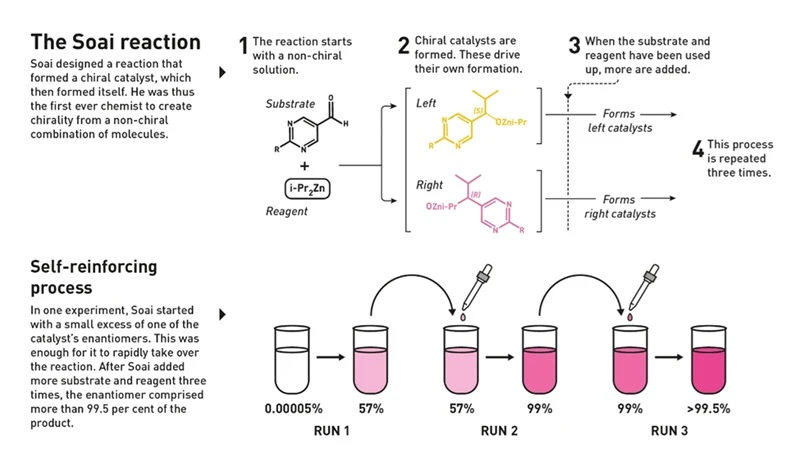
Figure 3. The Soai reaction. A chiral product catalyses its own formation, and three consecutive runs take an excess of about 0.00005 per cent to above 99.5 per cent. © Johan Jarnestad / The Royal Swedish Academy of Sciences [2].
By 2003 the system had been refined to a remarkable degree [8]. A starting excess of about 0.00005 per cent, far below anything an analytical laboratory can measure, became 57 per cent after one run, 99 per cent after two and above 99.5 per cent after three. Later work showed that the reaction proceeds even with no chiral input at all. Chance decides which enantiomer gains the first small lead, and autocatalysis does the rest [2].
The mechanism took a quarter of a century to unravel. The leading model, still debated in detail, is that four product molecules assemble with zinc into a cluster that is active only when all four share the same hand, while mixed clusters are stable and idle [9]. That is Kagan’s effect operating inside a self-copying system, which is why the two discoveries share one prize.
What it means for development and manufacturing
The Soai reaction itself is not a production method. The practical value of the prize lies in the thinking it established, most of it traceable to Kagan’s non-linear effects.
- A diagnostic for process understanding: Plotting product ee against ligand ee is a quick, inexpensive experiment. A straight line suggests a single ligand in the selectivity-determining step. A curve signals aggregation or multiple ligands, which is exactly the behaviour that can shift when concentration, catalyst loading, or temperature changes on scale-up.
- A lever on cost of goods: Where a positive non-linear effect operates, a ligand of moderate enantiopurity can deliver product of high enantiopurity. That can relax the specification and the price of one of the most expensive raw materials in a chiral process.
- A warning for the control strategy: A negative non-linear effect means a small drop in ligand ee causes a disproportionate drop in product ee. In that situation, the ligand’s enantiomeric purity deserves a tight specification and a place in the risk assessment.
- A reminder that small biases grow: Autocatalytic and self-seeding behaviour is not confined to one zinc reaction. Crystallisation-based resolutions and deracemisations rely on the same principle, where a slight excess or a seed determines the outcome of the whole batch. Understanding amplification helps a team decide when to exploit it and when to guard against it.
- Reach beyond pharmaceuticals: The Academy notes that the same reasoning now serves producers of flavours, fragrances, agrochemicals and some advanced materials, wherever a molecule must interact with living systems [2].
Limits and outlook
The prize does not settle how life became one-handed. Diisopropylzinc is destroyed by water, the reaction works for a narrow family of substrates, and the Academy itself calls it artificial and unlike the chemistry of life [2]. What Soai proved is that the route Frank described is chemically possible. Whether it was the route nature took remains open, and other mechanisms are under active study [10].
For industry, the outlook is more concrete. Detailed mechanistic work has turned the Soai system from a curiosity into a set of design rules [9], and research groups are now trying to build amplifying reactions for amino acids and sugars [2]. If that succeeds, self-amplifying catalysis could one day reduce the reliance on costly enantiopure ligands and chiral separations.
Until then, the lesson of the 2026 prize is practical enough. In chiral chemistry, proportions in do not always equal proportions out. Teams that measure the difference early gain both process understanding and a sounder control strategy.
References
1. The Royal Swedish Academy of Sciences. Press release: The Nobel Prize in Chemistry 2026, 7 October 2026. nobelprize.org
2. The Royal Swedish Academy of Sciences. They solved chemistry’s asymmetric mystery. Popular science background to the Nobel Prize in Chemistry 2026. Text: Ann Fernholm. Illustrations: Johan Jarnestad. nobelprize.org
3. Frank, F. C. Biochim. Biophys. Acta 1953, 11, 459-463.
4. US Food and Drug Administration. FDA’s policy statement for the development of new stereoisomeric drugs. Chirality 1992, 4, 338-340.
5. Puchot, C.; Samuel, O.; Duñach, E.; Zhao, S.; Agami, C.; Kagan, H. B. J. Am. Chem. Soc. 1986, 108, 2353-2357.
6. Girard, C.; Kagan, H. B. Angew. Chem. Int. Ed. 1998, 37, 2922-2959.
7. Soai, K.; Shibata, T.; Morioka, H.; Choji, K. Nature 1995, 378, 767-768.
8. Sato, I.; Urabe, H.; Ishiguro, S.; Shibata, T.; Soai, K. Angew. Chem. Int. Ed. 2003, 42, 315-317.
9. Athavale, S. V.; Simon, A.; Houk, K. N.; Denmark, S. E. Nat. Chem. 2020, 12, 412-423.
10. Blackmond, D. G. Chem. Rev. 2020, 120, 4831-4847.
Image credits
Figures 1 to 3: © Johan Jarnestad / The Royal Swedish Academy of Sciences, reproduced with attribution from the popular science background to the Nobel Prize in Chemistry 2026 [2].
Disclaimer and Disclosure
The views expressed herein are personal and reflect current thinking in this domain, based on information available in the public domain. They do not necessarily represent the views of any employer, organization, or affiliated institution.

Chandramouli Ramnarayanan, PhD, is a Global Technical Enablement Engineer at JMP Statistical Discovery LLC, a subsidiary of SAS Institute Inc. With over 20 years of experience in academia, pharmaceuticals, and clinical trials, he specialises in Quality by Design (QbD) and formulation.
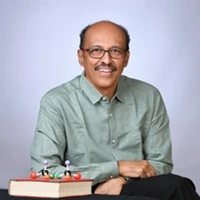
Valliappan Kannappan, PhD, is the Founder of Chiralpedia and a former Professor of Quality Assurance at Annamalai University, India. With over three decades of experience in medicinal chemistry, his work has focused on chiral analysis and separation techniques to address real-world challenges in pharmaceutical and biomedical research. In 2021, he launched Chiralpedia.com to promote accessible education and collaborative research in chiral science.