

Next-Generation Fill-Finish Technologies for Sterile Drug Products
Lakshmi, Editorial Team, Pharma Focus America
Sterile fill-finish has moved from the end of the manufacturing chain to the center of American pharmaceutical strategy. This article examines what next-generation fill-finish technologies mean for senior leadership: how gloveless robotic isolators change batch economics, why ready-to-use components are redrawing the sterile floor, where machine vision now decides quality, what one U.S. site achieved by rebuilding for format agility, and what these platforms cost to run.
Introduction:
The Narrowest Point in the U.S. Drug Supply
American pharmaceutical companies have spent a decade optimizing discovery, clinical operations and commercial launch. The step that actually puts a sterile product into a container has received a fraction of that attention, and it is now the step most likely to determine whether a launch lands on schedule. Filling capacity in the United States books out years in advance, and the assets in shortest supply are not the largest lines but the ones that can move quickly between formats.
The pressure has an obvious source. More than 70 percent of newly approved injectable products require aseptic processing, and the pipeline behind them is dominated by biologics, biosimilars, antibody-drug conjugates, cell and gene therapies and incretin-class medicines that patients administer themselves. Each of those categories arrives at fill-finish with a different container, a different sensitivity profile and a different batch size. A national manufacturing base built for high-volume vials is being asked to deliver a high-mix, device-centric portfolio, and the mismatch is where next-generation fill-finish technologies earn their case.
Why Sterile Fill-Finish Capacity Now Sets the Ceiling on Growth
The commercial signals point in one direction. The market for prefilled syringes is projected to expand from roughly USD 9.4 billion in 2026 to about USD 20.3 billion by 2035, and outsourced sterile injectable manufacturing is forecast to grow from approximately USD 41.6 billion in 2026 to USD 87.3 billion by 2033, a compound annual growth rate near 11.2 percent. Roughly half the autoinjector products on the market today were approved since 2017, which tells you how recently the delivery format shifted.
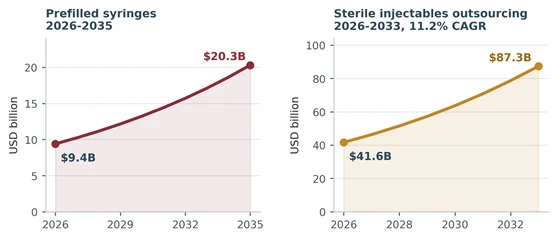
Figure 1. Two markets converging on the same bottleneck: device-based containers and outsourced sterile capacity.
For a chief executive, the strategic consequence is uncomfortable but simple. A company can own a differentiated molecule, a clean clinical package and a strong commercial plan, and still be unable to supply the market because it cannot secure a validated line in the right container at the right scale. Fill-finish has become the point in the value chain where scarcity is priced, and that pricing power now sits with whoever controls flexible sterile capacity rather than with whoever controls volume.
There is a defensive dimension as well. Sterile injectable supply remains structurally vulnerable, and manufacturing disruptions and quality findings continue to be among the leading contributors to drug shortages in the United States. When a single site holds the only qualified line for a product, a regulatory observation or an equipment failure becomes a national supply event rather than a company problem. Boards that have historically viewed sterile capacity as a procurement line item are now being asked by investors, health systems and federal agencies to explain their redundancy, and the honest answer at many companies is that there is none.
The Gloveless Turn: How Robotic Isolators Changed Fill-Finish Economics
The most consequential change on the sterile floor is the removal of the human operator from the critical zone. Conventional aseptic filling relies on gowned personnel working through glove ports, and personnel remain the dominant source of contamination risk in any cleanroom. Gloveless robotic isolators replace those interventions with articulated arms operating inside a sealed, decontaminated enclosure that handles ready-to-use containers without the line ever being opened.
Adoption in the United States is already substantial. Industry surveys indicate that roughly two-thirds of U.S. pharmaceutical manufacturers have moved to isolator-based vial filling and about 40 percent have adopted robotic filling systems, with robotics deployment up sharply against 2021 levels and manual interventions reduced by around three-quarters where these platforms are installed.
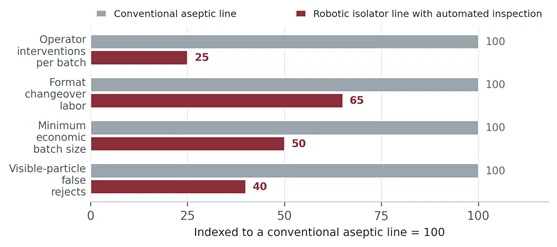
Figure 2. Reported performance of robotic isolator platforms against a conventional aseptic line, indexed.
The economic effect that matters most is not throughput. Robotic and isolator-integrated systems have been reported to cut format-changeover labor by 30 to 40 percent and to lower the minimum economically viable batch size by roughly half. That second number is the strategic one. It moves the break-even point far enough down that orphan indications, cell and gene therapy products and early commercial launches become fillable on a commercial line rather than being stranded in clinical-scale operations. More than half of new U.S. installations now target batch sizes below 10,000 units, which is a different industry from the one that built its capacity around blockbusters.
Ready-to-Use Components Are Redesigning the Sterile Floor
Behind the robotics sits a quieter shift with comparable consequences. Pre-sterilized, nested containers delivered in tubs remove washing, siliconization and depyrogenation tunnels from the filling suite entirely. What disappears with them is a substantial block of utilities, floor space, validation scope and cycle time. Consumables now account for the majority of fill-finish market revenue, which is a reasonable proxy for how far the industry has shifted the burden of component preparation upstream to specialist suppliers.
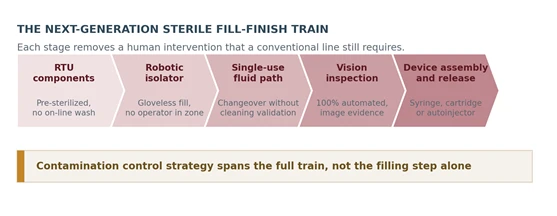
Figure 3. The next-generation sterile fill-finish train, stage by stage.
The quality argument is at least as strong as the operational one. Bulk-washed glass introduces cosmetic defects and particulate that pre-sterilized barrels largely avoid, and reported reductions in visible-particle rejects from higher-grade ready-to-use components run well into double digits. For high-value biologics where a single rejected batch can exceed the annual operating cost of the line, that difference compounds quickly.
The trade is a deeper dependency on component suppliers and their qualification data. Ready-to-use formats concentrate risk in a narrower set of vendors, and a change to a barrel, a stopper or a sterilization method propagates directly into a licensed process. Senior leadership should treat component supply agreements with the seriousness normally reserved for active ingredient sourcing, because that is now their functional equivalent.
In Sterile Fill-Finish, Machine Vision Decides Quality
Every parenteral product sold in the United States must be inspected for visible particulates, and federal guidance sets clear expectations for how that inspection is designed and justified. Human inspection has always been the weak link: it is probabilistic, it fatigues, and it generates both missed defects and expensive false rejects. Automated visual inspection has been standard on high-volume lines for years, but conventional vision systems struggle with the ambiguous cases, particularly distinguishing an air bubble at a syringe stopper from a genuine foreign particle.
Deep-learning inspection has begun to close that gap in validated production. One documented deployment reported a 70 percent improvement in particle detection alongside a 60 percent reduction in false rejections at a given inspection station. Both halves of that result matter commercially: the first is a patient safety and recall-exposure argument, and the second recovers saleable units that a conventional system would have discarded. On a high-value biologic, a meaningful reduction in false rejects can fund the inspection system outright.
The obligation attached is validation. An automated system must be demonstrated at least as effective as the method it replaces, and a model that adapts over time raises questions about lifecycle traceability, documented risk management and ongoing performance monitoring that regulators are actively working through. Companies deploying learning-based inspection should assume the data governance burden is part of the purchase price.
Case Study: The U.S. Site That Traded Line Speed for Format Agility
A contract sterile manufacturer operating a Midwestern facility entered the decade with a high-speed vial line capable of 24,000 units per hour, running below half its rated utilization. Its client base had shifted toward biologics programs needing syringes and cartridges in modest quantities, and the site was declining inquiries it had no way to serve. Management faced the familiar choice between adding a second high-speed line and rebuilding what it already had.
It chose to rebuild. The existing line was retained for two legacy vial contracts, and an adjacent suite was converted to a gloveless robotic isolator platform running pre-sterilized nested containers across vials, syringes, cartridges and ampoules, with single-use fluid paths and an automated inspection system fed by image-based batch records. Peak throughput on the new platform is a fraction of the old line's, and that was the deliberate trade.
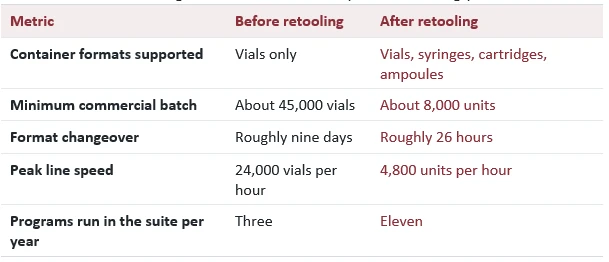
The commercial result was decisive. The converted suite ran eleven programs in its first full year against three on the legacy line, and the site began winning small-batch work it had previously turned away, at margins that reflected scarcity rather than volume. Because changeover no longer consumed nine days of cleaning validation and documentation, utilization rose without any increase in nominal capacity.
Two lessons proved harder than the engineering. The first was staffing: first-year performance on the new platform fell short of design targets by roughly a dozen percentage points until the team accumulated real aseptic experience with robotic operation, a gap consistent with what the industry reports generally and one that simulation-based qualification shortened but did not eliminate. The second was that the contamination control strategy had to be rewritten from first principles rather than amended, because the risk profile of a gloveless isolator bears little resemblance to that of a conventional line. Both costs were recoverable. Neither was in the original business case.
The Standing Cost of Running Next-Generation Fill-Finish
Sterile manufacturing carries an operating burden that does not shrink when the technology improves. Continuous environmental monitoring, recurring media fills and annual requalification are reported to cost between USD 2 million and USD 5 million per production line each year before a single commercial unit is filled. Advanced platforms add their own obligations: isolator decontamination cycle development, robotic recipe validation, and the data integrity architecture that automated inspection requires.
Talent is the constraint that money resolves most slowly. Aseptic operations expertise is scarce across the U.S. manufacturing base, and reported first-year line performance can fall eight to fifteen percentage points below design targets where teams lack that experience. Any capital plan that assumes design throughput from commissioning is, in practice, a plan that will miss its first-year forecast. Boards should insist on seeing a ramp curve, a training program and a realistic date for steady-state performance before approving the spend.
None of this argues against the investment. It argues for costing it honestly. The organizations getting the best return from next-generation fill-finish are those that treated the platform as an operating capability requiring permanent funding rather than a capital project with a completion date, and that budgeted for the quality, data and training functions the technology creates alongside the equipment itself.
Conclusion:
Fill-Finish Is No Longer a Back-End Service
For most of the modern pharmaceutical era, fill-finish was treated as the last and least strategic step in the chain, a service to be procured on price and schedule. That framing no longer survives contact with the market. Sterile capacity is the scarcest asset in American pharmaceutical manufacturing, the portfolio arriving at that step is more varied and more device-dependent than at any point in the industry's history, and the technologies that resolve the mismatch are available now rather than in development.
What next-generation fill-finish delivers is not primarily speed. It is the ability to fill what the portfolio actually contains, in the container the patient will actually use, at a batch size the indication can actually justify, without a multi-week changeover between programs. Companies that secure that capability, whether by building it or by contracting for it on terms that survive a supply squeeze, will convert manufacturing from a constraint into a commercial position. Those that continue to treat filling as something purchased at the end of the process will keep discovering, at the worst possible moment, that the narrowest point in their supply chain is the one they never owned.

Lakshmi is a science writer with a foundation in the laboratory. She earned her master's in biotechnology and trained through research internships at ICGEB (JNU) and DIPAS, DRDO, with her work appearing in the Egyptian Journal of Veterinary Sciences. Now APCRM-certified and part of the editorial team at Pharma Focus America and Pharma Focus Europe, she reports on pharmaceutical technology, research, and innovation — giving complex science a clear and confident voice for industry leaders.