

Next-Generation Immunotherapies: Innovations Beyond CAR-T
Lakshmi, Editorial Team, Pharma Focus America
CAR-T therapy validated engineered immunity but left solid tumors, manufacturing complexity and cost largely unsolved. A next wave of immunotherapies — T-cell engagers, in vivo CAR engineering, TIL and TCR-T therapies, and allogeneic and NK-cell platforms — is now advancing rapidly. This article examines the science, pipeline maturity, comparative economics and reimbursement realities shaping immunotherapy strategy for U.S. pharmaceutical and biotech leadership.
Introduction: Why U.S. Immunotherapy Strategy Has Moved Past CAR-T
Few therapeutic classes have changed oncology as quickly as CAR-T. Within a decade, a laboratory concept became a commercial reality capable of producing complete, years-long remissions in patients who had exhausted every other option. For the American biopharmaceutical industry, it was proof that engineering a patient's own immune system is not only scientifically possible but commercially viable.
That success has also defined the limits of the approach. CAR-T remains concentrated in a narrow set of blood cancers, delivered through a manufacturing model that is expensive, slow and geographically constrained, at prices that strain even well-resourced health systems. The patients it reaches are a small fraction of those who need better immunotherapy.
The strategic conversation in U.S. boardrooms has therefore shifted. The question is no longer whether engineered immunity works. It is which of the platforms now advancing behind CAR-T can deliver comparable biological effect to far more patients, at a cost and complexity the market can absorb.
What CAR-T Proved — and the Problems It Could Not Solve
CAR-T established three durable truths. A genetically redirected T cell can eliminate widespread malignancy. A single administration can produce remissions that persist for years. And regulators will approve living drugs when the evidence supports them.
It left an equally clear set of problems. The first is solid tumors, which represent roughly nine in ten cancer diagnoses and have proven largely resistant to CAR-T. Solid tumors lack the clean, uniformly expressed surface targets that make B-cell malignancies tractable, and they surround themselves with an immunosuppressive microenvironment that disables infiltrating T cells.
The second is manufacturing. Autologous therapy requires collecting a specific patient's cells, shipping them to a specialized facility, engineering and expanding them, then returning them to the bedside. Vein-to-vein times measured in weeks are clinically consequential for patients with aggressive disease, and the process resists conventional economies of scale.
The third is access. Treatment has been concentrated at academic centers equipped to manage cytokine release syndrome and neurotoxicity, leaving community oncology — where most American cancer patients are actually treated — largely outside the delivery model. The fourth, following directly from the others, is cost.
The next generation of immunotherapy is not competing with CAR-T on potency. It is competing on deliverability.
Mapping the Next-Generation Immunotherapy Landscape
The platforms advancing behind CAR-T are not variations on one idea. They represent genuinely different bets about which constraint matters most, and they sit at very different points on the maturity curve.
Allogeneic CAR-T and CAR-NK therapies attack the manufacturing constraint by producing cells from healthy donors in advance, turning a bespoke product into inventory. The scientific challenge is persistence: donor cells are recognized and cleared by the recipient's immune system, which has historically shortened their activity relative to autologous products.
TCR-T therapy attacks the target constraint. By engineering T-cell receptors rather than surface-binding receptors, these therapies can recognize intracellular proteins presented on the cell surface, dramatically expanding the range of tumor antigens available and opening access to solid tumors.
Tumor-infiltrating lymphocyte therapy takes the opposite approach, harvesting the T cells that have already found the tumor and expanding them ex vivo. Bispecific and multispecific engagers abandon cell therapy altogether, using antibody constructs to physically bridge a patient's T cells to tumor cells. And in vivo CAR engineering attempts to skip manufacturing entirely.
In Vivo CAR Engineering: The Innovation That Could Reset Immunotherapy Economics
Of everything in the current pipeline, in vivo CAR engineering has the greatest potential to change the economics of the field. The concept is deceptively simple: rather than removing T cells to engineer them, deliver the genetic instructions directly into the patient and let the CAR be manufactured inside the body.
The delivery approaches under investigation include targeted lipid nanoparticles carrying messenger RNA and engineered viral vectors designed to transduce T cells selectively in circulation. Both are early — most programs remain preclinical or in first-in-human studies — but the implications are substantial.
An in vivo product would be an off-the-shelf vial rather than a patient-specific batch. It would eliminate apheresis, cell manipulation, cryopreservation logistics and vein-to-vein delay. Cost of goods would fall toward that of a complex biologic rather than a cell therapy. Most importantly for American commercial strategy, it would be administrable in community oncology settings, expanding the addressable population by an order of magnitude.
The open questions are serious and unresolved: how precisely delivery can be targeted, whether transient messenger RNA expression produces adequate depth of response, how durability compares with a persistent engineered cell, and what a safety profile looks like when the engineering happens outside a controlled manufacturing environment. Executives should treat in vivo CAR as a high-conviction, long-horizon position rather than a near-term revenue line.
T-Cell Engagers: Off-the-Shelf Immunotherapy Built for Community Oncology
While in vivo engineering remains speculative, bispecific T-cell engagers are already reshaping the market. These constructs bind a tumor antigen with one arm and a T-cell receptor component with the other, forcing an immunological synapse without any cell manufacturing at all.
Their commercial advantages are structural. They are produced by conventional biologics processes, stored as inventory, dosed on a schedule, and stopped if toxicity emerges — an option unavailable with a living cell product. Step-up dosing protocols have made cytokine release syndrome manageable enough that treatment is migrating out of academic centers.
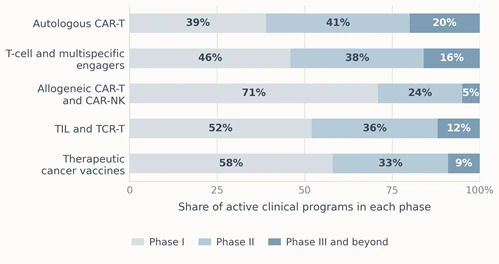
Figure 1 — Distribution of active clinical programs by development phase across leading immunotherapy platforms.
The trade-off is durability. Engagers generally require continued administration, and responses in many indications have proven less durable than the best CAR-T outcomes. Resistance frequently emerges through T-cell exhaustion or antigen loss. The field's response has been multispecific design — constructs engaging two tumor antigens simultaneously, or adding a costimulatory arm to sustain T-cell function.
For U.S. portfolio strategy, engagers occupy an important position: strong deliverability, a proven regulatory path, and enough pipeline depth to support genuine competition. Figure 1 shows the maturity gap clearly, with engagers and CAR-T carrying substantially more late-stage evidence than the newer platforms.
Cracking Solid Tumors: TIL Therapy, TCR-T, and the Microenvironment Problem
Solid tumors remain the defining commercial opportunity in immunotherapy, and the two cell-based platforms closest to addressing them take fundamentally different routes.
TIL therapy begins with a tumor resection, isolates the lymphocytes that have already infiltrated it, expands them to billions of cells, and reinfuses them after lymphodepletion. Because these cells were selected in vivo by the tumor itself, they recognize patient-specific neoantigens no engineered construct could have anticipated. The limitation is operational: every dose requires surgery, a lengthy manufacturing campaign, and an intensive inpatient regimen.
TCR-T therapy is more scalable but more constrained. Engineered T-cell receptors can target intracellular antigens, including cancer-testis antigens absent from healthy adult tissue. Because TCR recognition depends on human leukocyte antigen presentation, however, each product serves only patients with a matching HLA type — a genuine market-sizing constraint that also carries health-equity implications in a diverse U.S. population.
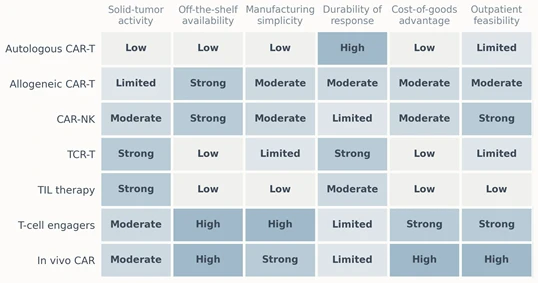
Figure 2 — Comparative profile of immunotherapy platforms across clinical and commercial dimensions
Both approaches confront the same underlying obstacle: the tumor microenvironment. Suppressive cell populations, metabolic hostility and inhibitory checkpoints combine to disable T cells that do reach the tumor. The most promising work now involves armoring engineered cells with cytokine payloads or checkpoint resistance, or combining cell therapy with agents that remodel the microenvironment directly.
Case Study: Rebuilding a U.S. Immunotherapy Portfolio Around Deliverability
A mid-cap American biotechnology company with an autologous CAR-T program in solid tumors offers a representative illustration of how portfolio thinking in this field has changed.
Its lead asset had produced encouraging early responses but at an unsustainable operating profile: a manufacturing success rate below 80 percent, a vein-to-vein time approaching four weeks, and a projected cost of goods that would have required pricing well above what payers had accepted for hematologic CAR-T. Enrollment was constrained because only a handful of centers could deliver the protocol.
Rather than continuing to optimize the existing construct, leadership reframed the question around deliverability. The company kept the validated antigen-binding domain and the clinical data supporting it, then licensed an allogeneic platform to move the same binder into a donor-derived product, and separately funded a preclinical in vivo delivery program using the same target.
Three consequences followed. The original autologous program was repositioned as a proof-of-biology asset supporting the platform rather than as the commercial lead. Development capital shifted toward the allogeneic construct, where a single donor batch could supply dozens of patients. And the commercial team began modeling community oncology adoption, which had been irrelevant under the autologous model.
The broader lesson is one U.S. executives are applying across the sector: in next-generation immunotherapy, the binder and the biology are increasingly the durable asset, while the delivery modality is a strategic variable that can and should be revisited.
The Reimbursement Equation Facing U.S. Immunotherapy Leaders
Commercial strategy in American immunotherapy is now inseparable from reimbursement design. One-time cell therapies priced in the high six figures sit awkwardly within a payer system built around annual budgets and high beneficiary turnover. A payer covering a curative therapy today may not retain the member long enough to realize the downstream savings.
Outcomes-based agreements have become common, tying payment to durable remission at defined intervals. Their practical value depends on data infrastructure most systems still lack — the ability to track a specific patient's response across years and multiple providers. Medicare coverage decisions and the growing role of the 340B program add further complexity for any therapy delivered in a hospital outpatient setting.
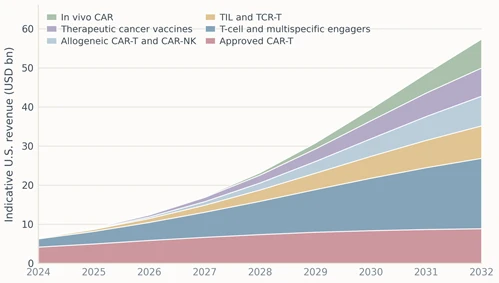
Figure 3 — Illustrative outlook for the U.S. next-generation immunotherapy revenue mix through 2032.
Figure 3 illustrates why this matters strategically. The growth in the category is not expected to come primarily from expanding approved CAR-T products. It is expected to come from platforms that can be administered more broadly — engagers, off-the-shelf cell products and, later, in vivo therapies. Site of care is the variable that determines addressable population, and it should be modeled at candidate selection rather than at launch.
Conclusion: Deliverability, Not Potency, Will Decide the Winners
The next decade of immunotherapy will not be won by whichever platform generates the deepest response in a Phase I cohort. CAR-T already demonstrated extraordinary potency, and its commercial ceiling was set by everything surrounding the biology: manufacturing, logistics, toxicity management, site of care and price.
For American pharmaceutical and biotech leadership, three implications follow. Portfolio decisions should weight deliverability alongside efficacy, because a therapy administrable in a community setting reaches a population an order of magnitude larger. Platform flexibility has real option value, since the same validated target can often be redeployed across autologous, allogeneic and in vivo modalities as each matures. And reimbursement architecture belongs in early development discussions, not in the final year before launch.
The organizations that internalize this will be the ones that convert engineered immunity from a remarkable therapy for a few thousand patients into a standard of care for hundreds of thousands. That is the opportunity beyond CAR-T, and it is fundamentally an operational and commercial challenge as much as a scientific one.
Frequently Asked Questions About Next-Generation Immunotherapies
What are next-generation immunotherapies?
Next-generation immunotherapies are treatments that redirect the immune system against cancer using approaches beyond conventional CAR-T. They include bispecific and multispecific T-cell engagers, allogeneic CAR-T and CAR-NK cell therapies, TCR-T therapy, tumor-infiltrating lymphocyte therapy, therapeutic cancer vaccines and in vivo CAR engineering. Each aims to broaden the patient population that engineered immunity can reach.
Why has CAR-T therapy struggled in solid tumors?
Solid tumors rarely express a single clean surface antigen that distinguishes them from healthy tissue, so engineered cells have difficulty finding a safe target. They also build an immunosuppressive microenvironment that exhausts T cells after they infiltrate, and dense tumor architecture physically limits how many engineered cells reach the malignant tissue.
What is in vivo CAR-T therapy and how is it different?
In vivo CAR therapy delivers the genetic instructions for a chimeric antigen receptor directly into the patient, usually through targeted lipid nanoparticles or engineered viral vectors, so the modified T cells are produced inside the body. This removes cell collection, external manufacturing and vein-to-vein delay, potentially making immunotherapy an off-the-shelf product.
Are T-cell engagers replacing CAR-T therapy?
They are more likely to complement it than replace it. Engagers offer off-the-shelf availability, conventional biologics manufacturing, dosing flexibility and administration outside academic centers. CAR-T continues to offer greater durability from a single administration in several hematologic indications. Sequence, indication and patient fitness increasingly determine which is used.
What is the difference between TIL therapy and TCR-T therapy?
TIL therapy expands T cells harvested directly from a patient's own tumor, so it targets patient-specific neoantigens without genetic engineering but requires surgery and a lengthy manufacturing campaign. TCR-T therapy engineers T-cell receptors to recognize a defined intracellular antigen, which is more scalable but restricts eligibility to patients with a compatible HLA type.
What should pharmaceutical executives prioritize when investing in immunotherapy?
Deliverability should carry weight equal to efficacy. Cost of goods, site of care, manufacturing success rate and time to treatment determine how large the addressable population actually becomes. Platform flexibility around a validated target, and early engagement with payers on outcomes-based reimbursement, are the other two priorities that most influence commercial return.

Lakshmi is a science writer with a foundation in the laboratory. She earned her master's in biotechnology and trained through research internships at ICGEB (JNU) and DIPAS, DRDO, with her work appearing in the Egyptian Journal of Veterinary Sciences. Now APCRM-certified and part of the editorial team at Pharma Focus America and Pharma Focus Europe, she reports on pharmaceutical technology, research, and innovation — giving complex science a clear and confident voice for industry leaders.