
Next-Generation Immunotherapy and Advanced Treatment Strategies
Lakshmi, Editorial Team, Pharma Focus America
Immunotherapy has moved from a last-line option to a foundation of modern cancer care, yet most American patients still do not benefit. This article examines the next wave of immunotherapy, from engineered cell therapies and bispecific engagers to personalized vaccines and treatments beyond oncology. Drawing on a landmark trial in which immunotherapy replaced surgery, it outlines the strategic, operational and commercial decisions US pharmaceutical leaders must make to capture this opportunity.
Introduction
Few areas of medicine have changed as quickly, or as profoundly, as cancer immunotherapy. In a little over a decade, the idea of harnessing a patient's own immune system to fight disease has progressed from scientific promise to standard practice across dozens of indications. Checkpoint inhibitors, cell therapies and immune-engaging antibodies now sit at the center of pharmaceutical pipelines and oncology budgets alike.
Yet the first generation of immunotherapy has also revealed its limits. Response rates remain modest for many tumor types, durable remissions are concentrated in a minority of patients, and complex therapies strain manufacturing networks, hospital capacity and payer systems. The next phase will be defined not by a single breakthrough but by a portfolio of advanced strategies designed to widen benefit, deepen responses and move treatment earlier in the disease course.
For American pharmaceutical executives, this creates a decisive moment. The companies that will lead are those that align scientific bets with manufacturing realities, evidence strategies and reimbursement models before the market fully forms.
Immunotherapy's Unfinished Revolution: Why Most Patients Are Still Waiting
The scale of the challenge remains significant. According to the latest national cancer statistics, about 2,114,850 new cancer cases and 626,140 cancer deaths are projected in the United States in 2026. There is real progress to build on: five-year relative survival for all cancers combined has reached 70% for the first time, and an estimated 4.8 million cancer deaths have been averted since 1991.
Some of the most dramatic improvements have come in advanced disease. Five-year survival for distant-stage melanoma rose from 16% in the mid-1990s to 35% in the most recent period, while distant-stage lung cancer survival increased from 2% to 10%. These gains span an era that saw immunotherapies and targeted therapies enter routine practice.
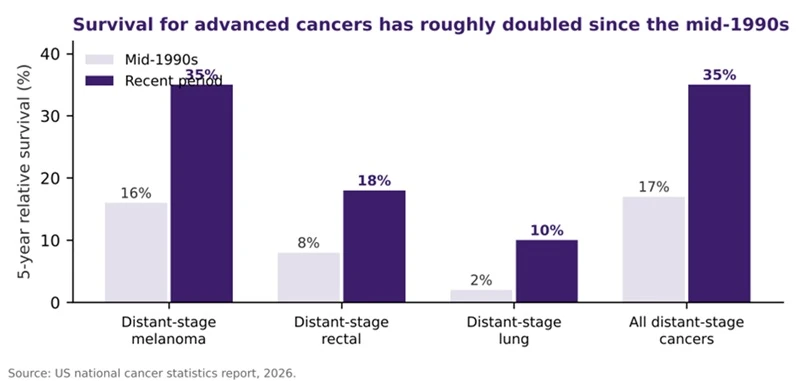
Figure 1: Five-year survival gains in advanced cancers, mid-1990s vs. recent period
However, the reach of checkpoint immunotherapy tells a more sobering story. A peer-reviewed analysis estimated that the share of US cancer patients eligible for checkpoint inhibitors rose from 1.54% in 2011 to 43.63% in 2018. Over the same period, the share estimated to respond increased from 0.14% to just 12.46%. In other words, even at the height of the checkpoint era, nearly nine in ten patients were not expected to respond.
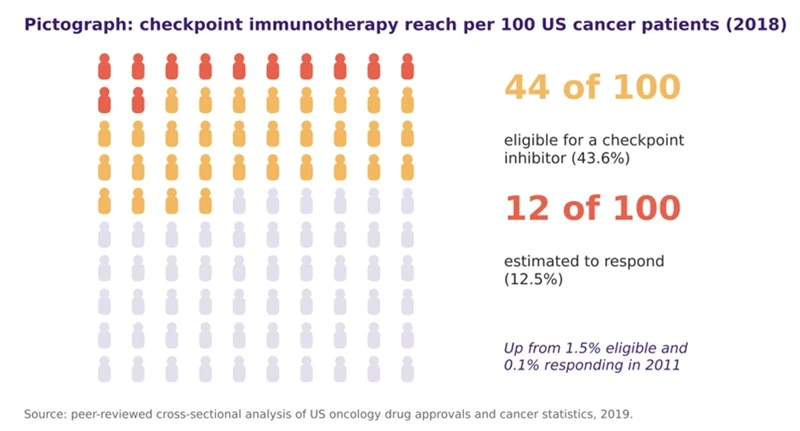
Figure 2: Pictograph of checkpoint inhibitor eligibility and response in the US
This gap between eligibility and benefit is the commercial and clinical frontier of next-generation immunotherapy. Closing it is where the next decade of value will be created.
From Checkpoints to Living Drugs: The Rapid Evolution of US Immunotherapy
The pace of innovation over the past fifteen years has been remarkable. The first checkpoint inhibitor targeting CTLA-4 was approved in 2011, followed by the first PD-1 inhibitor in 2014. In 2017, the field reached two milestones: the first CAR-T cell therapy and the first cancer approval based on a tumor's biomarker rather than its location in the body. In 2024, regulators approved the first tumor-infiltrating lymphocyte therapy for a solid tumor and the first engineered T-cell receptor therapy.
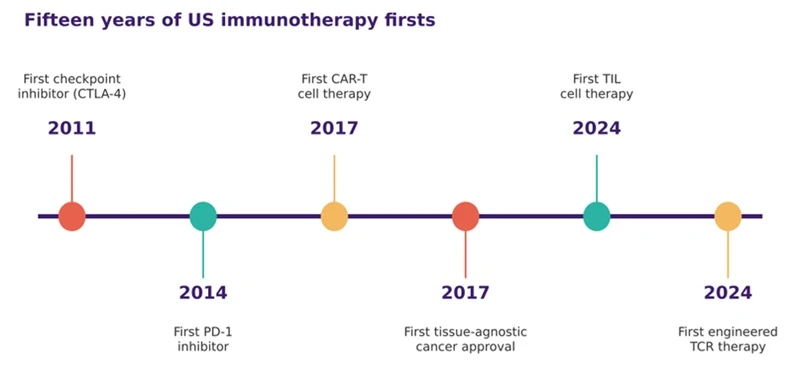
Figure 3: Milestones in US immunotherapy approvals, 2011–2024
Each wave has expanded what is possible, but each has also raised the bar for execution. Living drugs require vein-to-vein logistics, specialized treatment centers and new approaches to safety monitoring. Executives can no longer treat manufacturing and delivery as downstream concerns; in advanced immunotherapy, they are part of the product.
The Next-Generation Immunotherapy Toolkit: Six Strategies Reshaping the Field
The next wave of immunotherapy is best understood as a toolkit rather than a single modality. Each approach addresses a different limitation of the first generation.
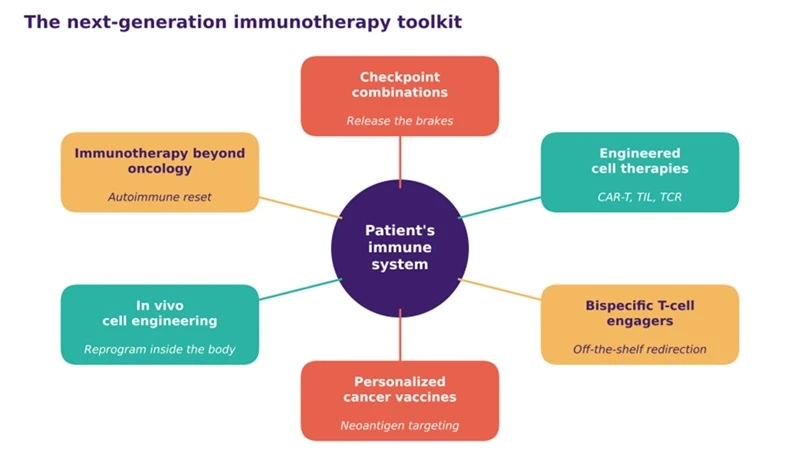
Figure 4: The six strategic pillars of next-generation immunotherapy
Rational checkpoint combinations aim to convert non-responders by pairing immune activation with therapies that reshape the tumor microenvironment. Engineered cell therapies, including CAR-T, tumor-infiltrating lymphocytes and engineered T-cell receptors, are extending beyond blood cancers into solid tumors.
Bispecific T-cell engagers offer many of the benefits of cell therapy in an off-the-shelf format, which can simplify delivery and broaden access to community settings.
Personalized cancer vaccines, which train the immune system to recognize a patient's unique tumor mutations, represent a convergence of genomics, rapid manufacturing and immunology. In vivo cell engineering, which seeks to reprogram immune cells directly inside the body, could eventually remove the need for complex external manufacturing altogether. Finally, early academic studies of engineered cell therapies in severe autoimmune diseases have reported drug-free remissions, opening the possibility that immunotherapy's next large market lies beyond oncology entirely.
For leadership teams, the strategic question is not which modality will win, but which combination of capabilities, partnerships and platforms will allow an organization to compete across several of them.
Case Study: When Immunotherapy Replaced the Scalpel
One of the most striking demonstrations of immunotherapy's potential to change treatment strategy came from a phase 2 trial conducted at a leading New York cancer center and published in April 2025.
The Clinical Challenge
Patients with early-stage solid tumors that are mismatch repair deficient (dMMR) have traditionally faced surgery, often combined with chemotherapy and radiation. For rectal cancer in particular, standard treatment can carry lasting effects on bowel, bladder and sexual function, as well as fertility.
The Strategy
Investigators tested whether the PD-1 inhibitor dostarlimab, given before any surgery, could eliminate tumors and allow patients to avoid surgery entirely. Patients who achieved a complete clinical response could proceed to careful monitoring instead of an operation.
The Results
A total of 117 patients enrolled and 103 completed treatment. In the rectal cancer cohort, all 49 patients achieved a complete clinical response. Among 54 patients with other dMMR solid tumors, 35 (65%) achieved a complete clinical response. Overall, 84 patients responded completely, and 82 of them chose to forgo surgery. Recurrence-free survival at two years was 92%, with a median follow-up of 20 months.
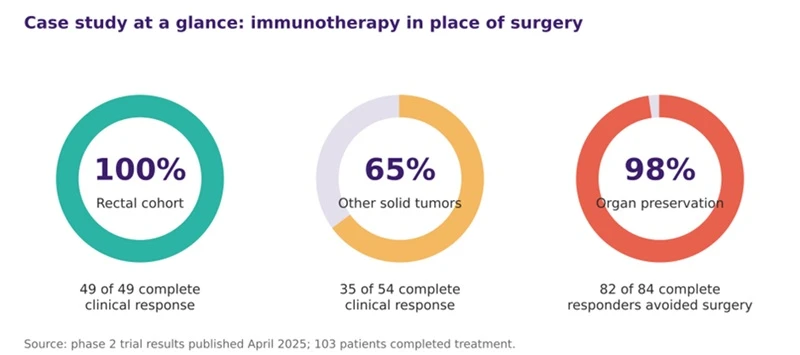
Figure 5: Key outcomes from the phase 2 trial of PD-1 immunotherapy in dMMR solid tumors
Lessons for the C-Suite
The trial shows that the greatest value of advanced immunotherapy may come from moving it earlier in the disease and selecting patients by biomarker, rather than reserving it for late-stage, refractory disease. It also signals a coming shift in how value is measured. Organ preservation, avoided procedures and quality of life are becoming central to the evidence that regulators, payers and patients will expect. Organizations that design trials around these outcomes, and invest in biomarker testing infrastructure, will be better positioned to demonstrate value.
Precision Immunotherapy: Turning Biomarkers and Safety into a Competitive Edge
If the first era of immunotherapy was about proving that the immune system could be unleashed against cancer, the next era is about precision: knowing which patients will respond, which combinations will help them and which will cause harm. Biomarkers sit at the heart of this shift. Tumor mutational profiles, mismatch repair status, immune cell signatures and circulating tumor DNA are increasingly used to select patients, monitor response and decide when treatment can safely stop.
This has direct implications for development strategy. Trials designed around well-defined biomarker populations can generate clearer signals with fewer patients, shorten timelines and produce evidence that regulators and payers find more persuasive. Companion diagnostics, once an afterthought, now need to be planned alongside the therapy from the earliest stages of development.
Safety is the other half of the precision equation. Advanced immunotherapies can trigger serious immune-related effects, including cytokine release syndrome and neurological toxicities with cell therapies. Organizations that invest in predictive safety tools, standardized management protocols and training for community oncologists will lower one of the most significant barriers to broader adoption. In a crowded market, a superior safety and monitoring profile can be as powerful a differentiator as efficacy.
Data capability ties these elements together. Integrating genomic, clinical and real-world data across trials and treatment centers allows companies to refine patient selection continuously, identify early signs of resistance and design the next generation of combinations with greater confidence.
Scaling Advanced Immunotherapy: The Manufacturing and Access Imperative
Scientific success alone will not determine market leadership. Autologous cell therapies require individualized production, rigorous chain-of-identity control and coordination with specialized treatment centers. Bottlenecks in manufacturing capacity, apheresis slots and hospital beds have historically limited the number of eligible patients who actually receive treatment.
Leading pharmaceutical organizations are responding with several strategies: automating and decentralizing manufacturing, developing allogeneic and off-the-shelf alternatives, and partnering with community oncology networks to extend access beyond major academic centers. Equally important is building capacity for biomarker testing, since next-generation immunotherapy depends on identifying the right patients at the right time.
Paying for Immunotherapy Breakthroughs: Rethinking Value in the US Market
The economics of advanced immunotherapy are forcing a broader conversation about value. One-time or short-course therapies with the potential for durable remission do not fit neatly into reimbursement systems built for chronic treatment. Outcomes-based agreements, installment payment models and evidence generation that captures long-term benefit are moving from experimental to essential.
For US executives, this means engaging payers and health systems early, investing in real-world evidence, and preparing to demonstrate not only survival benefit but also reductions in hospitalizations, procedures and long-term care costs. The organizations that build these capabilities now will shape the reimbursement frameworks that define the next decade.
Conclusion
Immunotherapy has already transformed cancer care, but its revolution is far from complete. The gap between the number of patients eligible for treatment and those who benefit remains wide, and the next generation of strategies is designed to close it.
Engineered cell therapies, bispecific engagers, personalized vaccines, in vivo engineering and applications beyond oncology each offer a path to deeper and broader benefit. The landmark trial in which immunotherapy replaced surgery shows how dramatically treatment strategy can change when the right therapy reaches the right patient early.
For American C-suite leaders, the mandate is clear: build multi-modality capabilities, treat manufacturing and access as strategic assets, invest in biomarker-driven development and help shape new value-based payment models. Those who act with conviction will not only capture a fast-growing market but also help deliver immunotherapy's ultimate promise of durable cures for many more patients.

Lakshmi is a science writer with a foundation in the laboratory. She earned her master's in biotechnology and trained through research internships at ICGEB (JNU) and DIPAS, DRDO, with her work appearing in the Egyptian Journal of Veterinary Sciences. Now APCRM-certified and part of the editorial team at Pharma Focus America and Pharma Focus Europe, she reports on pharmaceutical technology, research, and innovation — giving complex science a clear and confident voice for industry leaders.