


Next Generation Precision Oncology with Antibody Drug Conjugates
Lakshmi, Editorial Team, Pharma Focus America
Antibody-drug conjugates have become pharmaceutical oncology's most contested growth engine, displacing decades-old chemotherapy standards and redrawing biomarker boundaries. For American executives, the opportunity is matched by complexity in manufacturing, toxicity management and pricing policy. This article examines how next-generation ADCs are reshaping precision oncology and what leadership teams must decide now.
Introduction
The idea behind antibody-drug conjugates is more than a century old. Paul Ehrlich imagined a "magic bullet" that would find diseased cells and spare healthy ones. For most of oncology's history, that vision collided with reality: chemotherapy was potent but indiscriminate, and targeted antibodies were precise but often too weak to kill tumors on their own. Antibody-drug conjugates, or ADCs, combine the two, using an antibody to deliver a highly toxic payload directly into cancer cells.
The first generation struggled. The first ADC approved in the United States, in 2000, was withdrawn a decade later before returning at a lower dose. Today the picture is transformed. More than a dozen ADCs have reached the American market, several now sit in first-line treatment, and ADC assets have driven some of the largest transactions in recent pharmaceutical history. For American C-suite leaders, the question is no longer whether ADCs matter, but how to compete in a modality where scientific, manufacturing and commercial complexity are all rising at once.
Why ADCs Became Pharmaceutical Oncology's Important Asset Class
Three structural shifts explain the surge. The first is engineering maturity. Early ADCs suffered from unstable linkers that released toxic payloads into the bloodstream, causing systemic toxicity before the drug ever reached the tumor. Modern linkers are far more stable in circulation and cleave predictably inside the cancer cell, widening the therapeutic window.
The second is payload innovation. Newer ADCs frequently use topoisomerase I inhibitors that are membrane-permeable, meaning that once released, they can diffuse into neighbouring tumor cells. This bystander effect allows ADCs to work even in tumors where the target protein is expressed unevenly, a common reality in solid tumors.
The third is commercial validation. Once ADCs began delivering overall survival gains in large randomized trials, investors and acquirers moved quickly. Licensing activity, including a growing number of deals for ADC assets originating in Asia, has intensified competition for differentiated targets. The result is a crowded but rapidly expanding field in which strategic clarity is worth more than ever.
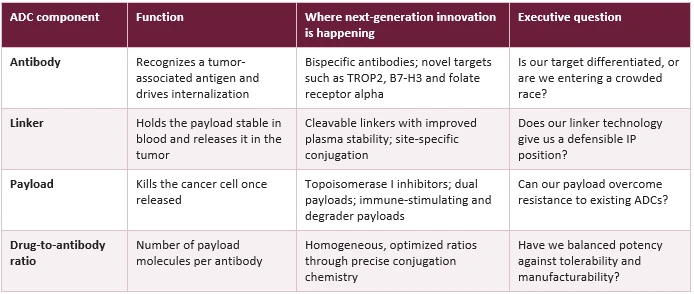
Table 1: Anatomy of an ADC and the executive questions each component raises
Case Study: The ADC Combination That Ended Three Decades of Chemotherapy Dominance in Bladder Cancer
For more than 30 years, platinum-based chemotherapy was the first-line standard for patients with locally advanced or metastatic urothelial cancer. Successive attempts to improve on it delivered incremental gains at best. Median overall survival for these patients had remained stubbornly limited, and many patients were unable to tolerate platinum regimens at all.
That changed with the combination of enfortumab vedotin, an ADC targeting Nectin-4, and pembrolizumab, an immune checkpoint inhibitor. In the phase 3 EV-302 trial, published in The New England Journal of Medicine in 2024, the combination nearly doubled median overall survival compared with platinum chemotherapy, from roughly 16 months to more than 31 months, and roughly doubled median progression-free survival. The FDA approved the regimen for first-line use in December 2023, and it rapidly became the new standard of care.
When an ADC combination doubles survival against a 30-year-old standard, it does not just win a market. It resets the competitive baseline for every company in that disease.
What leadership teams should take from EV-302
The first lesson is that ADCs are increasingly most valuable as combination partners rather than standalone agents. The cytotoxic payload can trigger immunogenic cell death, potentially making tumors more visible to the immune system and creating biological synergy with checkpoint inhibitors. Portfolio strategy therefore needs to consider partnering and combination rights from the earliest stages of development.
The second lesson is that the most transformative ADC wins can come from moving early in the treatment pathway. The commercial value of displacing a first-line standard is far greater than adding another later-line option. Bold trial designs that challenge entrenched standards carry more risk, but they are where category-defining value is created.
A second landmark reinforces how ADCs are redrawing biomarker boundaries. In the DESTINY-Breast04 trial, trastuzumab deruxtecan improved survival in patients whose breast tumors expressed only low levels of HER2, a population previously considered HER2-negative and ineligible for HER2-targeted therapy. The FDA's 2022 approval created an entirely new treatment category, "HER2-low," reclassifying roughly half of all breast cancer patients. The drug later received a tumor-agnostic accelerated approval for HER2-positive solid tumors. The strategic lesson is profound: an ADC does not merely treat a biomarker-defined population; it can redefine what the biomarker means.
From First-Generation to Next-Generation ADCs: How the Modality Is Evolving
Understanding where ADC science is heading is essential for portfolio allocation. Table 2 summarizes how each generation has addressed the weaknesses of the one before, and where the next wave of value is likely to emerge.
Table 2: The evolution of ADC technology
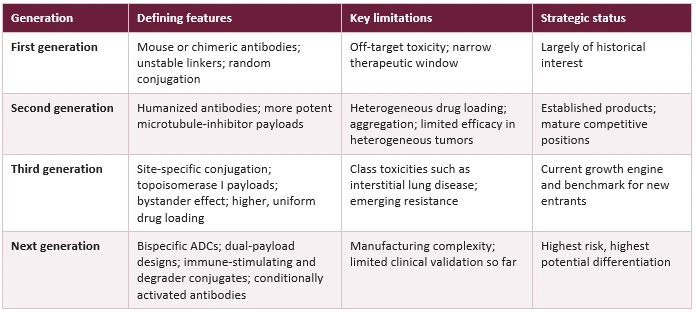
Bispecific ADCs, which bind two antigens or two epitopes of the same antigen, aim to improve tumor selectivity and internalization. Dual-payload ADCs carry two mechanistically distinct agents on a single antibody, offering a potential answer to resistance. Immune-stimulating antibody conjugates replace the cytotoxic payload with molecules that activate innate immunity inside the tumor. Each of these approaches remains early, but each offers a route to differentiation in a field where third-generation ADCs against the same targets are multiplying rapidly.
The Hidden Costs of ADC Success: Toxicity, Biomarkers and Manufacturing
ADCs are not without trade-offs, and executives who underestimate them risk costly surprises. Toxicity is the most visible. Some third-generation ADCs carry a risk of interstitial lung disease, which can be serious and occasionally fatal. Others cause ocular toxicity or peripheral neuropathy. Managing these risks requires dedicated monitoring protocols, clinician education and sometimes specialist involvement, all of which affect adoption and the total cost of care.
Biomarker testing presents a second challenge. The HER2-low category illustrated both the opportunity and the difficulty: distinguishing low from absent HER2 expression using conventional immunohistochemistry is subjective, and inter-pathologist agreement can be inconsistent. As ADCs target more antigens at lower expression levels, investment in quantitative digital pathology and validated companion diagnostics becomes a strategic necessity rather than an afterthought.
Manufacturing is the third and often most underestimated constraint. An ADC is effectively three products in one: a biologic antibody, a highly potent small-molecule payload and a chemical linker, brought together through precise conjugation. Payloads require high-containment facilities, and specialized conjugation capacity remains limited. Supply chain resilience, particularly given American policy emphasis on domestic manufacturing, is now a board-level consideration for any company scaling an ADC program.
Pricing, Policy and Market Access: The American ADC Commercial Equation
The American commercial environment adds its own layer of complexity. ADCs are typically high-cost therapies administered in infusion settings, and their value case rests on survival benefit weighed against the cost of toxicity management. Payers are increasingly scrutinizing combination regimens, where the cost of an ADC and a checkpoint inhibitor together can be substantial.
Policy also shapes strategy. Under the Inflation Reduction Act, biologics become eligible for Medicare price negotiation later than small-molecule drugs. Because ADCs are licensed as biologics, they benefit from this longer runway, which strengthens their relative attractiveness in portfolio decisions. However, Medicare negotiation still applies eventually, and executives should model how lifecycle strategies, including new indications and combinations, interact with that timeline.
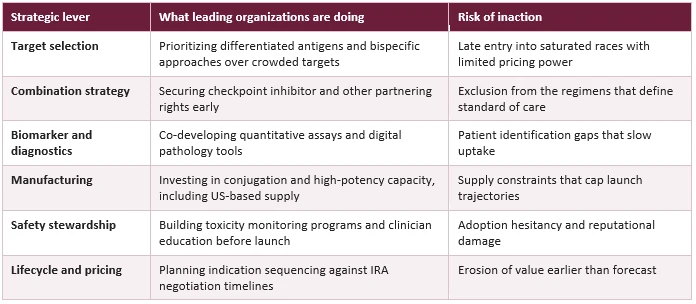
Table 3: Strategic priorities for American leadership teams building ADC portfolios
The Next Decade of ADCs: What Will Separate Winners from Followers
The ADC field is entering a phase where scientific novelty alone will not guarantee success. With multiple companies developing ADCs against the same targets, differentiation will come from three places: clinical positioning that challenges early-line standards, integrated diagnostics that identify the right patients reliably, and operational excellence in manufacturing and safety management.
Expect ADCs to move increasingly into earlier disease settings, including the neoadjuvant and adjuvant settings, where the potential to cure rather than control cancer is greatest and where the evidentiary bar is highest. Expect, too, a convergence of modalities, with ADC technology merging with immuno-oncology, targeted protein degradation and possibly radiopharmaceutical approaches. The companies that win will be those that treat the ADC not as a single product category but as a platform for engineering precision into every element of cancer therapy.
Conclusion
Antibody-drug conjugates have finally delivered on a promise more than a century in the making. The doubling of survival in first-line bladder cancer and the creation of an entirely new breast cancer category demonstrate that ADCs are not an incremental refinement but a structural shift in how oncology is practiced and how pharmaceutical value is created.
For American C-suite leaders, the window for strategic positioning is narrowing. The modality rewards those who choose differentiated targets, secure combination partnerships early, invest in diagnostics and manufacturing ahead of demand, and plan lifecycles with a clear view of the policy environment. ADCs have moved precision oncology from aspiration to execution. The leaders who match that execution with strategic discipline will define the next generation of cancer care.

Lakshmi is a science writer with a foundation in the laboratory. She earned her master's in biotechnology and trained through research internships at ICGEB (JNU) and DIPAS, DRDO, with her work appearing in the Egyptian Journal of Veterinary Sciences. Now APCRM-certified and part of the editorial team at Pharma Focus America and Pharma Focus Europe, she reports on pharmaceutical technology, research, and innovation — giving complex science a clear and confident voice for industry leaders.