

Next-Generation RNA Therapeutics: Expanding the R&D Landscape Beyond Vaccines
Lakshmi, Editorial Team, Pharma Focus America
mRNA vaccines proved the chemistry; they did not define the category. Silencing, splicing, editing and in-vivo cell engineering have turned RNA into a mainstream pharmaceutical modality, with roughly 25 approved products and a multi-billion-dollar non-vaccine commercial base. This article maps the scientific frontiers now opening, the delivery bottleneck that still gates value, and the regulatory arbitrage quietly reshaping how pharmaceutical portfolios in this modality are built.
Introduction:
The Vaccine Was the Proof of Concept — Not the Product
For most of the pharmaceutical industry, RNA walked into the boardroom in 2020 wearing a vaccine badge. The badge has proved difficult to remove, and it has become a strategic liability. It encourages executives to treat RNA as an infectious-disease capability attached to a pandemic-shaped demand curve, to be scaled up in an emergency and quietly written down afterwards. That framing misreads the asset.
The vaccine wave was the loud half of the story. The quiet half had been compounding for more than two decades. The first antisense oligonucleotide reached the market in 1998 for cytomegalovirus retinitis. The first small interfering RNA (siRNA) drug was approved in 2018 for hereditary transthyretin amyloidosis. Between them sat a steady accumulation of splice-switching, silencing and protein-restoring chemistries, most of them serving small populations and attracting little attention outside specialist circles.
That accumulation has now reached commercial escape velocity. Roughly 25 RNA-based therapeutics have secured approval, and the field supports around 734 active clinical trials. Excluding prophylactic vaccines entirely, RNA therapeutics generated in excess of $7 billion in 2025 sales, while disclosed RNA licensing deal value exceeded $17 billion in the same year. This is no longer an emerging modality. It is a drug class with a revenue line, a deal market and an increasingly contested patent landscape.
From Orphan Curiosity to Cardiometabolic Scale
The most consequential shift is not scientific but epidemiological. RNA therapeutics began in ultra-rare disease, where small populations tolerated high prices and imperfect delivery. The centre of gravity has moved decisively toward prevalent conditions. A cholesterol-lowering siRNA is now dosed twice a year, converting a daily-adherence problem into a clinic-visit event. Cardiovascular outcomes work is testing whether that dosing rhythm translates into population-level benefit.
Obesity has become the sharpest test. A Phase I siRNA programme reported in December 2025 produced fat loss comparable to incretin therapy from a single dose across twelve weeks, and did so without the muscle loss that shadows the GLP-1 class. Six-month follow-up data were anticipated in early 2026. If that signal holds, the competitive logic of metabolic medicine changes: the differentiator becomes dosing interval and body-composition quality rather than absolute weight reduction.
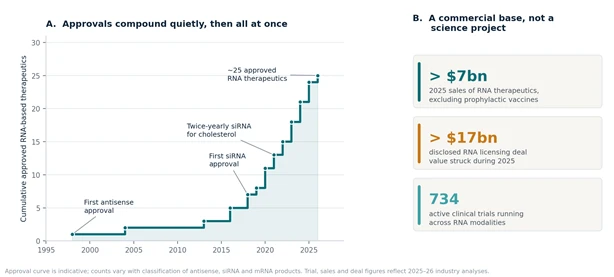
Figure 1. Two decades of quiet compounding, and the commercial base it produced.
Large pharmaceutical companies have read the same signal. Patent filings between 2019 and 2024 show siRNA moving from a biotech-only preserve into mainstream pharmaceutical R&D. That raises the entry bar sharply for smaller innovators without differentiated chemistry or a proprietary delivery route, and it changes what an acquirer is actually buying.
Four Frontiers Redrawing the R&D Map
1. Silencing that lasts
Conjugating N-acetylgalactosamine to an oligonucleotide routes it to the asialoglycoprotein receptor on hepatocytes with remarkable efficiency; five of the first six approved siRNA drugs used the approach. Combined with stabilising backbone chemistry, it delivers durable knockdown from infrequent subcutaneous dosing. Any liver-expressed target is now, in principle, addressable.
2. Editing without cutting DNA
Adenosine deaminases acting on RNA (ADAR) convert adenosine to inosine, which the cell reads as guanosine. Because the enzyme is already present and abundantly expressed in the central nervous system, the therapeutic is simply a guide oligonucleotide that recruits it. There is no nuclease, no foreign protein and no permanent change to the genome. The effect is dose-titratable and reversible — a risk profile that regulators and insurers find considerably easier to underwrite than DNA editing.
3. Circular and self-amplifying RNA
Circular RNA has no free ends, which makes it resistant to exonucleases and capable of sustaining expression well beyond linear mRNA. The first circular RNA therapy cleared to enter clinical trials received its US investigational clearance in October 2024. Self-amplifying RNA takes the opposite route to the same goal, encoding its own replicase so that a far smaller administered dose produces the required protein — a direct assault on cost of goods.
4. Cell engineering performed inside the patient
The most disruptive frontier borrows from cell therapy. Antibody-decorated lipid nanoparticles can deliver chimeric antigen receptor mRNA selectively to circulating T cells, generating CAR-expressing cells without apheresis, ex vivo culture or cryogenic logistics. Expression is transient, which the field increasingly treats as a feature rather than a compromise: it permits pharmacological control through repeat dosing and sidesteps the chronic B-cell aplasia and integration-related safety questions attached to stable viral constructs. More than 70 in vivo CAR assets had been disclosed by late 2025, with a first cohort in Phase I. One clinical-stage targeted-LNP developer was acquired for approximately $2.1 billion in mid-2025, months after its lead candidate entered Phase I in B-cell-mediated autoimmune disease.
Table 1. Seven RNA modalities, and what each one actually asks of a development organisation
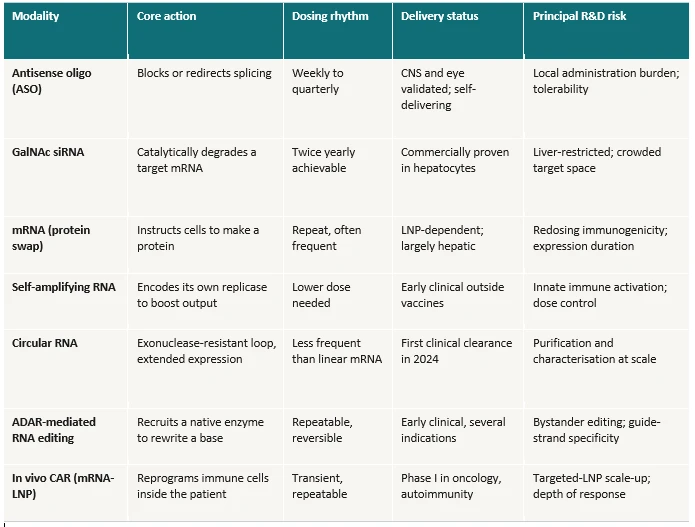
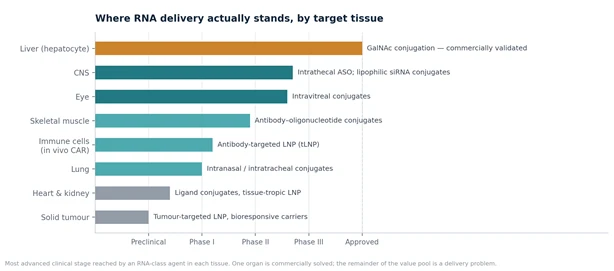
Figure 2. The delivery gradient: one solved organ, and a decade of contested territory behind it
Delivery Is the Franchise. The Sequence Is Only the Payload.
Designing an RNA sequence against a validated target is close to a solved problem, and it is not where value accrues. One organ has been commercially conquered. Everything else remains open, and that gap defines the competitive landscape for the next decade.
Progress is real. Lipophilic conjugation — attaching a long-chain hydrocarbon to the siRNA — has produced potent, durable silencing in the central nervous system, eye and lung in both rodents and non-human primates, with activity sustained for at least three months after a single intrathecal or intracerebroventricular dose. Antibody-oligonucleotide conjugates are opening skeletal muscle. Exosomes are being refined as carriers capable of crossing the blood-brain barrier. Bioresponsive materials that release payload in response to pH, redox state or enzymatic activity are in preclinical evaluation in solid tumour models.
The constraints are equally concrete. Anti-PEG antibody responses complicate the repeat dosing that transient modalities depend on. Intrathecal and intravitreal administration carry a real burden for prevalent-disease indications. Manufacturing targeted lipid nanoparticles at clinical dose and commercial scale remains, by the field's own admission, unvalidated. These are engineering problems with capital costs attached, and they belong in the operating plan rather than the science section of a board deck.
Case Study: A Conjugate, Not a Target, Opened the Brain
A useful illustration comes from amyotrophic lateral sclerosis. A developer working on superoxide dismutase 1 (SOD1)-mutant disease did not invent a new silencing mechanism; siRNA against SOD1 was well understood. What it built was a conjugate delivery platform pairing a duplex RNA with a chemically modified oligonucleotide carrier designed for extrahepatic tissue.
In a SOD1-G93A mouse model, intracerebroventricular or intrathecal administration slowed disease progression, extended survival and reduced motor deficits. In non-human primates, a single intrathecal dose produced robust, dose-dependent SOD1 messenger RNA knockdown across the central nervous system and a corresponding fall in SOD1 protein in cerebrospinal fluid. Those data supported an investigator-initiated study and then a formal Phase I trial in patients carrying SOD1 mutations.
The strategic lesson is uncomfortable for target-led organisations. The payload class was already validated and largely commoditised. The value-creating invention was the chemistry that moved it into a new organ. The same pattern explains the in vivo CAR acquisition noted earlier: the acquirer paid a multi-billion-dollar sum for a delivery vehicle with one clinical asset attached, not for the asset with a vehicle attached.
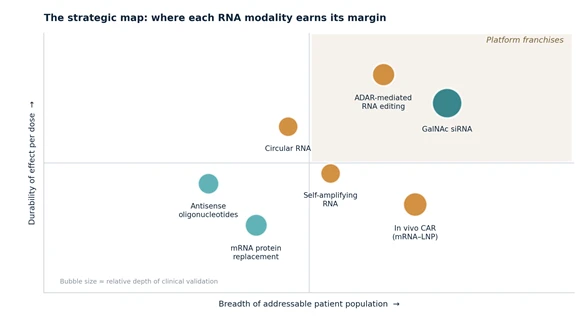
Figure 3. An illustrative strategic map. Durability and population breadth, not novelty, determine which modalities support a franchise.
The Regulatory Arbitrage Most Boards Have Not Yet Priced In
The quietest advantage in RNA is procedural. Because these products share a conserved backbone and differ mainly by sequence, a growing share of the development dossier is reusable. The Platform Technology Designation programme was built for precisely this situation. Agency guidance explicitly identifies lipid nanoparticle delivery systems, and a targeting moiety combined with a well-characterised siRNA, as candidate platforms. Eligibility requires that a first product using the platform already be approved, so the benefit accrues to follow-on programmes, with a review target of roughly 90 days once a complete request is filed.
Draft guidance issued in June 2026 for genome editing sharpened the underlying principle across nucleic acid medicines. Anything independent of the specific sequence — analytical methods, delivery-vehicle biodistribution, stability protocols, facility and process validation data — travels well between programmes. Anything sequence-dependent, including off-target profile, identity and potency, does not. The reusable asset, in other words, is the chemistry and the process, not the molecule.
This inverts conventional portfolio logic. A company holding one approved product on a conserved conjugate chemistry can advance follow-on candidates at materially lower marginal CMC cost than a rival that adopts a novel delivery approach for each programme. It argues for concentration rather than diversification of delivery platforms — and it makes an approved first product strategically valuable well beyond its own revenue line. On the plant floor, the economics help: solid-phase synthesis requires no cell culture and no viral vector, though amidite supply security, solvent intensity and impurity characterisation are the genuine pinch points.
Conclusion: The Modality Has Outgrown Its Origin Story
RNA earned its reputation on a vaccine, and that origin story now understates it considerably. The field has produced approximately 25 approved medicines, a non-vaccine revenue base above $7 billion, hundreds of active trials and a licensing market measured in tens of billions. It is moving from rare disease into cardiometabolic and immunological indications where dosing intervals measured in months represent a structural advantage rather than a convenience.
What separates the winners will not be sequence design, which is increasingly commoditised, nor target selection, which is increasingly crowded. It will be delivery chemistry that reaches tissues beyond the liver, manufacturing processes that scale targeted particles reliably, and the organisational discipline to treat a platform as an asset that compounds across a portfolio rather than a tool rebuilt for each programme.
For pharmaceutical leadership, the practical implication is straightforward. The question is no longer whether RNA belongs in the portfolio. It is whether the organisation is investing in the part of the value chain that will still be defensible when everyone can write the sequence.

Lakshmi is a science writer with a foundation in the laboratory. She earned her master's in biotechnology and trained through research internships at ICGEB (JNU) and DIPAS, DRDO, with her work appearing in the Egyptian Journal of Veterinary Sciences. Now APCRM-certified and part of the editorial team at Pharma Focus America and Pharma Focus Europe, she reports on pharmaceutical technology, research, and innovation — giving complex science a clear and confident voice for industry leaders.