


Strategic Alliances and Business Partnerships Across the U.S. Pharmaceutical Industry
Kate Williamson, Editorial Team, Pharma Focus America
U.S. pharma partnerships, from licensing and co-development to co-commercialization and joint ventures, help companies share the cost, risk, and expertise of drug development. This article explains five alliance models, highlights real-world deals, and outlines what makes a pharmaceutical alliance strategy succeed, including governance, fair economics, IP clarity, and exit planning.

Quick Answer
U.S. pharma partnerships are formal agreements in which two or more companies share the cost, risk, technology, or market access involved in developing and selling a drug. The most common forms are licensing deals, co-development agreements, co-commercialization arrangements, and joint ventures. Companies enter them because bringing a single drug to market can take over a decade and cost billions, and no one company has every capability in-house.
Why Nobody in Pharma Goes It Alone Anymore
A biotech team spends eight years perfecting a promising cancer molecule. It has great early data and a brilliant science story, but no sales force, no manufacturing scale, and eighteen months of cash left. Across the road, a big pharma company has a gap in its oncology pipeline and a patent cliff coming. It has the money and the muscle but not the molecule.
That is how most pharma strategic alliances begin: two organizations with complementary problems. Success in this industry depends less on who is biggest and more on who partners smartly.
The pressures pushing companies together are clear:
- Sky-high R&D costs. Late-stage trials are expensive and most drug candidates fail.
- Patent expirations. Big blockbusters lose exclusivity, and pipelines need refilling.
- Rapid science. Cell therapy, mRNA, antibody-drug conjugates, and AI-driven discovery move faster than any one company can master.
- Market complexity. Reaching patients across the U.S. means dealing with payers, PBMs, and regulators.
A well-built pharmaceutical alliance strategy turns those pressures into shared advantage.
The 5 Main Business Alliance Models for Pharmaceutical Companies in the U.S.
Not every partnership looks the same. Here are the core business alliance models for pharmaceutical companies in the U.S., in plain language.
1. Licensing Agreements
In pharma licensing, one company (the licensor) grants another (the licensee) rights to develop, manufacture, or sell a drug, usually in exchange for upfront payments, milestone payments, and royalties.
Licensing comes in two common forms:
- Out-licensing: A company with a great asset but limited resources hands the rights to a stronger partner.
- In-licensing: A company brings in an external asset to fill a pipeline gap.
U.S. pharma licensing deals are often geographic or therapeutic. A partner might get rights to a drug only in certain regions or only for one disease area. Deal headlines can show huge "biobucks," but much of that value is contingent on milestones being hit, so read the fine print before assuming the full figure changes hands.
Best for: Small biotechs that need capital and capability, and big companies that want to fill pipeline gaps fast.
2. Co-Development Agreements
Pharma co-development means both sides actively work on the drug together. They split the R&D workload, the costs, and often the profits.
A well-known example is the Merck and Moderna collaboration on an individualized mRNA cancer vaccine, where the two companies share development and commercialization responsibilities and costs. Another is Regeneron and Sanofi's work on Dupixent, which became one of the most successful immunology drugs on the market.
Best for: Complex programs where both partners bring real scientific or clinical strengths, and where risk is too high for one company to carry.
3. Co-Commercialization and Co-Promotion
Here the partners split the selling. Each company might handle different regions, physician specialties, or care settings. It is common when a drug needs a large field presence across the American market.
Eli Lilly and Boehringer Ingelheim's alliance around diabetes medicines is a well-known example of two large companies pooling development and commercial strength.
Best for: Drugs that need broad reach, or where two companies' sales teams complement each other.
4. Joint Ventures
A joint venture creates a separate legal entity owned by both partners. It is a heavier commitment, with shared governance, shared capital, and shared risk. It suits long-term platform plays, such as manufacturing capacity or a new technology.
Best for: Long-horizon bets where both sides want equity-style commitment.
5. Research and Academic Collaborations
Many U.S. pharma partnerships start well before a drug exists. Companies team up with universities, medical centers, and government research bodies to access early science, patient data, and specialized expertise. These deals are usually lighter on cash but rich in long-term potential.
Best for: Early discovery, translational research, and tapping the strength of the U.S. academic ecosystem.
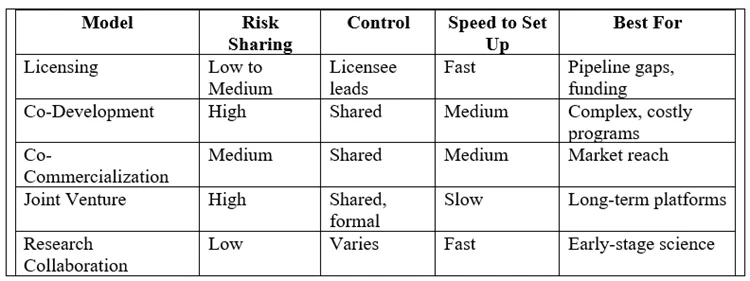
Quick Comparison: Which Model Fits Which Goal?
What Big Deals Tell Us About the Market
Look at recent activity and a pattern emerges. In 2023, Merck and Daiichi Sankyo announced a collaboration on antibody-drug conjugates worth up to $22 billion including milestones. It's a reminder that in oncology, pairing one partner's targeting technology with another's late-stage development and commercial reach can be more valuable than either asset alone.
Similarly, AbbVie's partnership with Genmab on bispecific antibodies shows how established U.S. players use alliances to reach new modalities without building everything from scratch.
The lesson is not that every deal is a blockbuster. Deal value is often front-loaded in headlines and back-loaded in reality. What matters is whether the partnership is built on a genuine fit.
What Makes a Pharma Alliance Actually Work
Plenty of alliances look brilliant on signing day and fall apart within two years. Some, like Gilead's collaboration with Galapagos, were ended or restructured when priorities shifted. Here is what separates the durable ones.
Clear strategic fit
Both sides should be able to finish this sentence: "We are doing this because - can do what we cannot." If the answer is vague, the deal is shaky.
Balanced incentives
If one partner carries the risk while the other captures the upside, resentment grows quickly. Milestones, royalties, and cost-sharing should feel fair to both.
Governance that is boring on purpose
Joint steering committees, decision rights, and dispute processes are not glamorous, but they prevent stalemates. Decide before signing who breaks a tie.
Cultural compatibility
A nimble biotech and a giant pharma company move at very different speeds. Partnerships fail more often from miscommunication than from bad science.
Exit clarity
The best agreements plan the divorce as carefully as the wedding. What happens if a trial fails, priorities change, or one company is acquired? Rights reversion, opt-outs, and change-of-control clauses matter more than most teams expect.
Legal and Regulatory Guardrails in the U.S.
- U.S. deals do not exist in a vacuum. Partners generally need to keep several things in mind:
- Antitrust review. Large alliances may draw scrutiny from the Federal Trade Commission and the Department of Justice.
- FDA compliance. Responsibilities for regulatory submissions, pharmacovigilance, and manufacturing quality must be assigned clearly.
- Intellectual property. Ownership of jointly developed IP is one of the most negotiated points in any deal.
- Anti-kickback and fraud rules. Commercial arrangements must be structured carefully to stay within healthcare laws.
Anyone entering a deal should involve experienced legal counsel. This article is general information, not legal advice.
A Practical Checklist for Building a Pharmaceutical Alliance Strategy
Whether you are a startup or an established firm, ask yourself:
1. What gap are we actually filling? Capital, capability, geography, or speed?
2. Which model fits? Licensing is simpler; co-development goes deeper.
3. Have we vetted the partner's track record? Look at how they treated past collaborators.
4. Is the economics structure realistic? Understand upfronts, milestones, and royalties in cash terms.
5. Who owns what? Settle IP and data rights early.
6. How will we make decisions together? Define governance in writing.
7. What is Plan B? Build in exits and reversion rights.
Where U.S. Pharma Partnerships Are Heading
Watch these trends in the coming years:
- AI-enabled discovery partnerships, pairing tech firms with drugmakers.
- Cross-border deals, especially with Asian and European biotechs licensing assets to U.S. companies.
- Platform collaborations around mRNA, cell and gene therapy, and ADCs.
- Risk-sharing commercial models, tying payment to patient outcomes.
The direction is clear: partnerships are becoming central to how American pharma builds its pipeline, not a side strategy.
Frequently Asked Questions
What is a strategic alliance in the pharmaceutical industry?
A strategic alliance is a cooperative agreement between two or more companies to share resources, risks, and rewards in developing or commercializing drugs, without necessarily merging.
What is the difference between pharma licensing and co-development?
In licensing, one company grants rights to another, which typically leads development. In co-development, both companies actively work on and fund the program together.
Why do U.S. pharmaceutical companies form partnerships?
To reduce R&D costs, access new technologies, fill pipeline gaps, expand market reach, and share the risk of clinical failure.
How do licensing deals typically pay out?
Usually through an upfront payment, milestone payments tied to development or sales targets, and royalties on net sales.
What are the biggest risks in pharma alliances?
Misaligned goals, IP disputes, slow decision-making, cultural clashes, and clinical or regulatory failure.
Are pharma partnerships only for large companies?
No. Small biotechs and startups often use licensing and co-development to access funding and commercial infrastructure they lack.
Final Thoughts
The strongest strategic partnerships between U.S. pharmaceutical companies are not built on press-release excitement. They are built on honest fit, fair economics, and clear rules for working together when things get complicated. Whether you are evaluating pharma licensing, exploring pharma co-development, or designing a broader alliance playbook, the same principle applies: pick partners who make your weaknesses irrelevant and your strengths louder.

Kate, Editorial Team at Pharma Focus America, leverages her extensive background in pharmaceutical communication to craft insightful and accessible content. With a passion for translating complex pharmaceutical concepts, Kate contributes to the team's mission of delivering up-to-date and impactful information to the global Pharmaceutical community.